


Fifteen years after Clifton Elementary School shut its doors, Fairfax County Public Schools leaders are at last taking steps toward demolishing it.
“It’s time we close this chapter,” at-large Fairfax County School Board member Kyle McDaniel said as the board debated taking action to officially declare the building uninhabitable last Thursday (June 26).
That vote passed unanimously, albeit with one abstention and one board member away from the dais. It came immediately after a unanimous vote approving a policy change that will guide how similar situations are handled in the future.
The school board had voted 9-2 in 2010 to close the 1950s-era building, citing water-quality concerns and other issues. A year later, the Virginia Supreme Court rejected a lawsuit from parents, paving the way for the building’s permanent closure.
However, nothing happened with the property for more than a decade, as the school sat locked up and deteriorating.
“It’s no one’s fault. It just got lost in time,” said McDaniel, who joined with Springfield District Representative Sandy Anderson to push for action.
Their proposal had the backing of the Clifton Town Council, which argued that continuing to delay a decision on what to do with a “a dangerous, vacant, blighted” building “serves no one.”
“Many residents have personal connections to the school, having attended as children or watched their own children learn there,” the town council and Mayor Tom Peterson said in a letter to the school board. “While we value those memories, the deteriorating building no longer serves our community and has become a place for vandals and poor behavior by our young people.”
A 2021 architectural report by Samaha Associates determined that the existing building can no longer be feasibly used for educational purposes. It recommended demolition over renovation or a raze-and-rebuild strategy.
Under the new policy adopted at the school board’s June 26 meeting, once a building is determined to be uninhabitable for school purposes, the superintendent and staff will have 36 months to come back with a plan to address the situation, including a cost analysis.
Should that not be enough time, the superintendent could ask for an extension.
The former Clifton Elementary, located at 7010 Clifton Road, would be the first school to fall under the new policy.
Several board members expressed concern that designating Clifton Elementary as derelict would begin the process with no firm estimate of what the cost of ultimately demolishing it might be.
“There should be a price tag on it,” Hunter Mill District Representative Melanie Meren said. “Let’s get that information.”
Meren proposed delaying the school’s designation as uninhabitable until at least the July 10 meeting to receive more information.
“Two more weeks would not hurt us,” at-large member Ryan McElveen agreed.
But a slim majority said there was no benefit to waiting.
School Board Chair Karl Frisch, who represents Providence District, said Superintendent Michelle Reid and staff will have time to provide all that information when they compile a report for the board.
“We’re not committing funds, we’re not committing action,” Frisch said of the proposal to designate Clifton Elementary as uninhabitable.
Meren’s proposal to postpone a vote died 6-5 with Dranesville District’s Robyn Lady abstaining.

A subsequent amendment by Braddock District Representative Rachna Sizemore Heizer, prohibiting the allocation of any funds for demolition until the report is presented to Board members, passed 11-0.
Though she sought more time to get a cost estimate, Meren acknowledged that FCPS shouldn’t leave a school empty and deteriorating, with its future unaddressed, for so long.
“There is no universe in which this building should have been left vacant for 15 years,” she said.
Demolishing a school building and carting away the remains is not an inexpensive task. Reid promised that FCPS will “have to do a full exploration of funding sources.”
At-large member Ilryong Moon, who served on the school board from 2004 to 2019 before returning for a sixth term in 2024, said board members also need to have clarity on FCPS’ current policy for dealing with surplus property.
By his recollection, a site deemed surplus is required to be turned over to the Board of Supervisors, but Moon asked staff to check and confirm.
“I want to have some clarification,” he said.
Sandy Anderson said she was pleased a road map for future action had been approved.
“It’s on the right path,” she said. “It’s a step forward for this community toward resolution.”
The Clifton Elementary School site has served educational purposes for well over a century, according to an FCPS timeline of its history.
In the early 1910s, a small high school was built on the site, later serving as a joint elementary-high school until 1935, when the high-school portion was closed.
In September 1953, a new $168,000 elementary school opened to students with four classrooms, a library, “cafetorium” and administrative spaces. Two additional classrooms were added in 1954, according to FCPS records.
Opened during an era of segregation across Virginia, the school initially served only white students before becoming integrated with its first Black students in 1966.
The school expanded with an addition in 1984, but by the time of its closure, Clifton Elementary had the smallest student body of any elementary school in Fairfax, hosting around 370 students. The continued reliance on two wells for drinking water also raised health implications for students and staff, who reported positive tests for arsenic, lead and other substances.
Faced with the costs of addressing those issues and renovating the aging building, the school board ultimately opted to shutter the school despite objections from local residents, according to FCPS.
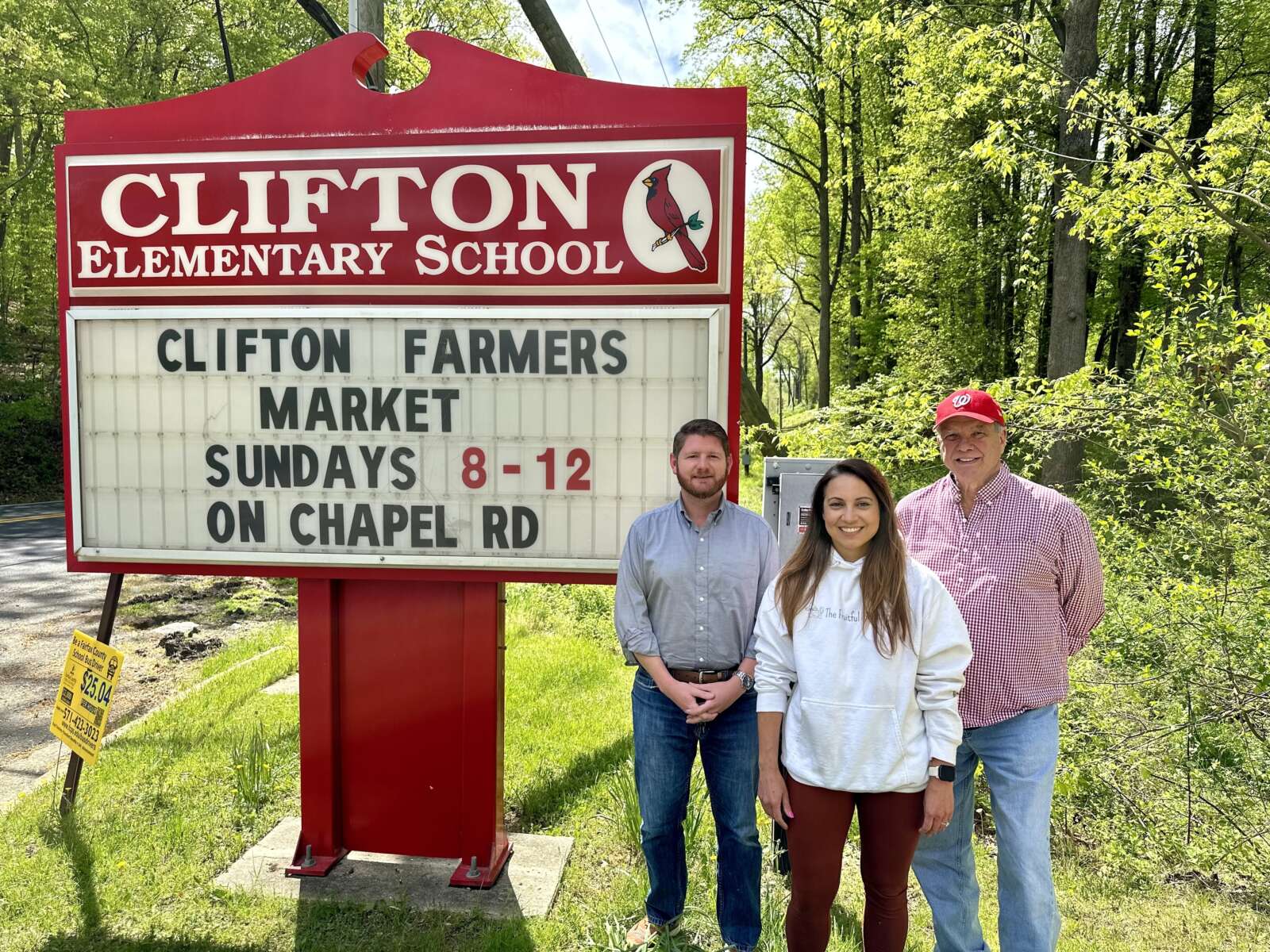
While the school is unoccupied, new life has been breathed into its main signage. Last year, town and School Board representatives worked to bring the sign back to life in order to promote community events.
Regardless of the ultimate decision on the site, Sully District Representative Seema Dixit said FCPS should not consider selling it.
“It’s just not possible to find land any more in most areas of the county,” she said.
While supportive of the revised policy on derelict buildings, Mount Vernon District Representative Mateo Dunne said care needs to be taken before dismissing alternatives to demolition. The former Mount Vernon High School was closed but is now getting repurposed into a community facility, he noted.
“If it had been demolished, as I believe had been under discussion, that would have been a tragedy,” Dunne said.
