

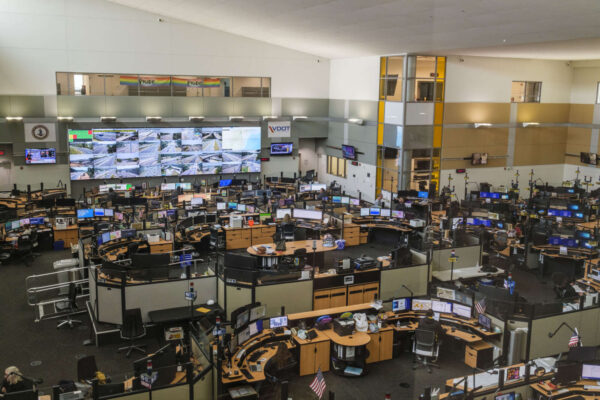
Yesterday (Tuesday) marked a major milestone in the future of Fairfax County’s emergency response: one of the agency’s first uses of artificial intelligence.
For a brief period of time that day, the county’s Department of Public Safety Communications (DPSC) tested an AI system to triage select calls for service to the non-emergency line, officials announced.
“This limited test only handled calls that didn’t need police, fire or EMS response,” the county said. “Think of questions about permits, noise complaints from last week, or asking which department handles a specific problem.”
The initial test of ANET (Assisted Non-Emergency Triage) was used to determine not only how the process worked, but also if it was truly beneficial to callers.
“While the test was only for a short time frame, it could represent a big shift in how emergency services work,” the county said.
As part of the test, callers reported problems or asked questions like they normally would with a human. The AI system, which could register both English and Spanish, then helped callers directly or, if needed, connected them to the proper department.
DPSC says integrating AI with its non-emergency response system could ease the workload for human dispatchers, allowing them to focus on critical emergencies.
“In 2024, more than 30 percent of calls to the non-emergency line were simple questions or requests for information,” the department said in a press release. “People called asking about county services, reporting old incidents or seeking help with non-urgent matters.”
The test is the county’s latest step in attempts to modernize its emergency response, with plans to embrace emerging technologies currently underway.
In December, the county announced a partnership with George Mason University’s Center for Resilient and Sustainable Communities (C-RASC) that worked to also implement AI within emergency services, although for different purposes.
That project focused more on the training of emergency dispatchers and not the receipt of calls themselves, according to executive advisor Linton Wells II.
“We think the AI can be used to offload some of the instructors from some of the work they do now, in the sense of being able to give students the opportunity to respond to scenarios and respond to different circumstances,” Wells previously told FFXnow. “Then the AI can actually help provide advice on how to do things better.”
After Tuesday’s test, county officials intend to ramp up AI’s use, starting this fall.
“Phase 2 would let AI handle some non-emergency service calls, like reports of theft that happened days ago or minor property damage,” the county government said.
The program’s expansion will not come at the expense of human dispatchers, however.
“When someone calls 9-1-1 with a heart attack or house fire, trained professionals will still handle those calls,” the county said.
Per the press release, DPSC receives approximately 1 million calls for public safety services annually. It manages dispatches for the county’s police, fire department and sheriff’s department, while also serving as the designated 911 point-of-contact for Fairfax City and the towns of Herndon and Vienna.
Earlier this year, Fairfax County partnered with the local government in Nashville and Davidson County, Tennessee, to launch the first interstate 911 backup system in the U.S. The agreement allows dispatchers in one jurisdiction to handle 911 calls from the other, allowing service to continue during system failures, natural disasters and other disruptions.
