

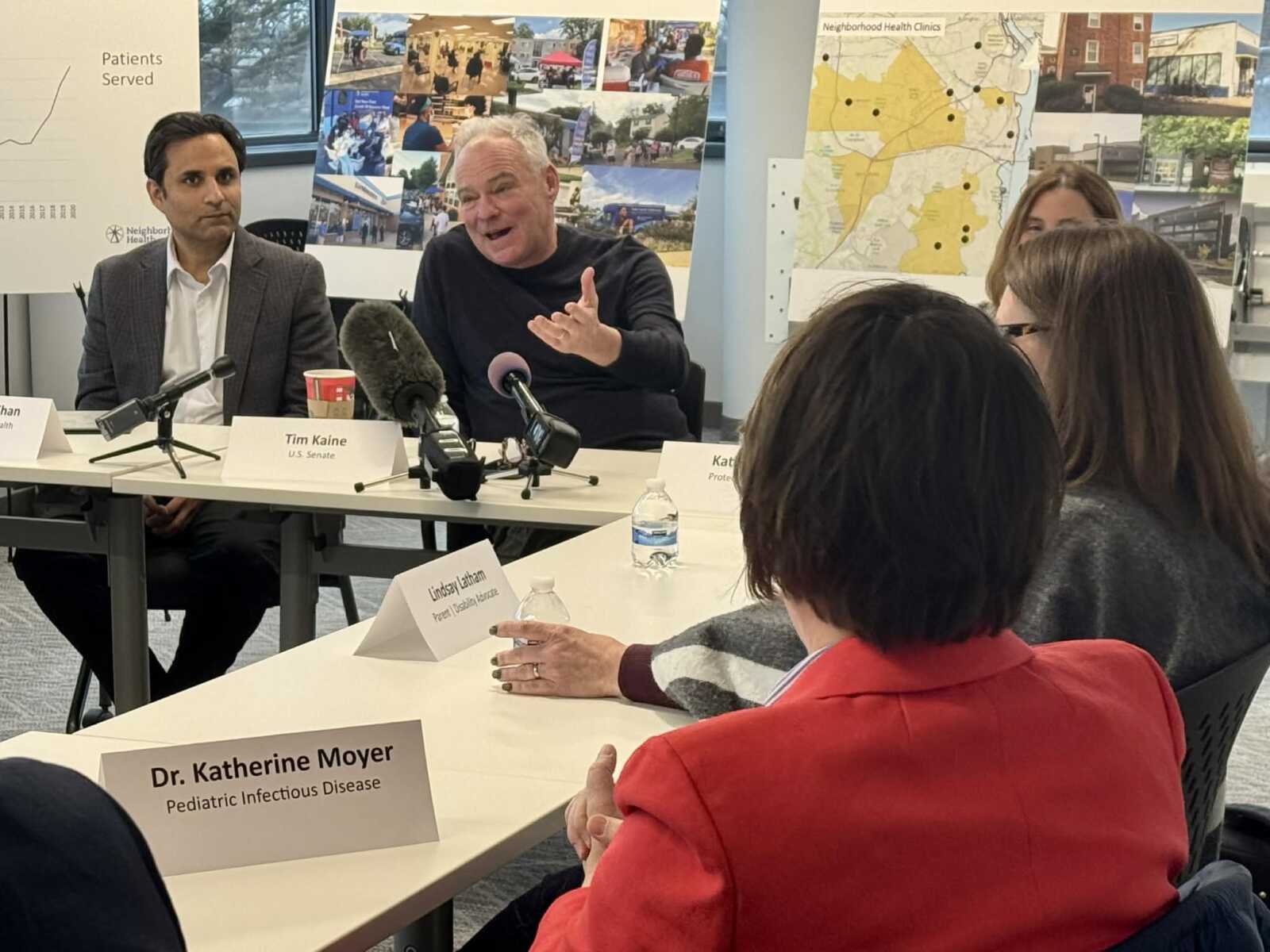


Sen. Tim Kaine (D-VA) predicts there’s a small chance that the Senate will coalesce around a deal to prevent premium health care hikes for millions of Americans before next month.
Kaine made the statement today (Friday) at a roundtable with health care professionals at a Neighborhood Health clinic in Hybla Valley after most Senate Republicans rejected a Democratic bill Thursday that would’ve extended Affordable Care Act subsidies set to expire at the end of this year.
A bill proposed by Republicans that would’ve overhauled the insurance marketplace instead of extending the ACA tax credits, which were introduced in 2021, similarly failed to pass.
Kaine said that sometimes each party’s proposal has to fail before something comes together.
“Yesterday was not a good day,” Kaine said. “I would say it’s a 40% likelihood that we’ll find a solution between now and the middle of January on the tax credit, and that would require an extension of open enrollment and some backdated reimbursement of people if they had to pay higher premiums between January, and then giving people the chance to access lower premiums. It’s probably less than 40%, but this is going to be the dominant issue in public policy over the next year or so.”
Kenensa Gree Sumers, a local clinical services case worker, broke down into tears when discussing the impact that the cuts to subsidies will have on her clients.
“These cuts are going to kill a lot of the people we support, and it’s going to harm so many kids who are getting the support they need,” Sumers said. “It’s going to end up causing a deficit in caregivers, where no one’s going to be able to get services.”
Kaine broke ranks with his Democratic colleagues last month to end the federal government shutdown, which lasted from Oct. 1 to Nov. 12, after Senate Republicans promised a vote to extend ACA premium tax credits. The adopted appropriations bills also included some protections for federal workers.
“Insurance is just too expensive, and so, unless we extend those tax credits, so many people are going to have to pay too much,” Kaine said. “About 100,000 people will not be able to buy health insurance on the exchange [in Virginia], and about half of them won’t be able to find health insurance at all. Some will find lesser insurance or super more expensive insurance, but about half — 50,000 people — are likely to go uninsured unless we find a path forward.”
In Northern Virginia, Neighborhood Health supports more than 40,000 low income patients. CEO Dr. Basim Khan said that access to care in Virginia was dramatically improved by an expansion to Medicaid coverage in 2019, but now, community health care centers are more stressed than he’s ever seen.
“I worry a lot about the patients who are going to lose coverage,” Khan said. “I worry a lot about our safety net as well, community health centers across the state, how we’re going to be able to meet the need come in the coming months.”
Kaine said that he “took some grief” for being one of the eight Democratic Senators to vote to end the shutdown.
“Not everybody felt good about the decision I made,” Kaine said. “The Dems unified around a straightforward three-year extension of the enhanced tax credits.”
Kaine continued, “I think the right strategy is extend the tax credits for a period of time. There’s nothing magic about three years. It shouldn’t be one year, because it’d be too nutty with the election cycle next year, but it should be at least two.”
