


Local residents have until the end of the month to submit feedback on proposed changes to Fairfax County’s rules for accessory living units (ALUs).
“We see ALUs as a valuable tool in the housing toolkit,” Casey Judge, a deputy zoning administrator in the county’s Department of Planning and Development, said in a Jan. 21 online community forum.
Regulations for accessory living units were last changed in 2021 when the county government adopted its zoning ordinance modernization initiative, also known as zMOD.
“Now that we’ve had four years of applying the provisions, we’d like to relook at this topic,” Judge said.
ALUs are secondary dwelling areas either inside or outside single-family residences. Outside Fairfax County, they are more commonly called ADUs, or accessory dwelling units, but Fairfax shifted to ALUs during zMOD to avoid confusion with affordable dwelling units.
The county’s existing ordinance establishes requirements for residences that offer ALUs, including limitations on size, occupancy, entrances, parking and other criteria.
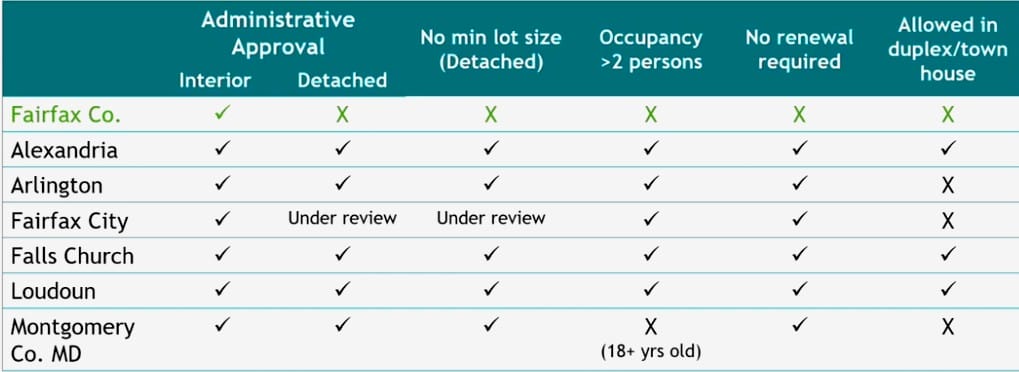
While some surrounding communities have embraced accessory units, Fairfax County hasn’t seen the expansion officials anticipated after loosening zoning regulations with zMOD.
Prior to that zoning code update, the county limited ALU occupants to people who were 55 and older or had a disability, and property owners were required to go through a special permit process with public hearings to obtain approval.
Now, under its current zoning regulations, Fairfax allows anyone to live in an ALU, but the property owner must live in the primary residence on the site. A single-family home must be situated on at least 2 acres of land to be eligible for a detached ALU, which can be occupied by no more than two people.
Currently, there are about 160 approved ALU permits in the county, representing about 0.08% of single-family detached lots, according to county staff.
In terms of the restrictiveness of current zoning requirements, “we do seem to be the outlier” among local jurisdictions, said Carmen Bishop, another deputy zoning administrator.
At the direction of the Board of Supervisors, which wants to expand the availability of affordable housing even as it opposes perceived challenges to its authority by the state, Fairfax County staff are revisiting regulations for ALUs with a proposed zoning ordinance amendment.
According to a white paper released in early December, potential revisions under consideration include incorporating ALUs into the overall building permitting process rather than requiring a separate permit, increasing the time between renewals from two to five years, and changes to the 1,200-square-foot size limit.
To gauge public views, the county government has an online survey open through Feb. 28. Among the questions being asked:
- Should occupancy limits be increased to three or more persons?
- Should the property owner be required to live on the property if there is an ALU?
- Should an additional parking space be required for an ALU?
- Should a detached (freestanding) ALU that meets all required standards be allowed without a public hearing?
- Should a detached ALU be allowed on lots smaller than 2 acres?
- Should an interior ALU be allowed in a townhouse?
At the Jan. 21 community forum, several speakers raised concerns that allowing a wider array of accessory units would likely draw in developers and private-equity firms looking to snatch up properties and maximize the footprint of buildings on a lot.
“It’s fair for people to ask if it’s worth the risk,” resident Clyde Miller said of reducing current restrictions.
Miller said before moving forward, county officials should dissect recent changes elsewhere in Northern Virginia to see if they resulted in more housing for those who need it most.
“It’s reckless to roll back those standards without an understanding of the extent to which they are likely to improve the supply of affordable housing,” he said.
Others at the meeting argued that less restrictive regulations would ease the county’s housing crunch, while also giving homeowners additional income.
One speaker noted more housing options are needed. When recently searching for a new home in a particular school attendance zone, he found that the lowest-priced option on the market was listed at $1.7 million.
Though a contentious issue that brings out passions on both sides, there can be room for compromise.
In April 2025, the Falls Church City Council adopted a major rewrite of its accessory dwelling regulations. Despite — or perhaps because of — a lengthy gestation period, the changes were adopted on a 7-0 vote.
“There was a serious effort to find compromise — to find a middle ground,” City Council member David Snyder said when the vote occurred. “A genuine effort to listen to all the citizens.”
Throughout the process, Snyder had voiced concerns about the impact of accessory units on residential neighborhoods, but by the end, he was satisfied with the final result.
Any staff proposal that evolves out of Fairfax’s current evaluation process would work its way through the county’s advisory bodies before landing at the planning commission and, finally, the Board of Supervisors.
Judge said staff hopes to develop proposals that the community could support.
“Having clear standards in our zoning ordinance will ensure consistency and predictability,” she said.
