

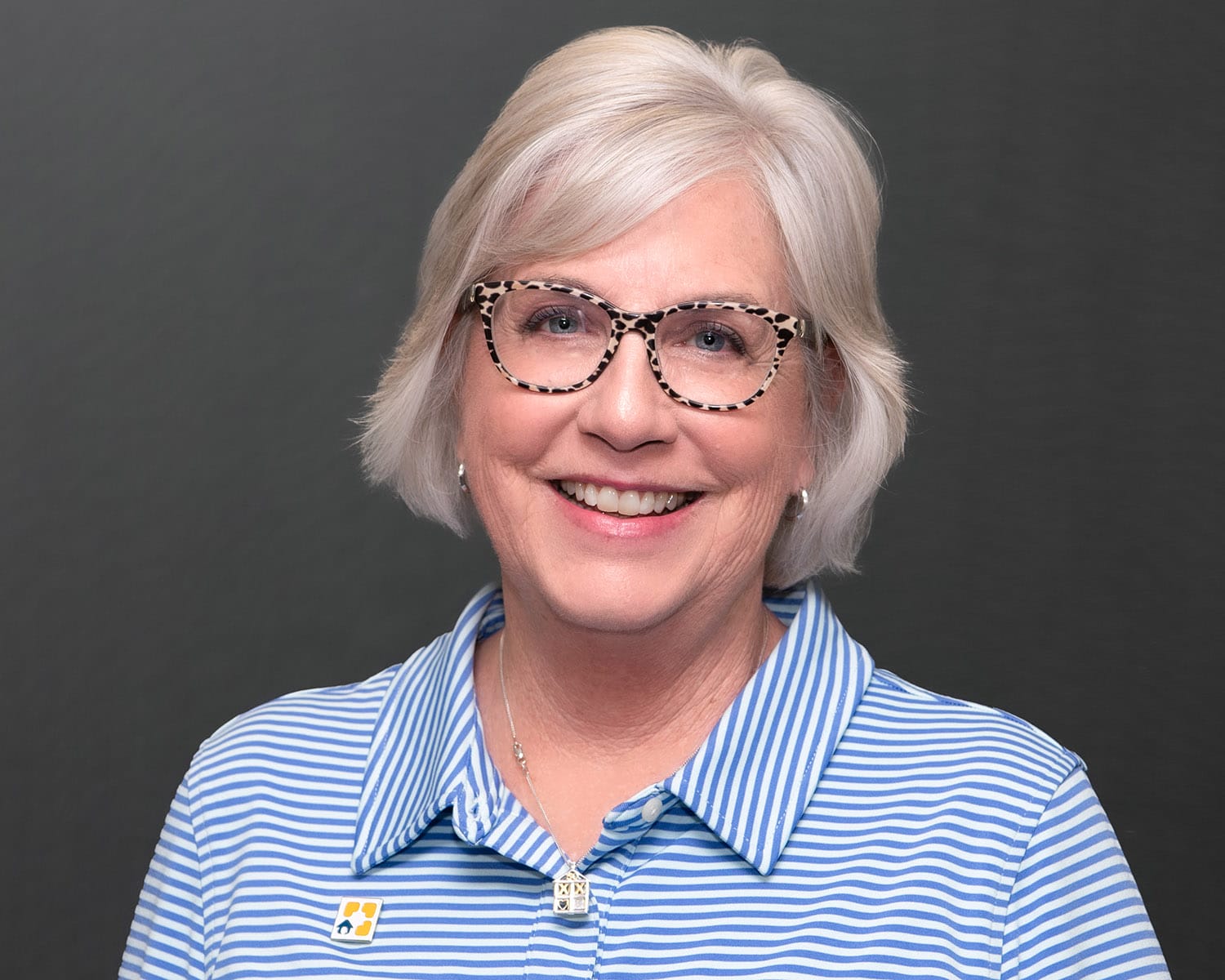
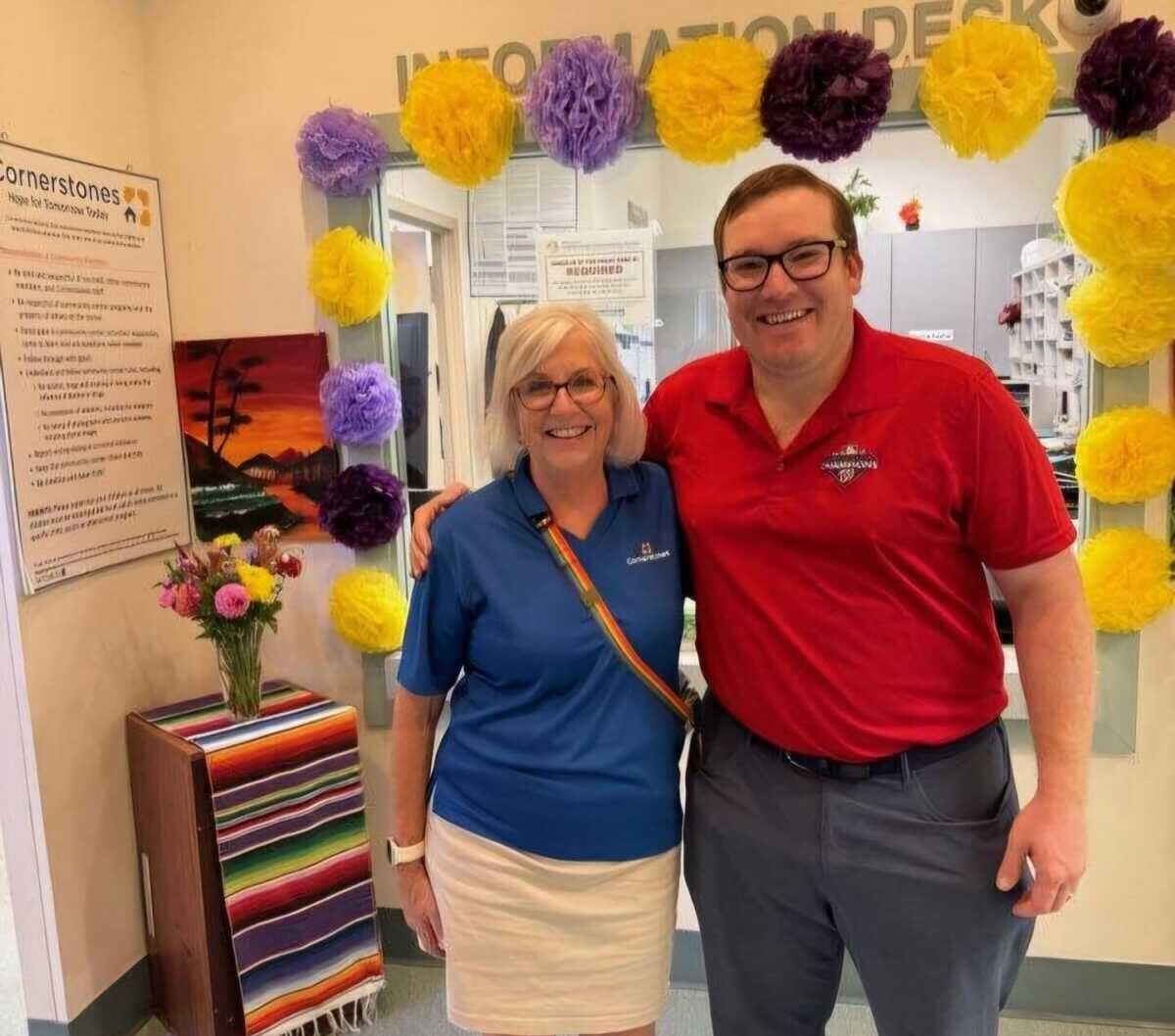
When she officially retires next month after 25 years, Cornerstones CEO Kerrie Wilson is confident that she will be leaving the Reston-based social services nonprofit in more-than-capable hands.
With both major projects and a turbulent economic and political climate to manage, the Cornerstones Board of Directors couldn’t have chosen a better successor for her than Shannon Steene, Wilson told FFXnow in an interview earlier this month.
Set to take over as CEO on April 13, Steene is coming to Reston from Alexandria, where he oversaw a redevelopment of Carpenter’s Shelter as its executive director for nearly 11 years. His career also includes 12 years leading Good Shepherd Housing in Lorton, giving him as much experience in Northern Virginia’s nonprofit world as Wilson.
“I’ve worked with [Steene] for 20 years, so he knows our work. He’s going to bring fresh eyes, fresh leadership at a time when things are really tough,” Wilson said. “So, that part of it, I’m very excited. I’m also, as I look back, just very proud of where we are today — and the partnerships and the board and the staff and what we have been able to do together.”
Wilson oversaw growth of Cornerstones
Founded in 1970 as Reston Interfaith by six local religious organizations, Cornerstones has expanded its scope over the decades beyond Reston to most of western Fairfax County and into Loudoun County. Its services have also become more comprehensive, encompassing food and financial assistance and child care on top of its longstanding focus on housing.
Reflected by its 2013 name change, the nonprofit’s evolution has progressed very deliberately in response to the changing population and needs of the community, Wilson says.
“Some of it was natural, in that Herndon didn’t have any infrastructure. Reston didn’t have anything,” she said. “… As we began to see changes in the demographics, it was natural that we expanded, certainly, right around the Dulles corridor.”
Reston was still a relatively new community when Reston Interfaith undertook its first affordable housing project — and the first in the Dulles corridor — in 1971. Originally built to support the workforce at the U.S. Geological Survey’s new headquarters, the 200-unit Laurel Glade Apartments are still standing, though they’ve been rebranded a number of times, most recently as Reston Glade.
“We really were the boots on the ground,” Wilson said, noting that Fairfax County didn’t have any office of its own in the area to provide public services at the time.
A building for the Hunter Mill District supervisor’s office and the Fairfax County Police Department’s Reston District Station opened in 1985 and was replaced by the current North County Governmental Center in 2015.
At the same time, development throughout the corridor began to accelerate, including with Reston Town Center’s emergence just down the road from the Embry Rucker Community Shelter that Cornerstones has operated at 11975 Bowman Towne Drive since it opened in 1987.
In the 1990s and early 2000s, the nonprofit saw a shift in the people using its emergency shelter and other services, from more transient workers, including those coming from West Virginia to work on construction sites for the week, to an influx of immigrants drawn to Herndon in particular as the area became more built out, according to Wilson.
That shift meant an increased demand for family and employment services, prompting Reston Interfaith to introduce school-age academic programs and establish the Herndon Official Workers Center in 2005 with Project Hope & Harmony, another nonprofit, to assist day laborers.
Though opposition to the center’s work with undocumented immigrants led the Town of Herndon to force its closure less than two years later, Cornerstones continues to provide services in Herndon through the Herndon Neighborhood Resource Center, which it began managing in 2011 after the town handed off operations to Fairfax County.

Under Wilson, Cornerstones has increasingly prioritized providing permanent housing, doubling its affordable housing stock to over 100 units in 2020 and jumping on opportunities for potential projects in Loudoun County.
“Loudoun County’s Board of Supervisors began, I think, mimicking and really wanting to support affordable housing in the same way that Fairfax had,” Wilson said. “What we were seeing in Fairfax is that there was a lot of build-out. There was still some public land, but mostly, we were going to see redevelopment opportunities, whereas in Loudoun, there was a lot of open space.”
In addition to opening the Free From Hunger Center in Sterling, which has now collected over 1 million pounds of food since 2023 for local pantries and feeding programs, the nonprofit has partnered with Wellington Development to deliver 253 affordable units, including some permanent supportive housing, “in the next couple years” at Tuscarora Crossing in Leesburg and Sterling’s former Arcola School site.
Cornerstones also remains active in Fairfax, working with the Fairfax County Redevelopment and Housing Authority (FCRHA) and Lincoln Avenue Communities on the Residences at Government Center II project that broke ground in December 2024.
On track to begin leasing in June, per Wilson, the Fairfax Crest apartment building will have 279 homes for people earning 70% of the area median income or less and a 15,500-square-foot community facility with day care for up to 129 children.
“We’re prioritizing for the low-income community members that are going to live there, but it will be open to others or other neighborhoods,” Wilson said of the day care, which will be run by Cornerstones. “Child care such a huge need, and so, we’re working right now to really make sure that we have the resources” to serve low-income families.

Federal funding changes add uncertainty
Cornerstones relies on government support to provide many of its services, from state subsidies that could help families afford the future Fairfax Crest day care center to lease agreements between FCRHA and developers guaranteeing affordable housing projects maintain that status long-term.
Funding or policy changes can have far-reaching consequences, as Cornerstones saw when Herndon closed the workers’ center and, more recently, when the Trump administration announced it will slash grant money for permanent supportive housing, instead emphasizing temporary shelters or transitional housing, even though homeless service providers say that approach has proven to be less effective and more expensive.
“Under the proposed funding, [they’re] limiting the number of permanent supportive housing projects that will move forward, and that could mean a reduction of homes for people that we’ve rehoused from the streets,” Wilson explained. “So, that’s the biggest concern right now.”
Though a December court injunction put the federal program overhaul on hold for now, the uncertainty has already stalled a supportive housing project that Cornerstones had proposed in the Fair Oaks area. The project would’ve provided up to 34 units in a three-story building with support services on county-owned land near the West Ox Road and Route 50 interchange.
A rezoning application for the development was indefinitely deferred in July 2024 at Cornerstones’ request ahead of a scheduled planning commission hearing, county records show. But Wilson says it was ultimately shelved due to the potential loss of federal funding, which left Fairfax County unable “to secure the easements it needed from the adjacent property.”
FCRHA spokesperson Allyson Pearce confirmed in a statement that the project stalled as a result of the federal funding changes:
Permanent supportive housing (PSH) provides long-term housing combined with supportive services for individuals with significant needs, including those with chronic health conditions, physical disabilities, or who are experiencing or at risk of homelessness. Supportive Housing relies heavily on federal operating subsidies for housing stability and the provision of supportive services. In light of recent reductions in federal funding for PSH programs and continued uncertainty regarding the availability of future operating subsidies, Cornerstones and FCRHA have mutually agreed to pause development of the project at the intersection of Route 50 and Fair Ridge Drive in order to evaluate alternatives that will ensure the delivery of these critical services to vulnerable residents in the future.
Earlier this month, the county also had to increase its own funding for a project to renovate and preserve affordable housing in the Coralain Gardens Apartments in West Falls Church after the Trump administration nixed a key federal grant program.
“We’re looking at other opportunities,” Wilson said, noting that the county opened the Fair Ridge Shelter for families nearby last year.
Located in a former Extended Stay America hotel, the new shelter is operated by Shelter House and allowed Cornerstones to expand Embry Rucker’s capacity to 76 beds for single adults.
Outside of housing, Cornerstones has had to scramble to adjust to reduced federal funding for safety net programs like food benefits and Medicaid, but Wilson says the second Trump administration’s indiscriminate approach to immigration enforcement has had the most lasting repercussions so far.
“All of our families are being affected by the trauma,” she said. “The uncertainty for them, it has really taken a toll, and we see it in the schools. There’s increased absenteeism. Parents are afraid … We’ve heard stories that people are not sure they’re going to go to a food drive or food distribution at a local church that’s been partnering because they’re afraid that people might come.”
Looking to the future
Despite those challenges, Wilson expressed hope and excitement about Cornerstones’ future under Steene.
On top of the previously mentioned housing projects, the nonprofit still has the long-awaited replacement of the Embry Rucker shelter on deck. Plans for the Reston Town Center North redevelopment remain under review with no clear timeline for approval, but the shelter and Reston Regional Library are expected to be the first elements built.
“I think it’s at least two years, especially with changes in federal funding, [to secure] things that they’ll need before the plans are final, approved, and then, they can move forward on construction,” Wilson speculated. “But my guess is as good as anyone’s.”

The outgoing Cornerstones CEO is also heartened by changes in how nonprofits interact with the people they serve during her tenure. A top-down, bureaucratic model has evolved into a more collaborative partnership exemplified by Fairfax County’s Opportunity Neighborhoods initiative and Cornerstones’ own resident councils, which give tenants an avenue to provide feedback and advocate for their own needs.
“We really rely on them and their voice to help guide and shape our programs, and that’s something that I really appreciate,” Wilson said.
As she prepares to retire, Wilson says she looks forward to spending time with her family and having the space for the first time in 25 years to consider what she wants for her future.
She has no intention, however, of stepping back from community service, adding that she will continue serving as chair of Fairfax County’s Affordable Housing Advisory Council through the end of 2026.
“You can bet that I’m going to be out there working on some of these community initiatives and the things that I care so deeply about, but I get to do it from another place and to cheer on my colleague, Shannon, and the people at Cornerstones who I love so much,” she said.
