

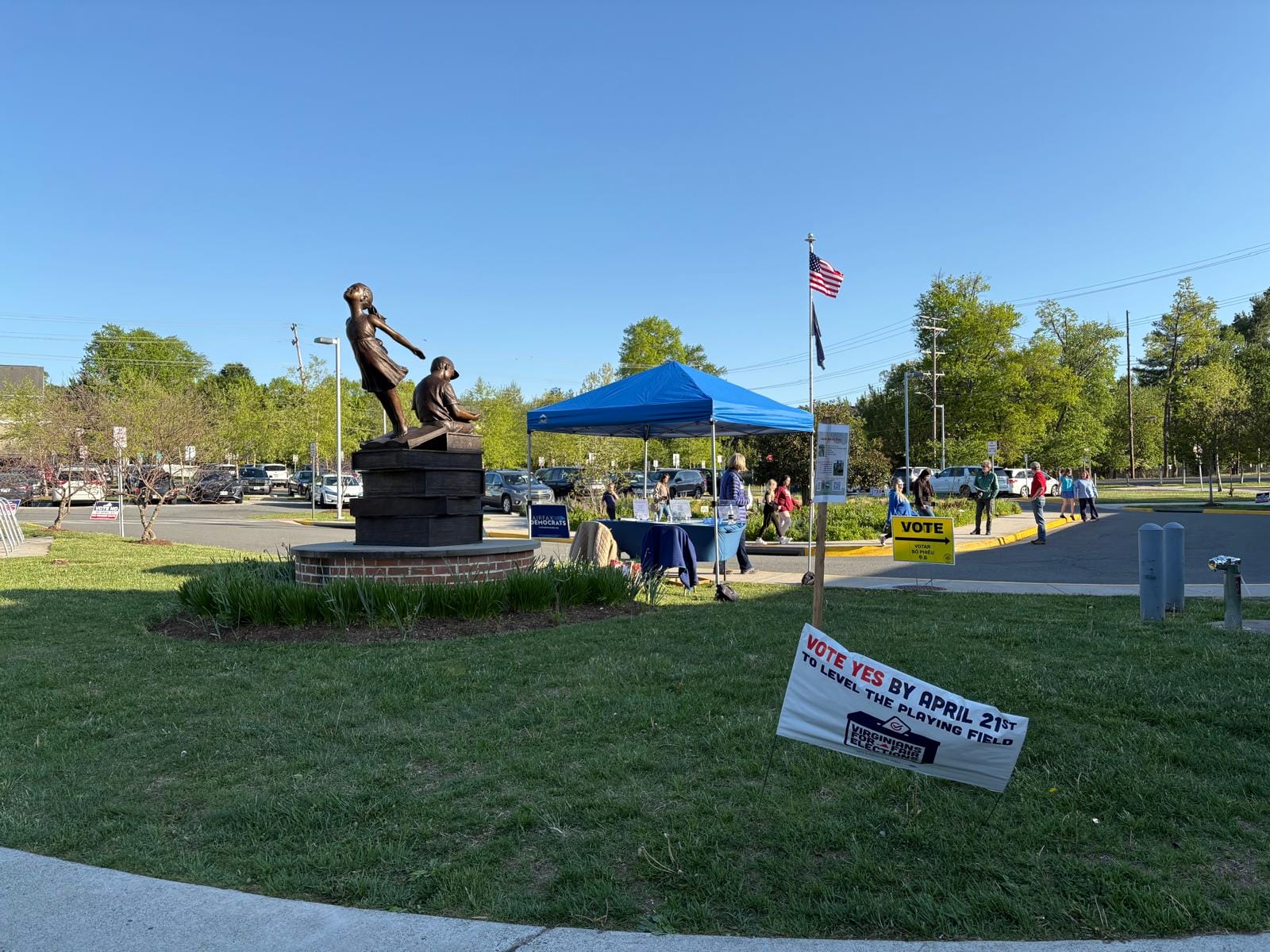
Virginia voters appear to have approved a constitutional amendment to allow a one-time, mid-decade redistricting effort in today’s tightly contested special election.
While opponents initially led based on early voting, ballots reported later in the evening by Fairfax County and other heavily Democratic jurisdictions in Northern Virginia tipped the scales in favor of supporters, according to preliminary results reported by the Virginia Department of Elections.
With 60% of precincts reporting results, Fairfax County voters were decidedly supportive of the proposed amendment, with 70.9% voting yes to 29% voting no. Statewide, the election was much closer, with a difference of about 3 percentage points out of more than 2.8 million votes cast, as of press time.
In its final update at 5 p.m., the Fairfax County Office of Elections reported a turnout of 41.1% of 813,763 voters. Polls closed at 7 p.m.
The Associated Press called the race at 8:49 p.m.
The constitutional amendment backed by voters bypasses a bipartisan redistricting commission to allow the use of new districts drawn by Virginia’s Democratic-led General Assembly. But the public vote may not be the final word. The state Supreme Court is considering whether the plan is illegal in a case that could make the referendum results meaningless.
The Virginia redistricting referendum marked a setback for President Donald Trump, who kicked off a national redistricting battle last year by urging Republican officials in Texas to redraw districts. The goal was to help Republicans win more seats in the November elections and hold on to a narrow House majority in the face of political headwinds that typically favor the party out of power during midterm elections.
The Texas gambit led to a burst of redistricting nationwide. So far, Republicans believe they can win up to nine more House seats in newly redrawn districts in Texas, Missouri, North Carolina and Ohio. Democrats think they can win up to five more seats in California, where voters approved a similar mid-decade redistricting effort last November, and one more seat under new court-imposed districts in Utah.
Democrats hope to offset the rest of that gap in Virginia, where they decisively flipped 13 seats in the state House and won back the governor’s office last year.
But the back-and-forth battle is continuing in Florida, where the Republican-led Legislature is to convene April 28 for a special session that could result in more favorable congressional districts for Republicans.
In Virginia, Democrats currently hold six of the 11 U.S. House seats under districts that were imposed by the state Supreme Court in 2021 after a bipartisan commission failed to agree on a map based on the latest census data.
The new plan could help Democrats win as many as 10 seats. Five seats are anchored in the Democratic stronghold of northern Virginia, including one stretching out like a lobster to consume Republican-leaning rural areas. Revisions to four other districts across Richmond, southern Virginia and Hampton Roads dilute the voting power of conservative blocs in those areas. And a reshaped district in parts of western Virginia lumps together three Democratic-leaning college towns to offset other Republican voters.
Democrats portrayed the Virginia redistricting as a response to Trump. It is “pushing back against what other states have done in trying to stack the deck for Donald Trump in those congressional elections,” Democratic Gov. Abigail Spanberger said during an online rally last week.
Ads for the “yes to redistricting” campaign featuring former President Barack Obama flooded the airwaves.
But opponents of the redistricting also distributed campaign materials citing statements from Obama and Spanberger, who had both criticized gerrymandering in the past.
Congressional redistricting typically is done once a decade after each census.
In 2020, Virginia voters approved a constitutional amendment meant to diminish political gamesmanship by shifting redistricting responsibilities away from the legislature.
But lawmakers endorsed a new constitutional amendment allowing mid-decade redistricting last fall, then passed it again in January as part of a two-step process that requires an intervening election in order for an amendment to be placed on the ballot. The measure allows lawmakers to redistrict until returning the task to a bipartisan commission after the 2030 census.
In February, they passed a new U.S. House map to take effect pending the outcome of the redistricting referendum. The map will split Fairfax County into five different Congressional districts.
Republicans have filed multiple legal challenges against the redistricting effort.
A Tazewell County judge ruled that the redistricting push was illegal for several reasons. Circuit Court Judge Jack Hurley Jr. said lawmakers failed to follow their own rules for adding the redistricting amendment to a special session. He ruled that their initial vote failed to occur before the public began casting ballots in last year’s general election and thus didn’t count toward the two-step process. And he ruled that the state failed to publish the amendment three months before that election, as required by law.
If the state Supreme Court agrees with the lower court, the referendum results could be rendered moot.

