

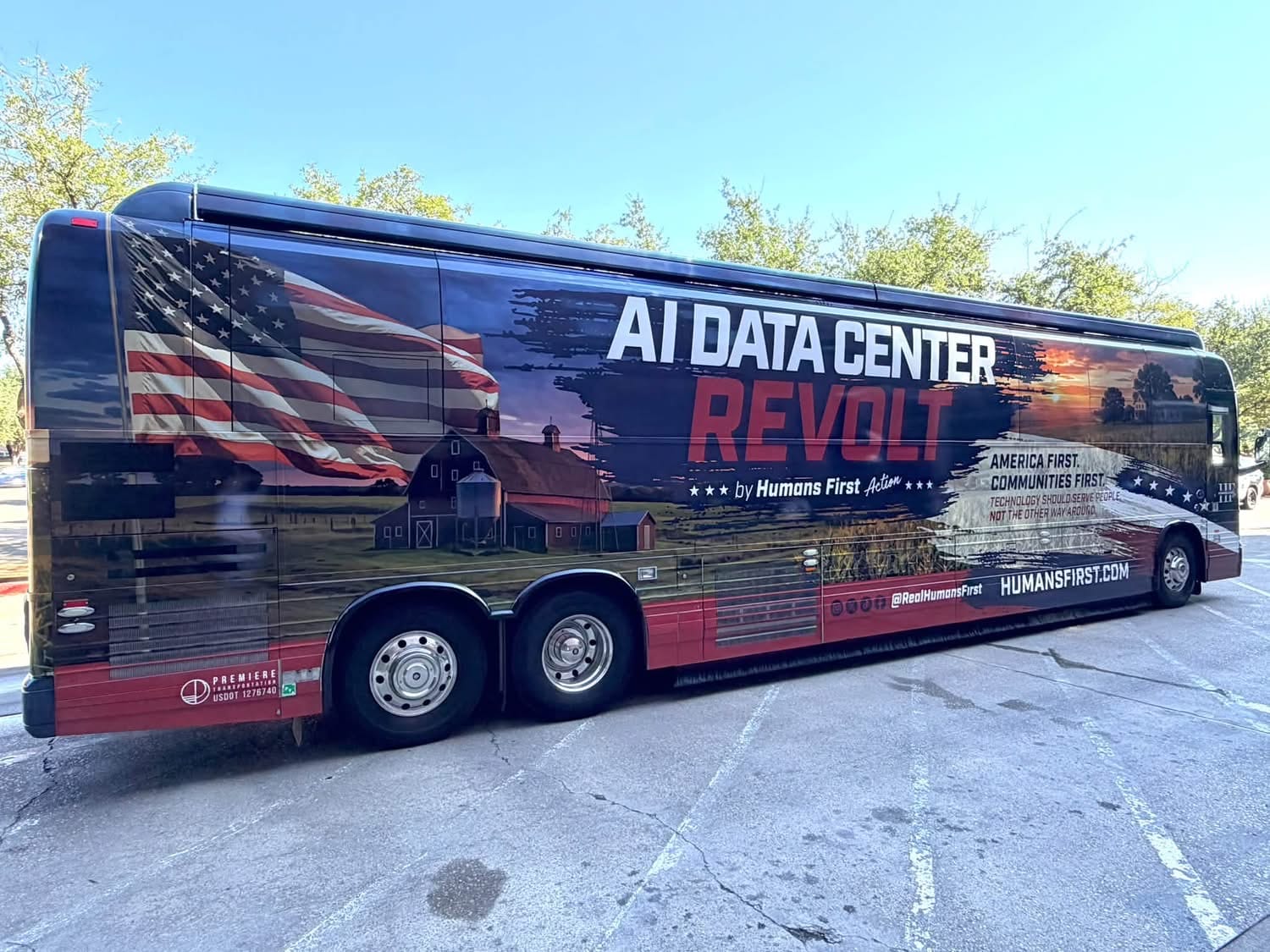
As opposition to data centers continues to mount nationwide, some unexpected alliances have emerged.
Just two days after democratic socialist Bernie Sanders shared a stage with right-wing strategist Steve Bannon, a grassroots conservative organization led by the self-proclaimed “founder of the modern day Tea Party” will stop in solidly blue Fairfax County as part of a national “Data Center Revolt” bus tour.
Following an appearance at 10 a.m. in Manassas, Humans First will hold a press conference at 3 p.m. today (Thursday) at the Bren Mar Park Recreation Center (6324 Edsall Road), where it will be joined by local residents opposed to Starwood Capital Group’s planned Plaza 500 data center in their neighborhood.
“There is no issue that ignites anger among the conservative base more than the issue of big AI data centers,” Humans First Chair Amy Kremer said in a press release. “These data centers, which are often the beneficiaries of the very corporate welfare Republicans claim to oppose, are being forced on communities who do not want them. To grassroots conservatives our message is clear — help is on the way! We are coming to stand with you and make sure your voices are heard.”
A former flight attendant who now serves on the Republican National Committee for Georgia, Kremer became an early leader of the Tea Party movement after writing a blog post in 2009 questioning the legitimacy of newly inaugurated President Barack Obama’s election, according to a New York Times Magazine story on the evolution of right-wing claims that the 2020 election was “stolen.”
During Donald Trump’s first bid for the presidency, Kremer founded a political action committee to support his campaign in January 2016, and she later organized the groups Women for Trump and Women for America First during his first term.
Following Joe Biden’s election in 2020, she created a “Stop the Steal” Facebook group and helped organize a “March for Trump” bus tour around the country as well as the Jan. 6, 2021 demonstration in D.C. that preceded the attack on the U.S. Capitol by Trump supporters seeking to prevent Congress from certifying the results of the 2020 election.
The “March for Trump” tour bus has now been repurposed by Humans First, which says it’s “fighting for an America First AI policy” that will give local residents control over how the technology is used and developed. According to its website, the organization doesn’t support a moratorium on data centers but believes “each community must be able to decide … whether or not to have a data center built in their community.”
“The last time we fired up the bus was in November of 2020, to fight for President Trump and against a stolen election,” Kremer said in the press release. “While big tech and their flunkies were busy deplatforming President Trump and silencing the voices of any conservative who questioned the election, patriotic Americans all across the country stood up for President Trump and election integrity … If Republicans want to win in November and keep control of the House and Senate, as well as key state races, then they absolutely must listen to the grassroots.”
Per the release, Humans First launched its bus tour at the Republican National Convention in Dallas, Texas, and will culminate with a stop in Silicon Valley on Oct. 5.
In addition to Kremer, scheduled speakers at today’s Bren Mar stop include Save Bren Mar Coalition founder Tyler Ray, Bren Mar Recreation Association President André Newman, and Alliance for Secure AI Director of External Relations and Coalitions Rober Arnakis.
When asked about his decision to participate in the event, Ray told FFXnow that he wants to continue highlighting the Bren Mar neighborhood’s concerns about the Plaza 500 data center but is not endorsing Humans First’s political views:
“Save Bren Mar represents all Bren Mar area residents, regardless of political viewpoint. My participation is not an endorsement of the views of the organizers of this press conference. All of us must speak out on this issue, and work with those whom we vehemently disagree with on many other issues, if we want to be able to stop these types of data center projects. I am participating not to make a political statement but to represent all residents who are opposed to this data center campus just 67 feet from residents. Everyone should be informed about the negative consequences of this data center campus because air, water, energy, and economic harms do not distinguish between us. The issue of data center placement is not about political views but the harmful impacts these will have to our communities.”
FFXnow reached out to Newman, who also serves as president of the Jefferson Green Condominium Association, for comment.
Building plans for the first phase of Starwood Capital’s 34-acre Plaza 500 data center project at 6299 Edsall Road in Lincolnia are currently under review by Fairfax County staff. Replacing an existing office building, the first of two buildings would be 75 feet tall and span over 226, 469 square feet of space, the Washington Business Journal reported.
Nearby residents have been rallying against the data center for years now, but their objections to its proximity to homes and potential environmental impacts have recently gained momentum, with several elected officials and the Fairfax County Federation of Citizens Associations coming out in opposition to the project.
While the data center itself is subject only to administrative reviews, the Fairfax County Planning Commission must still approve an electrical substation proposed by Dominion Energy to power the facility. A public hearing on the 2232 review application — a process required for public facilities — was postponed from Sept. 24 to Dec. 2 at Dominion’s request.
Poll finds bipartisan concern about AI
A new poll from The Associated Press-NORC Center for Public Affairs Research and the Energy Policy Institute at the University of Chicago found that concerns about the environmental and local impacts of AI and the data centers that support the technology cross partisan divides.
Democrats are increasingly worried about AI’s environmental consequences. About two-thirds of Democrats say they are “extremely” or “very” concerned about how AI will affect the environment, the poll found, up from about half in 2025. By contrast, about half of independents and about 4 in 10 Republicans are highly concerned about the environmental impact of AI.
While concerns about environmental impacts are higher among Democrats, there is a broad sense of wariness about a rapid data center boom.
About 6 in 10 Americans support limiting the number of new data centers that can be built, including most Democrats and Republicans.
About two-thirds of U.S. adults support requiring data centers to use clean energy sources, such as wind or solar, to supply their electricity needs. About 8 in 10 Democrats support this, along with 56% of Republicans.
Still, some Americans say data center worries feel distant. Mary Fisher, 68, hasn’t seen any come up in her Jacksonville, Florida, neighborhood.
“You know, it hasn’t come across my desk as something I should be concerned about,” said Fisher, who is retired and identifies as a Republican.
Republicans see more benefits to data centers than Democrats
About one-quarter of U.S. adults say data centers are “extremely” or “very” beneficial when it comes to technological advancement, and about 2 in 10 say the same about job creation. Many U.S. adults say data centers are “somewhat” beneficial or aren’t sure, while about one-quarter say they’re “not very” or “not at all” beneficial for technological advancement, and about a third don’t see a benefit for job creation.
“I see a huge increase in the number of temporary construction workers that are coming to areas, which is vitally important to the U.S. economy,” said Eriech Tapia, a higher education advocate and Republican from Arlington.
Republicans are more likely than Democrats to see data centers’ benefits. But about 3 in 10 Republicans still think the centers are “not very” or “not at all” beneficial for improved infrastructure and job creation.
Gedeon Kebede, a computer science student and Democrat from Cincinnati, Ohio, said he feels pressured to use artificial intelligence. Despite his concerns surrounding the technology, he still wants to be a competitive applicant for the jobs of the future.
“I think a lot of people just feel that it’s very much a bubble,” he said. “Ultimately, when it pops, it’s going to be very detrimental to everyone, whether you bought into the AI hype or not.”

