

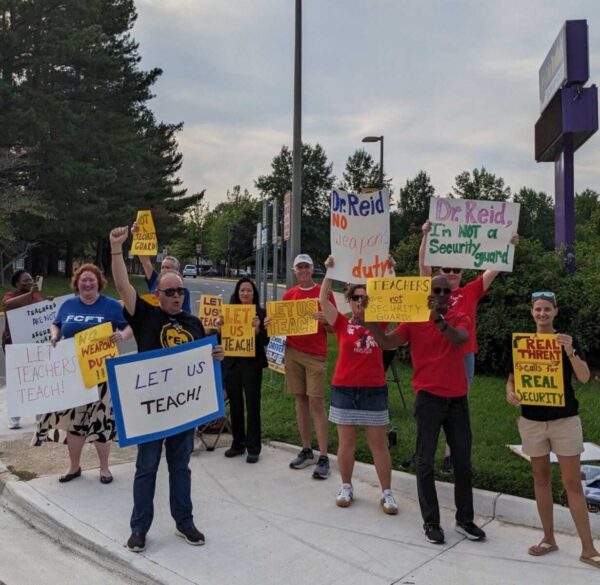
Some teachers at Lake Braddock Secondary School are pushing back against a relatively new job duty: weapons detection.
The staff members say that they are not qualified nor the appropriate personnel to screen for weapons as students pass through OpenGate security systems at the Burke school. As part of the ongoing dispute, the Fairfax Education Unions — a partnership between the Fairfax County Federation of Teachers and Fairfax Education Association, the labor unions representing non-managerial employees — has filed a formal grievance against FCPS.
“We felt that, for a number of reasons, that this was not an appropriate situation,” said Bill McCabe, an English teacher at Lake Braddock, speaking in his capacity as a shop steward. “First of all, we were asked to do this as what’s called an IPR, which stands for instructional and professional responsibility. [For] the teachers who decided — and I was one of them — that we would not do the duty, we could not do the duty, one of the reasons was that this is neither instructional nor related to anything professional.”
McCabe said that the teachers were concerned about safety, liability issues, and the potential for a “lifetime of sleepless nights” if the worst occurred.
“We have a staff of six security professionals at Lake Braddock, and we asked: why weren’t they doing this?” McCabe recalled. “We were told, well, they were doing other things. And we said, ‘well, if it’s dangerous enough for … a weapons detector, it should be dangerous enough to have a security professional operating the machine.'”
Following a pilot program, OpenGate weapons detection systems were permanently installed in every middle and high school in the district in the fall of 2025, through one-time year-end funding and settlement funds from a class action lawsuit against a vaping company. FCPS assigns school-based staff and security personnel to manage weapons screening.
At the core of the grievance is the union’s assertion that weapons detection is neither a normal professional duty, nor an instructional one. To date, members have approached the principal informally, gathered a staff petition with more than 80 signatures, protested outside the school on Back to School night, spoken at school board meetings, and started a petition with 3,000 signatures from the general public.
After McCabe and another teacher refused to perform the screening and asked to be reassigned to another duty, they were formally reprimanded.
“I have taught at Lake Braddock for 30 years … I’m a three-time National Board certified teacher,” said McCabe. “I’m a past president of the English Teachers Association of Northern Virginia. I’ve sponsored the literary magazine … I have tried to sort of epitomize professionalism in my teaching career — my three-decade teaching career. I was called unprofessional. I was called insubordinate.”
The formal grievance process is a final step toward a resolution. Both sides testified on the issue in front of a hearings officer during a public hearing Sept. 23. The hearings officer will soon make a recommendation to the school board, who will have the final word on the issue.
“In the hearing, what I found interesting and also perplexing is that we had witnesses that outlined how weapons detection duty was handled at other schools, and some of [the solutions], I feel, were exactly what we asked to have happen at Lake Braddock,” said Sonja Curry-Johnson, an English teacher and one of the grievants, who also spoke in her capacity as a union steward.
“One witness said at Fairfax High School there was a Google form or a Google survey … they were asked if they wanted to perform weapons detection duty, and if they did, they were given a stipend,” she added.
In response to a FFXnow inquiry about the union’s concerns, an FCPS spokesperson declined to comment before the grievance process is complete.
As for the union, the bigger picture of the grievance is about establishing limits to the kinds of responsibilities a principal can assign to employees, said Emily VanDerhoff, FCFT president.
“Weapons detection is not really related to the job of, say, an English teacher or a school counselor,” said VanDerhoff.
“Really the solution that we’re seeking here is pretty basic and low hanging fruit,” she added. “… We believe that if people had the option to opt into it, that there would be enough volunteers that would step up to fill that role. We’re just asking for the choice.”
It’s a choice some would pass on.
“It’s bargain-basement security for the students in Fairfax County,” said McCabe. “And I’m not qualified to do it.”
This article was edited to clarify that the grievance was filed by Fairfax Education Unions, the partnership between the Fairfax County Federation of Teachers and the Fairfax Education Association
