

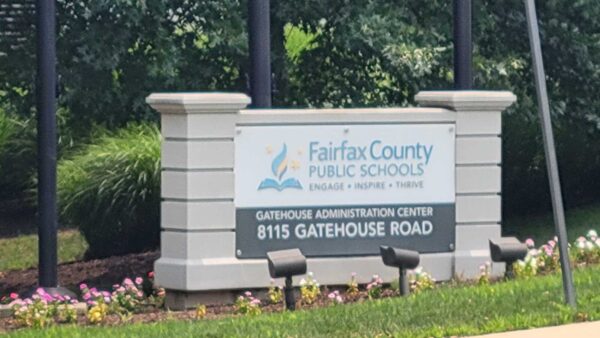
Some of the most high-profile actions the Fairfax County School Board is expected to take during the 2026-27 school year will relate to the use of technology, particularly in emerging areas such as artificial intelligence.
Based on feedback from a newly established advisory committee, Fairfax County Public Schools staff presented early drafts of two policies — one for use of educational technology in general and one for emerging tech — to the school board’s governance committee for its input last week (Oct. 27).
While the working drafts are technical documents, the final products will affect everything from what grade FCPS students start to take devices home, whether and when they can use AI, and what platforms, such as YouTube, they will be allowed to access.
The emerging tech policy is envisioned as “a framework to ensure the safe, ethical, equitable, and transparent evaluation and use of emerging technologies,” the draft says.
Similarly, the broader policy on the use of educational technology sets out to establish “a framework” for “developmentally appropriate use of educational technology that aligns with the division’s educational mission,” while addressing concerns such as student privacy, data security, and accessibility.
Crucially, the proposed emerging tech policy attempts to define artificial intelligence and distinguish between different types of it, such as an “AI-enabled tool” versus “agentic generative AI” that automatically performs tasks.
The lack of clear definitions has been an issue for FCPS in the past, including when the board discussed, and ultimately approved, a new ban on generative AI for elementary school students this summer. That ban was intended to remain in place until the board received updated guidance from the Educational Technology Review Committee (ETRC).
The early draft of the policy also sets out updated proposed guidelines by grade. It suggests banning use of AI entirely in kindergarten through sixth grade before allowing some limited usage for specific “curriculum-grounded tools” in grades 7 and 8.
Parental approval and guidance from a teacher would still be needed. At that point, general-purpose tools, which would presumably include platforms such as ChatGPT, would also still be banned.
Under the Oct. 27 draft, high school students would be allowed to use approved “curriculum-grounded tools” and more generally available AI with teacher guidance and parental approvals after they demonstrate AI literacy.
This fall, FCPS began providing digital literacy lessons focused on ensuring students know how to evaluate online information and protect their own privacy and safety. While the Virginia Department of Education already mandated a digital literacy curriculum, previously, FCPS integrated those requirements into existing courses.
The proposed emerging tech policy calls for “grade-appropriate AI literacy, awareness, safety, and human-judgment instruction” — without students needing to use tools prohibited for their grade.
Meanwhile, the educational technology policy draft lays out expectations for how FCPS students would use and store devices, and at what grade levels. The draft suggests retaining the ban on issuing devices to pre-K and kindergarten students, while allowing limited use in grades 1 and 2. Students wouldn’t have the option to take a device home until grades 7 and 8.
School board shares initial feedback
Members of the Governance Committee offered positive feedback on the draft policies as well as plenty of suggestions for changes.
Tom Dannan, who represents the Braddock District on the school board, said the policies were “at the right level of detail and specificity” to the point of being about “75 percent” ready.
He suggested that the emerging tech policy could set more granular standards for high school students, perhaps distinguishing between grades 9-11 and seniors “if our goal is to make sure kids are prepared if they decide to go to college or in the professional world to use [AI].”
Hunter Mill District Representative Melanie Meren thought the policies are “promising” and “have come a long way,” but said they needed to emphasize a more analytical and specific approach.
“There has to be a statement of commitment and expectation that the case for technology in education is being made continuously,” Meren said. “There’s statements like ‘when technology does not advance the learning.’ Well, how do we know that that happens? Saying in here that it will be measured … how so?”
Marcia St. John-Cunning, the Franconia District representative, said “equity and access” also needs to be at the forefront as the policies move forward.
“There’s a perception sometimes that everybody does have devices at home, and some people don’t,” she said. “Some people don’t even have access to the internet. So, when there are certain assignments and there are certain things that have to be considered, that may not be able to be completed at home, if they don’t have a take-home device.
“I just think equity has to be looked at very, very carefully because there are so many potential impacts to that,” she concluded.
Springfield District Representative Sandy Anderson, who chairs the governance committee, agreed the two drafts are “probably about a 75 percent solution,” but said that additional language outlining the FCPS superintendent’s responsibilities is needed.
She also didn’t think the drafts, which include some carve outs for students with individual learning plans and section 504 accommodations, include “a strong enough accessibility connection right yet.”
“I think that we have some work to do,” she said, “… to make sure those kiddos that are using assistive devices or technology for other means are captured and protected by what we include in the policies.”
Providence District Representative Karl Frisch said the governance committee needs to “stay intentional” about its word choices as it refines the draft policies to take to the full board.
“Beyond us and beyond the leadership team,” he cautioned, “community members are going to be going to the policy as well, to try and wrap their heads around what it is that we’re trying to do.”
Both draft policies will now go back to an advisory Educational Technology Review Committee (ETRC) for members’ feedback.
Board members will take up the issues again during work session and governance committee meetings; a formal vote is currently expected to take place on Feb. 11, 2027.
