

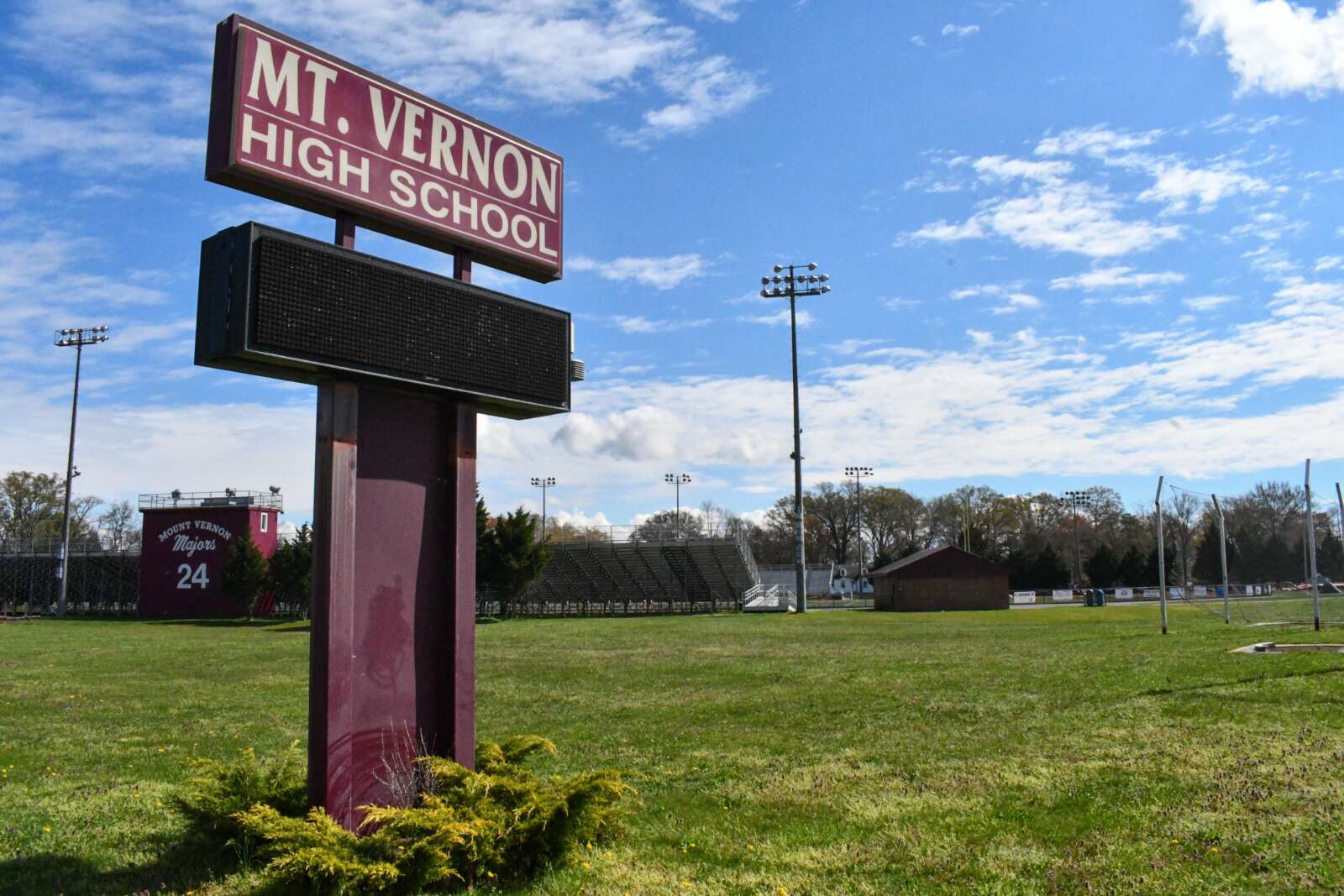
Enrollment has been declining in school divisions around the D.C. region for years, including at Fairfax County Public Schools. At John R. Lewis and Mount Vernon high schools, however, the student populations have dipped far below program capacity.
To reverse that trajectory, FCPS staff last week presented the Fairfax County School Board with options for new programming at the two schools. The board had previously directed Superintendent Michelle Reid to identify ways to increase enrollment at schools with a program capacity utilization of under 85% and fewer than 1,800 students.
“Because we have registration that begins in January, we have to make decisions on programming now for the schools that are under-enrolled,” Superintendent Michelle Reid told board members during the Nov. 10 work session.
Lewis High School
For Springfield’s Lewis High School, that could include expanding coursework and pursuing notable designations, such as a Regional Governor’s School, for its existing Lewis Leadership Program. Alternatively, FCPS could establish a Junior Reserve Officers’ Training Corps (JROTC) program there, additional career and technical education (CTE) options, or new opportunities to earn college credits.
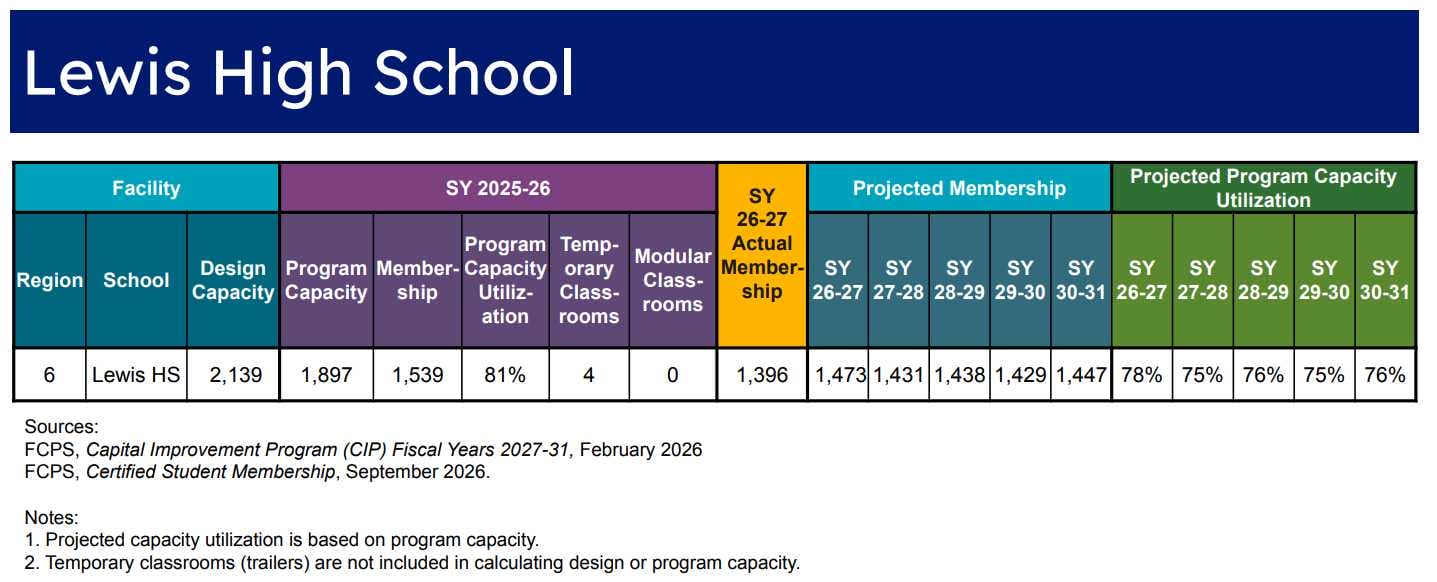
As of September, the school had 1,396 students in attendance, or approximately 78% of its capacity. Parents have in recent months been lobbying the school board for solutions, saying that the enrollment issues have created inequities in program offerings across the division.
Coming out of an earlier discussion where FCPS staff forecast a nearly $200 million budget deficit, school board members appeared to have little enthusiasm for some of the costliest ideas, such as adding a radiological technology, medical assistant, and sports medicine pathway. Teacher staffing alone for that program would roughly cost $414,000.
However, if the ideas for health and medical, or emerging technology, pathways were pursued, a couple of board members said they would prefer a regional specialty program. That option could serve both students in the school’s boundaries and full-time transfers from other schools over a career academy, which would involve part-time students traveling to Lewis from their base school.
An early college program had fewer known costs, with the staffing costs not yet determined, but there could be complications because it would need to be implemented in partnership with Northern Virginia Community College (NOVA).
The one obvious consensus among board members was that the Lewis leadership program is significantly under-marketed. Open to all Lewis students and a limited number of transfers, the program offers a deep dive into government, public policy, leadership, and human rights through classes and optional activities, from service projects to opportunities to meet with elected officials on Capitol Hill and learn about history in partnership with the Smithsonian.
“I would like much better, robust communication around the Lewis Leadership Program, and I would like us to consider what does it take to become a regional governor’s school,” said Robyn Lady, the school board’s Dranesville District representative.
“The second you name Lewis a regional governor’s school, the people will come,” she added. “If we build it, they will come. That program is off the charts.”
Marcia St. John-Cunning, who represents the Franconia District that includes Lewis, was more skeptical of the designation, positing that “a lot of the community is not interested in that.” She observed that the challenges at both Lewis and Mount Vernon extend beyond under-enrollment.
“Both of these schools traditionally have been under-enrolled, and it’s not just that they’re under-enrolled,” St. John-Cunning said. “It’s that … this area of the county is underserved and represents a lot of our neediest multilingual, multiracial, socioeconomically diverse populations.”
Mason District Representative Ricardy Anderson, however, said the idea is “worth investigating” because “we’re trying to draw other people in.”
At the same time, she lamented that FCPS “missed the lowest hanging fruit of all to increase capacity at Lewis” during its system-wide boundary redistricting process completed in January.
“Lewis is in proximity to another school that is over-enrolled,” she said. “… We missed that opportunity, and now we’re grasping at straws to bring kids back.”
Mount Vernon High School
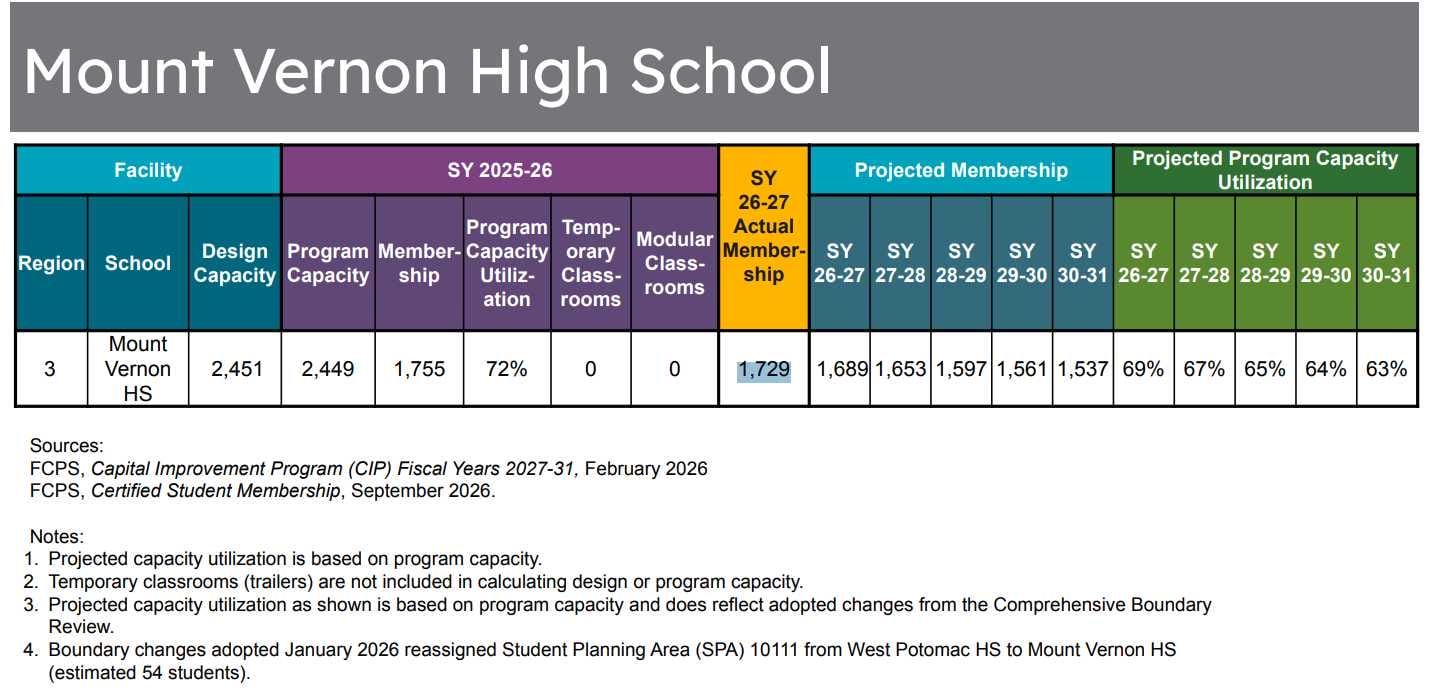
For Mount Vernon High School, which had 1,729 students in September, utilizing just 69% of its program capacity, boosting enrollment could involve new career and technical education options in fields such as aerospace and pilot training, aviation maintenance, national security, and public safety.
“We think Mount Vernon is uniquely positioned for some of these program expansion ideas because of their existing CTE and STEM and JROTC infrastructure,” FCPS Chief Academic Officer Sloan Presidio said. “Also, they’re very close in proximity to Fort Belvoir and the Richmond Highway Redevelopment Corridor, and [have] access to aviation employers at Reagan National and Dulles Airports.”
A Federal Aviation Administration grant could help with some of the start-up costs: the most expensive track — aviation maintenance — could cost more than $824,000. Another $638,000 would be needed to support aerospace engineering and pilot training classes, while a national security and public safety track might cost $248,000.
All of those expenses are before transportation is factored in.
School board members appeared interested in the aviation options, but wary of the costs.
“I love the idea of aviation at Mount Vernon,” said Lady. “It’s fantastic. I hope we get the grant that we applied for. It’s going to be a workforce issue because we’re losing people in those industries. But I have no appetite to spend $1.7 million dollars at a time where we’re in crisis.”
Sully District Representative Seema Dixit also wanted to know if FCPS has any contingency plans.
“If the FAA grant doesn’t come through, what’s going to happen to this program?” she asked.
“We would need either to change out a program or to add other programming,” Reid replied. “We need … either a corporate sponsor, a grant, some type of other funding, maybe from the state, that would support that, because I think everybody’s sensitive to our current budget situation.”
According to Presidio, a survey to gather community feedback on the programming options for Lewis High School is in the works, but public input will be collected on both schools before FCPS staff present the school board with more robust proposals.
Finding the funding
The school board acted quickly on the information provided in the session, unanimously voting during its regular meeting on Thursday (Nov. 12) to amend its legislative program to request state funding for potential programs.
The board is seeking $1.5 million to “establish the Center for Aerospace and Security Studies at Mount Vernon High School.” It also seeks state funding to establish and expand “a regional quantum education program, Integrated Quantum Photonics for Healthcare, that includes both photonics and optics, with connections to medical imaging, diagnostics, and the health technology workforce.”
Finally, the legislative program requests $1.5 million to “support curriculum, equipment, teacher training, and student access, as well as the development of potential partnerships with industry and the National Institutes of Health at John R. Lewis High School.”
