

Several Fairfax County supervisors this week signaled an interest in expanding the “Beyond the Bell” child care program following a reportedly successful pilot over the previous school year.
County staff proposed at the Board of Supervisors’ Health and Human Services Committee meeting on Tuesday (June 16) transitioning all existing School Age Child Care (SACC) sites to Beyond the Bell over the next few years, starting with an additional 21 schools this fall.
Run by the Fairfax County Department of Neighborhood and Community Services (NCS), the Beyond the Bell pilot program launched in October with the goal of reducing lengthy wait lists for child care.
It operates under a licensure-exempt model, meaning the ratio of staff to students could reach a maximum of 1:22, while the SACC model allows 1:18 under standards set by the Virginia Department of Education (VDOE). The model also eases some requirements around staff experience.
“We strongly propose a…four-phase expansion of the Beyond the Bell program, transitioning it from a successful pilot to full implementation by school year 2029-2030,” NCS Director Lloyd Tucker told supervisors. “We will maintain the site selection criteria while also factoring in upcoming school boundary redesigns and capital improvement projects.”
During the pilot, Neighborhood and Community Services selected 20 sites to test the new model based on the existing SACC wait list, Title I designations, percentages of students who receive free and reduced meals, and the county’s vulnerability index.
According to Tucker, expanding the program will carry additional costs, including “increased food costs for snacks, general operating costs increases for educational activity, and health and safety supplies, and increased training for our staff.”
The county would also need to convert 18 existing positions to merit employees who can receive paid leave, health care and other benefits.
However, given the size of the SACC waiting list, the additional revenue brought in by the expansion of available slots should make the program cost-neutral.
“To see the impact of these positions in time for 2026-27 school year, resource approval will be sought through the [fiscal year] ’26 carryover review process, and recruitment will begin immediately, unless otherwise directed by the Board of Supervisors,” Tucker said.
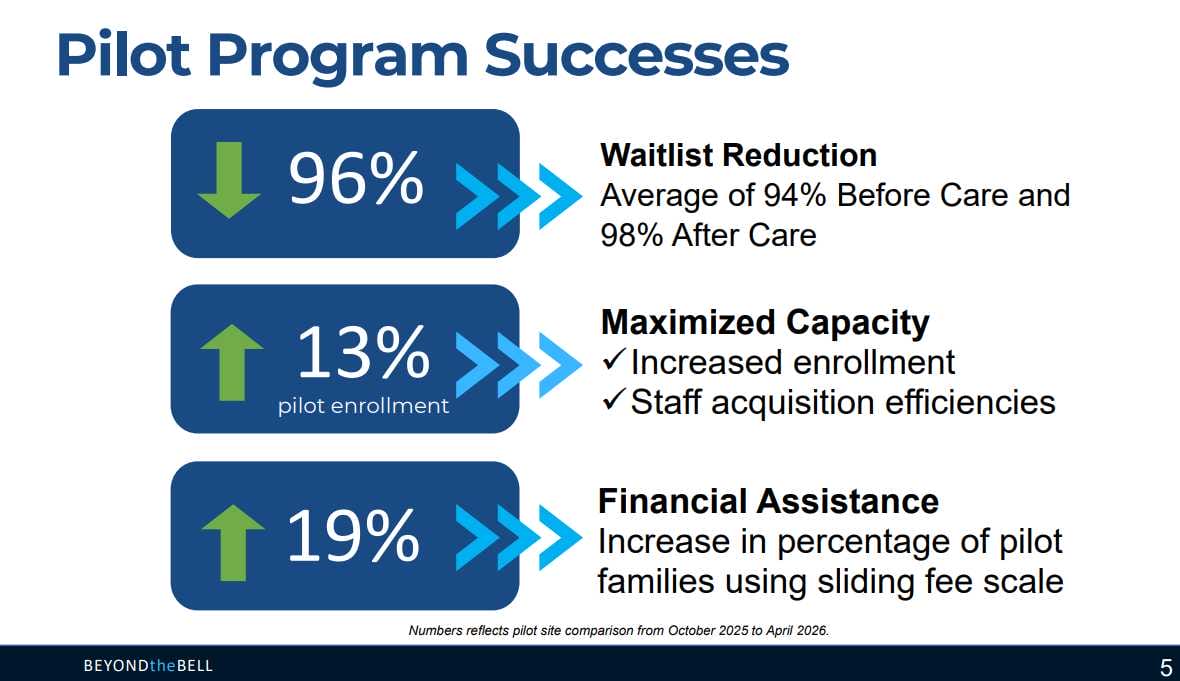
While the supervisors’ feedback was largely positive, they did mention parental concerns that increasing the staff-to-child ratio would impact the quality and safety of care.
“For some of the parents who are concerned about this, I don’t think it’s very clear to them exactly what the difference is between this program and what a licensed program by the state is,” said Chairman Jeff McKay. “So, when we use the proper terminology, which is ‘license exempt, local government program,’ that sounds to any … normal person, like it’s not as good a program. That’s what that translates to for people.”
The county has to do a lot of work to explain “the real trade-off” because “parents need reassurance that “this is a high-quality program for anyone who’s putting their kids in,” McKay added.
Hunter Mill District Supervisor Walter Alcorn said that while the pilot showed “some very good results” in reducing the wait list for child care, he wants to ensure an outside entity would evaluate the program.
“Is there somebody outside of this program who will play the same role that the state plays for our private sector-licensed providers and licensed programs?” Alcorn asked. “Because what I don’t want to see happen is a situation where somebody at NCS…are the only ones that are responsible for making sure that the standards that we are applying [are] upheld.”
“A program can be wildly popular, but still have problems with compliance with those state standards,” he added.
Sully District Supervisor Kathy Smith reiterated that supervisors had received many emails from parents who were “afraid to send their kid to an unlicensed program, and they were afraid about the number of kids in the program.” The county’s message about the quality of the program “didn’t get to the community back when this was first starting,” she said.
This year, Beyond the Bell operated at Annandale Terrace, Bailey’s, Braddock, Brookfield, Flint Hill, Hybla Valley, Lake Anne, Lorton Station, Mosaic, Mount Eagle, Mount Vernon Woods, Oak View, Orange Hunt, Pine Spring, Providence, Spring Hill, Timber Lane, Vienna, Westlawn, and Wolftrap elementary schools.
