

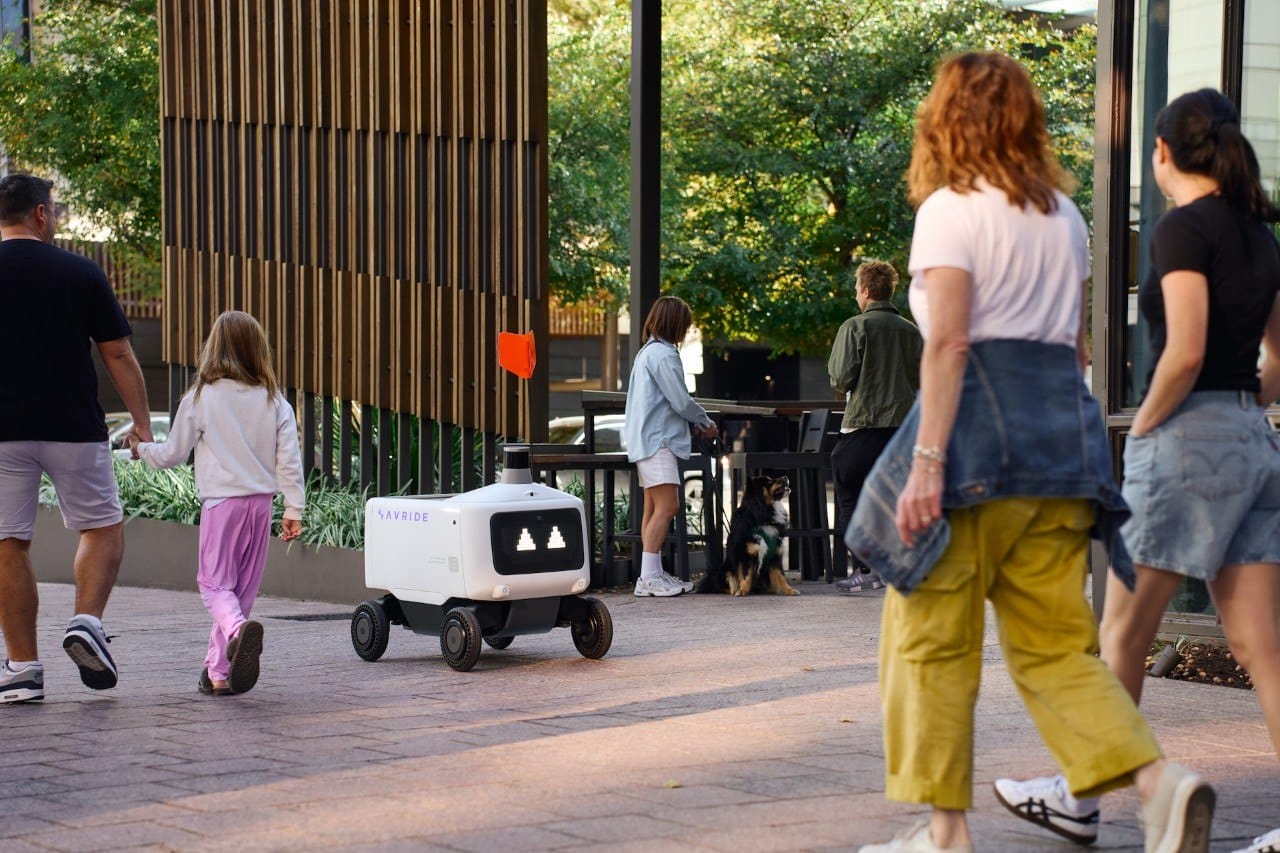
Community members who visit George Mason University in Fairfax this fall might notice a change in the boxy robots that putter around the campus, bringing food to hungry students.
The Austin-based company Avride announced last week that its autonomous delivery robots will roll out to more than 25 college campuses across the U.S., including GMU, by the end of September.
“We’ve moved beyond proving that autonomous delivery works on an individual campus,” Avride Head of Robotic Delivery Roman Nefedov said in a press release. “We are now demonstrating that it can be launched repeatedly, operated efficiently, and scaled across a national network. Our focus is ensuring that reliability and service quality remain consistent as that network grows.”
The robots began operating on Mason’s Fairfax campus when the fall semester started yesterday (Monday), according to the release. Avride is taking over operations from Starship Technologies, which had provided delivery robots to GMU since 2019 before announcing in June that it would shift its focus from university campuses to grocery hauls.
A spokesperson declined to comment on how many robots Avride has deployed at GMU, stating that it’s the company’s policy not to disclose the number of robots at each campus.
However, they confirmed that the company is operating specifically at the main Fairfax campus, even though it has a separate fleet of robots that began delivering Uber Eats orders in Arlington’s Rosslyn-Ballston corridor earlier this summer. GMU has additional campuses in Arlington and Prince William County.
Started in 2017, Avride is focused on self-driving transportation technology and recently expanded into robotaxis, launching service in Dallas, Texas, through Uber last December. The all-electric vehicles still come with a human “safety operator,” though the company has said fully driverless operations are its ultimate goal.
The autonomous ride-hailing vehicles have come under scrutiny, with the National Highway Traffic Safety Administration announcing an investigation in May after they were involved in 16 crashes in Dallas and Austin within the first three months of 2026.
Though rival Waymo has been itching to bring its robotaxis to D.C., rolling out the vehicles for test drives last month, local residents are still likely more familiar with self-driving technology in the form of delivery robots.
In addition to GMU’s Fairfax campus and downtown Arlington, where they’ve been pronounced either a “cute” convenience or a “corporate intrusion on public space,” food-carrying bots previously popped up at the Mosaic District in Merrifield, offering deliveries from participating restaurants.
Provided by the startup Cartken, the delivery robots at the Mosaic District were intended to be temporary. Added in spring 2023, they have since been phased out.
“Cartken’s robot delivery service at Mosaic was a limited-term initiative designed to test the concept in a busy, mixed-use suburban environment,” Sommer Hixon, communications director for property owner Edens, told FFXnow. “It was not the plan for the service to continue over the long term.”
According to Avride, its announced expansion will add approximately 475,000 more college students to its campus delivery network, which would exceed 610,000 students once the rollout is complete.
CEO Dmitry Polishchuk said the company sees college campuses and urban settings as “complementary pillars” at the foundation of its delivery business.
“Campuses are an important part of that strategy because they bring together high order density, repeat demand, and compact service areas, creating safe and strong conditions for efficient autonomous delivery,” he said in the press release. “Combined with our city deployments, they help us build a more diversified delivery business across distinct operating environments.”
According to Avride’s website, the “couriers” are equipped with 360-view sensors that can detect objects from up to 200 feet away and batteries that provide power for up to 12 hours. They operate in a variety of weather and traffic conditions, completing “99% of deliveries without human assistance,” per the press release.
