

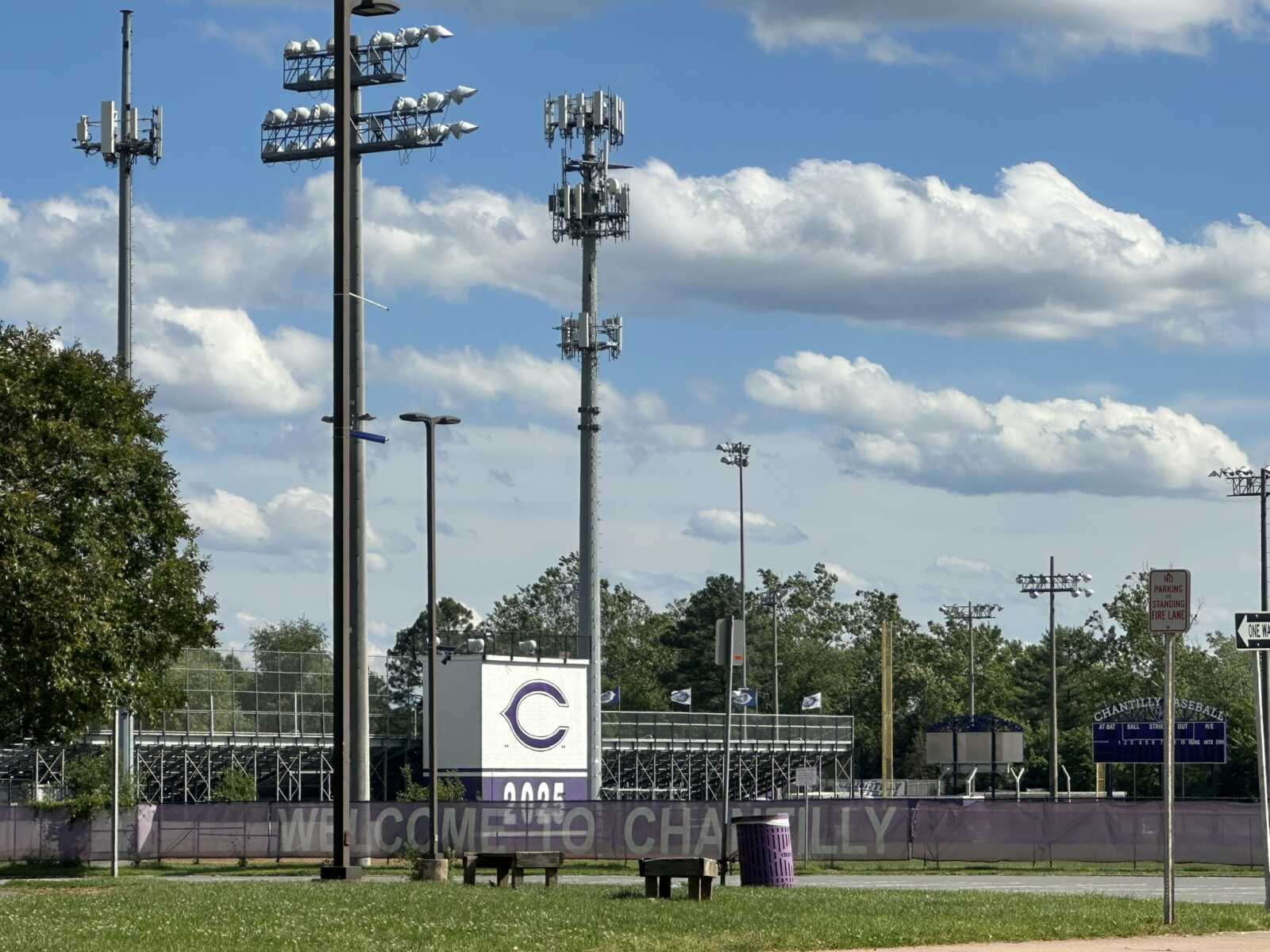
Fairfax County Public Schools officials are willing to at least explore the idea of selling naming rights to high school athletic facilities.
At its Sept. 8 work session, the Fairfax County School Board directed county staff to gather more information from the business community, while the elected officials try to hammer out policy guardrails.
No process has been approved yet, nor did a majority of the board indicate it would support selling naming rights. However, most board members were cautiously open to getting more details on a possible plan.
The proposal was brought forward in March by at-large member Kyle McDaniel and Mount Vernon District Representative Mateo Dunne as an option to ease shortfalls expected in the next year’s budget as maintenance backlogs increase.
Tom Horn, the executive director of activities and athletic programs for FCPS, presented a potential framework for soliciting corporate partnerships and distributing revenue. He said sporting events at the county’s 26 public high schools collectively draw more than 1 million spectators each year.
One problem with naming rights, however, is that many courts, fields and athletic complexes already have some honorarium attached.
The board could explore multiple naming options to keep those in place, Horn said, comparing the facilities to college stadiums. For example, Arizona State University’s football team plays on Frank Kush Field at Mountain America Stadium and North Carolina State University’s women’s basketball team plays on Kay Yow Court at Reynolds Coliseum.
Other potential risks to consider include inequitable resource allocation, reputational damage and the threat of over-commercialization, Horn said. He proposed addressing those issues by pooling revenue divisionwide, mandating strict morals clauses and capping the number of nameable assets.
While the school board has an existing policy that allows it to sell naming rights, Horn said it needs to be shored up. The policy doesn’t say what is eligible to be named and establishes few guidelines beyond ensuring contracts last for a minimum of five years.
He proposed identifying the nameable facilities, such as fields, stadiums, concession stands and scoreboards, while prohibiting naming rights sales for places used daily by students like libraries.
Horn wasn’t aware of any large school division with a coordinated policy to sell naming rights, though some schools in Falls Church and Loudoun County have used corporate sponsorships for specific projects.
Board members highlighted how there are already inequities in FCPS athletics programs, because some schools have more active booster clubs than others and some have higher attendance numbers. Ticket revenue can range from $50,000 to $200,000 a year, depending on the school, according to Horn.
At-large representative Ilryong Moon, who has served on the school board off and on since 1995, said the naming rights discussion has come up many times over the years, but board members can never agree on how money should be distributed or the role of each school community in the process.
“I don’t want to face a situation where the board is going to enforce a certain name for a certain facility directly in opposition to what the community’s desire may be,” he said.
Moon and others pointed out potential animosity from higher-revenue schools if the money from naming their stadiums doesn’t go directly toward their programs. Moon compared it to a PTA that actively fundraises being forced to send some of its money to a school with a less active PTA.
“I think there’s some value in investigating this further, but it cannot be structured in a way that schools that can [generate revenue] receive the lion’s share and schools that cannot continue to be in the position that they are,” said Mason District Representative Ricardy Anderson.
Over-commercialization was a concern for some board members. Sully District Representative Seema Dixit was “hesitant” about the proposal and didn’t want more revenue to come “at the cost of our values.” Anderson said there need to be strict limits on the scope of sponsorships.
“I would not want our schools to become like the back of a soccer jersey – just sponsored by everybody under the sun,” Anderson said. “I’m really concerned about having limits that allow our schools to look like schools and not just corporate sponsorship.”
McDaniel said there are many potential partners in the region.
“We have corporations — you could swing a dead cat and find 30 of them around here — that are great public sponsors,” he said. “They are great corporate partners. Those are the types of companies I am very interested in approaching.”
County staff suggested adopting a policy in February and seeking sponsorships next fall, but it’s unclear how the board’s cautious approach could affect that schedule.
Franconia District Representative Marcia St. John-Cunning supported getting more information, but wanted the board to remain vigilant.
“What we’re all trying to do is be creative in a time when there are significant budget shortfalls, and we do want the best for all of our students,” she said. “And if we can be creative while at the same time being responsible, then I think that’s the best move forward.”
“I think the fact that we’re even discussing this is a sad state of affairs in terms of public education and funding because we’re having to look for resources, and we’re having to be creative about looking for resources for our schools, for our students, for our programs,” St. John-Cunning added.
