

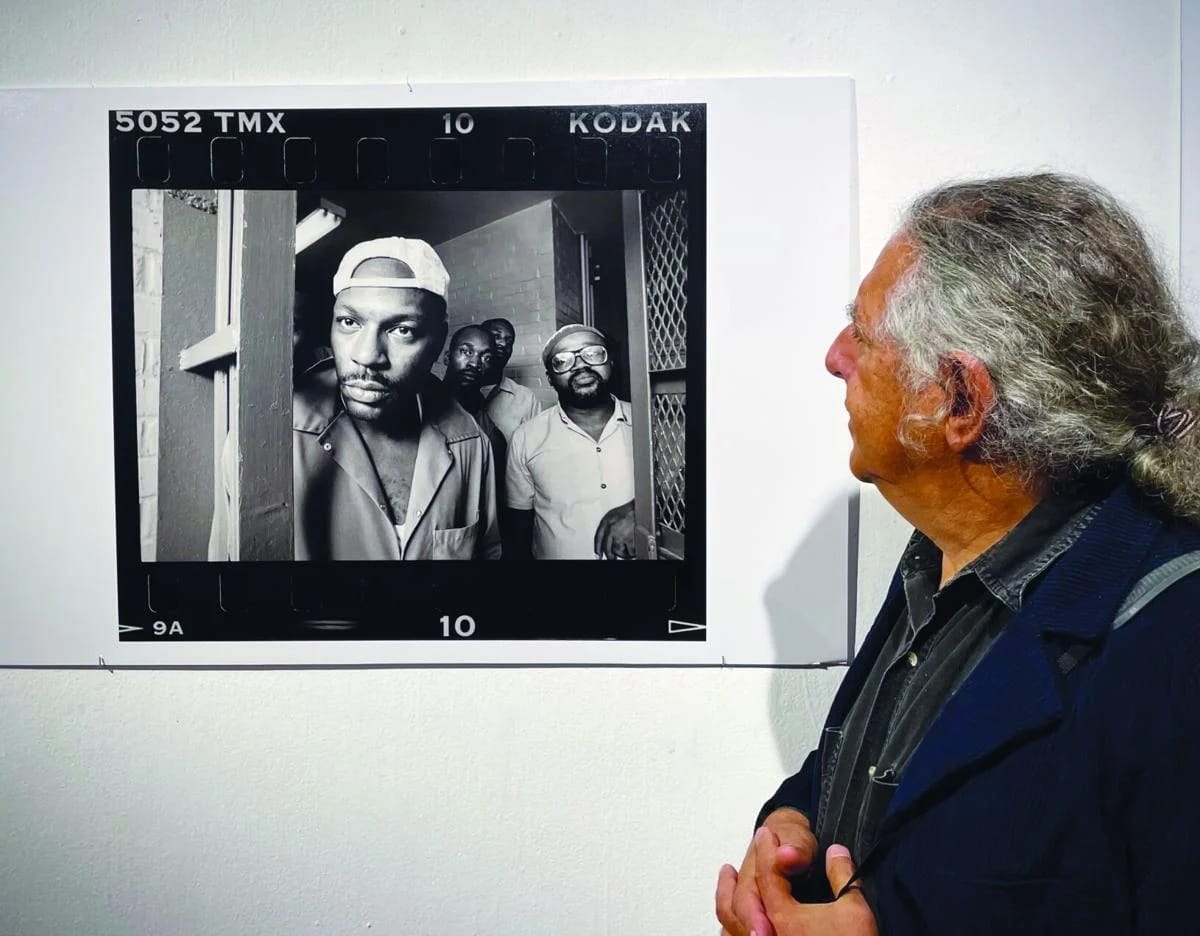
When photographer Lloyd Wolf sought to document a substance abuse rehabilitation program at Lorton Correctional Complex nearly four decades ago, his request was met with outright hostility.
It was the late 1980s, and Washington, D.C., was grappling with a crack cocaine epidemic and violent turf wars.
At the sprawling facility near the Fairfax-Prince William border, where over 60% of inmates were convicted for violent crimes, participants viewed his attempt to photograph them with suspicion.
That mistrust eased, however, after his fellow journalist and chronicler John Cohen proposed to teach them writing so they could narrate their own stories.
Over the next two years, Wolf went on to capture the participants’ progress through the program and their transition toward life outside prison.
“I learned that people can get better … that properly designed programs can work,” Wolf told InsideNoVa, adding that the inmates had recorded low rates of recidivism upon their release. “I could see, clearly, from start to finish, the transformation that occurred.”
Nearly 40 years later, the photographs have found a new audience at the very site of what was once one of America’s largest correctional populations.
Spread across 3,500 acres, the facility opened its gates in 1901, its first prisoners transported on barges down the Potomac.
Lorton Correctional Complex was shut down in 2001. Today, part of the former prison is home to Workhouse Arts Center, where Wolf’s intimate portraits are on display in an exhibition titled “Transformations: Documenting the Substance Abuse Program at Lorton Reformatory, 1989-1991.” Wolf’s work was originally featured as a cover story for the Washington City Paper in 1990.
“This year marks the 25th anniversary of its closure, and so we really want to mark that in a meaningful way,” said Sarah Berry, curator at Workhouse Arts.
“These images that we are surrounded by now cover everything from the start of the [rehabilitation] program to their opportunity to leave the prison and enter into a halfway house and seek employment,” Berry said. “I couldn’t pass up the opportunity to mark the time.”
Wolf’s black-and-white photographs offer glimpses of the participants’ solitude as well as their communal joy. Some capture quiet moments of reflection, others show the men gathered together, smiling, laughing.
The exhibition also includes portraits of Dr. Jasper Ormond, founder of the Pilot Substance Abuse Program, or PSAP, including one in which he is huddled together with participants during a lecture.
Wolf, who is based in the D.C. area, recalled one of Ormond’s speeches, when he challenged the participants to reconsider their understanding of respect.
“He stood up that day in his quiet voice and said, ‘All of you, you got here because you thought you had the right idea,’” Wolf said.
Ormond went on to challenge them to consider what they can do to earn respect: holding a job, raising their children, and being present for their families and communities.
“I felt like light bulbs went off right there,” he added.
Storied history
The correctional facility had a long, complex history, spanning more than nine decades as a prison.
Its inmates included women suffragists who served time for campaigning for voting rights during President Woodrow Wilson’s administration.
The facility has a rich cultural history, too, having featured performances by Ella Fitzgerald and Frank Sinatra.
Earlier this year, Hakim Flowers – a Washington-based visual artist, author and poet who served 22 years at Lorton Correctional Complex – featured his exhibition, “How to Cage a Butterfly.”
These stories reflect the layers of Lorton’s significance that deserve preservation, Berry said.
“It is a bridge between the past and the present. The bricks were created by the people being incarcerated here. The history is troubled, but we don’t need to shy away from it,” she said. “It’s a story that we are going to continue to tell for many years to come, and acknowledge that the site that we sit on has gone from a place of confinement to a place of creativity.”
Check out ‘Transformations’
- What: “Transformations: Documenting the Substance Abuse Program at Lorton Reformatory, 1989-1991”
- Where: Workhouse Arts, 9518 Workhouse Way, Lorton
- When: Now through Nov. 7
- More Info: workhousearts.org/transformations-at-lorton
This article was written by FFXnow’s news partner InsideNoVa.com and republished with permission. Sign up for InsideNoVa.com’s free email subscription today.
