

Fairfax County is creating commercial profiles of different neighborhoods to guide future economic development and placemaking.
At an economic initiatives committee meeting on Dec. 12, the Fairfax County Board of Supervisors discussed a place-led economic development pilot program that will provide snapshots of communities throughout the county.
“It’s really about providing all of us with data driven insights into Fairfax County commercial districts, how that…area is performing and functioning as well as who is being served by the commercial activity,” said Laura Baker, the catalytic development manager for the Fairfax County Department of Economic Initiatives.
In the first phase of the pilot program, staff studied Bailey’s Crossroads and University Mall near Fairfax City. The locations were selected due to their diversity in scale, geography, business characteristics and community, as well as the willingness of stakeholders to take part in the process.
Each template dives into data on users and visitors, retail spending, recent investments, key insights and business highlights.
Dranesville District Supervisor John Foust and Board Chairman Jeff McKay said they were concerned about how the profiles will be updated and what new information they generated — beyond assembling disparate data the county already receives.
“What we don’t want to do is have outdated information out there that kind of works against the marketing of a particular area,” McKay said.
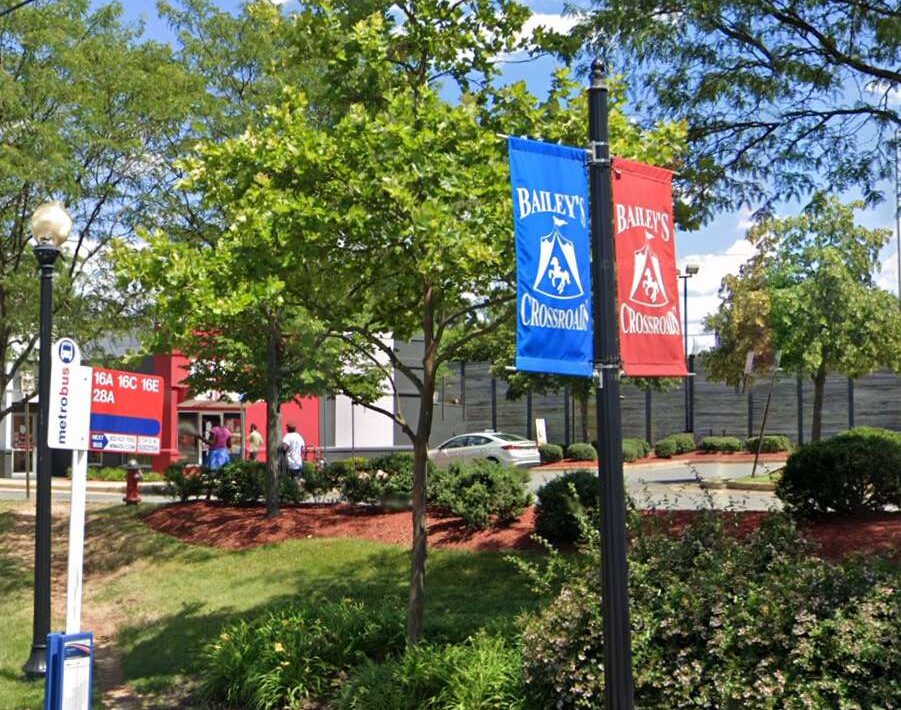
The Bailey’s Crossroads profile, for example, found limited connectivity between the community’s shopping centers, overall healthy commercial performance, and that the population’s median age and income are lower than the rest of the county.
The community also sees strong weekend activity, and there has been a slight increase in visitor growth after the pandemic.
Mike Van Atta, president of BC7RC, a volunteer organization that promotes community revitalization in Bailey’s Crossroads and Seven Corners, said the profiles are particularly helpful because they can guide how partnerships between organizations drive community revitalization.
“Frankly, we think that’s a community health story as much as it is a community development story,” Van Atta said.
McKay noted none of that information was surprising — indicating that the community profiles provided an accurate snapshot.
In phase two, staff plan to study 26 special planning areas — except for those with a specified land use purpose or those that have already been the focus of recent studies.
Baker said Tysons and Reston will likely be excluded from the effort, since they have recently updated comprehensive plans and existing organizations, such as the Tysons Community Alliance and Partnership Reston, that focus on placemaking.
“There’s already a lot of transformation happening there,” she said.
County staff also plan to take a look at an additional 86 shopping centers, like the Pan Am Shopping Center in Merrifield and the Rose Hill Shopping Center.
Mason District Supervisor Penny Gross, whose district includes Bailey’s Crossroads, said she wants to see a dedicated section to vision in the profiles and more community integration.
“There’s not the community piece in here and I’m very concerned about that because people are resistant to change,” she said. “They don’t necessarily like what’s there now, but they don’t want much new.”
Hunter Mill District Supervisor Walter Alcorn said the community pieces come from the county’s comprehensive plan — which was created with significant input.
“The comprehensive plan really is a document that is highly integrated with the community, and the community in all cases have been involved in the development of that,” he said.
In the coming months, staff will finalize the template for the profiles and criteria to determine exactly which areas are studied before issuing a request for proposals. The second phase will likely begin in the first quarter of 2024.
Image via Google Maps
