

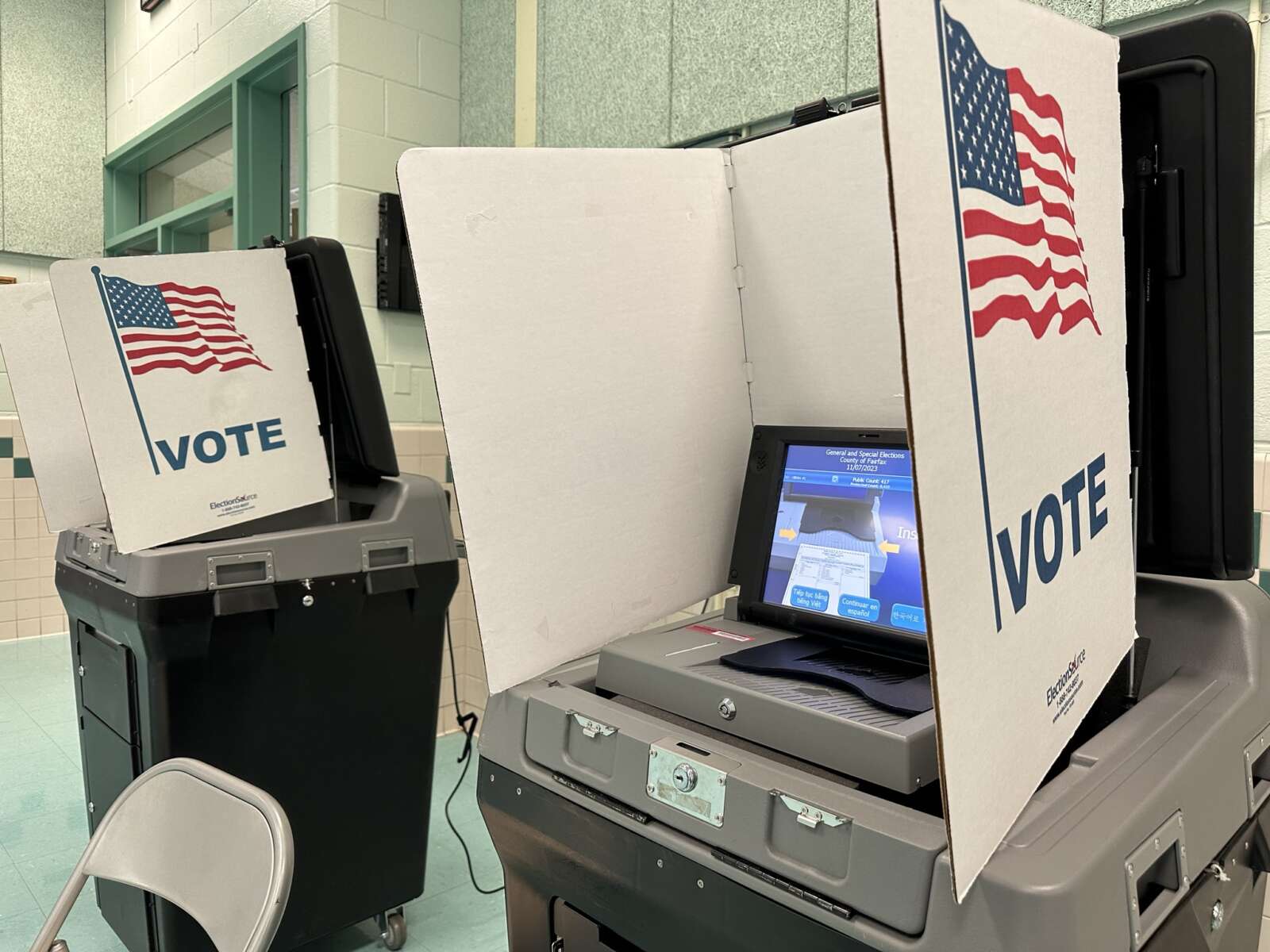
Fairfax County has a new policy that could lead to the prosecution of individuals who were removed from the voter rolls after being identified as possible non-citizens.
The move comes after Virginia Gov. Glenn Youngkin signed a new executive order in August directing the Virginia Department of Elections to update the voter rolls by removing deceased individuals, felons, those deemed mentally incapacitated and non-citizens before the general election on Nov. 5.
The Fairfax County Electoral Board, a three-member panel appointed by the Circuit Court, approved the policy in a 2-1 vote on Sept. 16. The board’s two Republican members voted for the policy, while its lone Democratic member opposed it.
However, Youngkin’s directive is facing legal challenges.
Last week, local civil rights organizations and the U.S. Department of Justice (DOJ) filed separate lawsuits against the state’s new voter removal policy, asserting it violates the National Voting Rights Act’s “quiet period” provision, which prohibits purging voter rolls 90 days before federal elections. They argue the policy could disenfranchise eligible voters due to errors in the state’s voter data.
“Congress adopted the National Voter Registration Act’s quiet period restriction to prevent error-prone, eleventh hour efforts that all too often disenfranchise qualified voters,” Kristen Clarke, assistant attorney general of the Justice Department’s Civil Rights Division, said in a press release on Friday (Oct. 11). “The right to vote is the cornerstone of our democracy and the Justice Department will continue to ensure that the rights of qualified voters are protected.”
The Virginia Department of Elections didn’t comment on how many voters have been purged from the rolls since Youngkin signed his executive order on Aug. 7, stating that it could take up to 90 days to provide the public records under the National Voter Registration Act.
However, Youngkin said in his executive order that the state removed 6,303 non-citizens from the voter rolls between July 2022 and July 2024.
In Fairfax County, the general registrar canceled 22,648 voter registrations through Aug. 31, including 4,092 in August. While most cancellations were due to deaths and relocations, 210 voters — including 28 in August — were declared non-citizens by the state after failing to provide proof of citizenship, per draft minutes of the electoral board’s Sept. 16 meeting.
Electoral board debates ‘non-citizen’ referral policy
Voters flagged as non-citizens by the state get 14 days to respond to a letter asking them to confirm their citizenship, Fairfax County General Registrar Eric Spicer told the electoral board. The voter registration records of anyone who doesn’t confirm their status in that time frame are automatically canceled.
Electoral Board Chair Katherine Hanley — the sole dissenting vote on the county’s new voter referral policy — criticized the timing of the purges, noting that the August removals occurred within 90 days of a federal election.
“She also stated that she is receiving phone calls that the confirmation of citizenship status letter looks like a hoax and may be contributing to the lack of response,” the draft minutes said.
The now-approved policy directs the county’s general registrar to refer all individuals identified as “non-citizens” by the Virginia Department of Elections and removed from the voter rolls to the Fairfax County Commonwealth’s Attorney’s Office and Virginia Attorney General Jason Miyares’s Office “to determine if they have violated Virginia elections law.”
To avoid administrative strain and maintain voter trust during the presidential election cycle, Hanley proposed delaying the policy’s implementation until Dec. 1, after the election’s certification and audits.
According to the meeting minutes, Vice Chairman Jeffrey Shapiro acknowledged he had not investigated the claims about confusion over confirmation letters but argued the 90-day freeze on voter roll updates likely doesn’t apply to non-citizens, as there’s no grace period for “illegal” registrations.
He also suggested Virginia’s allowance for same-day voter registration could exempt it from the National Voting Rights Act’s 90-day restriction on list maintenance. Shapiro raised concerns, however, about how the Department of Motor Vehicles manages data, particularly on individuals with driver privilege cards (a driver’s license for non-citizens), who, he noted, shouldn’t appear on the voter rolls in the first place.
Lawsuits challenge Virginia’s voter removals
The DOJ’s lawsuit against the state of Virginia was spurred in part by Rep. Gerry Connolly (D), who said in a statement that he alerted the federal department to the ongoing voter roll purges.
In a letter sent to Youngkin and Virginia Attorney General Jason Miyares last Monday, Oct. 7, Connolly called for an immediate halt to the purge, contending that the state may be using outdated DMV records to check voter’s eligibility.
He argues those records might not reflect recent changes in a person’s citizenship status, potentially resulting in the removal of naturalized citizens who have the right to vote.
Connolly also noted that conducting such purges so close to an election gives those affected little time to correct mistakes and restore their voting status.
“The [National Voter Registration Act] restricts states from systematically removing voters from voter rolls within 90 days of a federal election to prevent widespread disenfranchisement and ensure the integrity of the voting process,” Connolly said in a press release. “This restriction is designed to protect voters from being wrongly purged close to an election, which could disrupt their ability to cast ballots.”
On Friday, Connolly sent out another release praising the DOJ for filing its lawsuit to stop the state from removing voters 90 days before the general election.
Youngkin called the DOJ lawsuit “unprecedented,” asserting that it represents “a desperate attempt to attack the legitimacy of the elections in the Commonwealth, the very crucible of American Democracy.”
“With the support of our Attorney General, we will defend these commonsense steps, that we are legally required to take, with every resource available to us,” he said. “Virginia’s election will be secure and fair, and I will not stand idly by as this politically motivated action tries to interfere in our elections, period.”
Simultaneously, the Virginia Coalition for Immigrant Rights and the League of Women Voters of Virginia filed a federal lawsuit on Oct. 7 in the U.S. District Court in Alexandria, also claiming that the state’s “Purge Program” violates the NVRA’s quiet period provision.
The plaintiffs are seeking a court order to halt the removals and reinstate any voters who have been improperly disqualified. They’re also calling for increased transparency from state officials about the criteria and methods used to determine voter eligibility.
Responding to the complaint, Christian Martinez, a spokesperson for Youngkin, told the Associated Press that the voter list maintenance efforts are in full compliance with state and federal laws, calling the purges a necessary step to ensure the integrity of Virginia’s voter rolls.
Fairfax County’s election office declined to comment on the matter, citing the pending litigation.
A recent investigation by the Washington Post found that most of the 6,300 voters purged by Youngkin’s administration for being flagged as non-citizens through July were actually removed due to paperwork errors. State election officials and the Youngkin-appointed state elections commissioner said many were legal citizens who mistakenly identified themselves as non-citizens on DMV voter registration forms.
