


As federal worker layoffs drive up unemployment, a new roadmap to reshaping the regional economy, proposed by local business leaders, says Northern Virginia will have to reinvent its economy if it hopes to succeed.
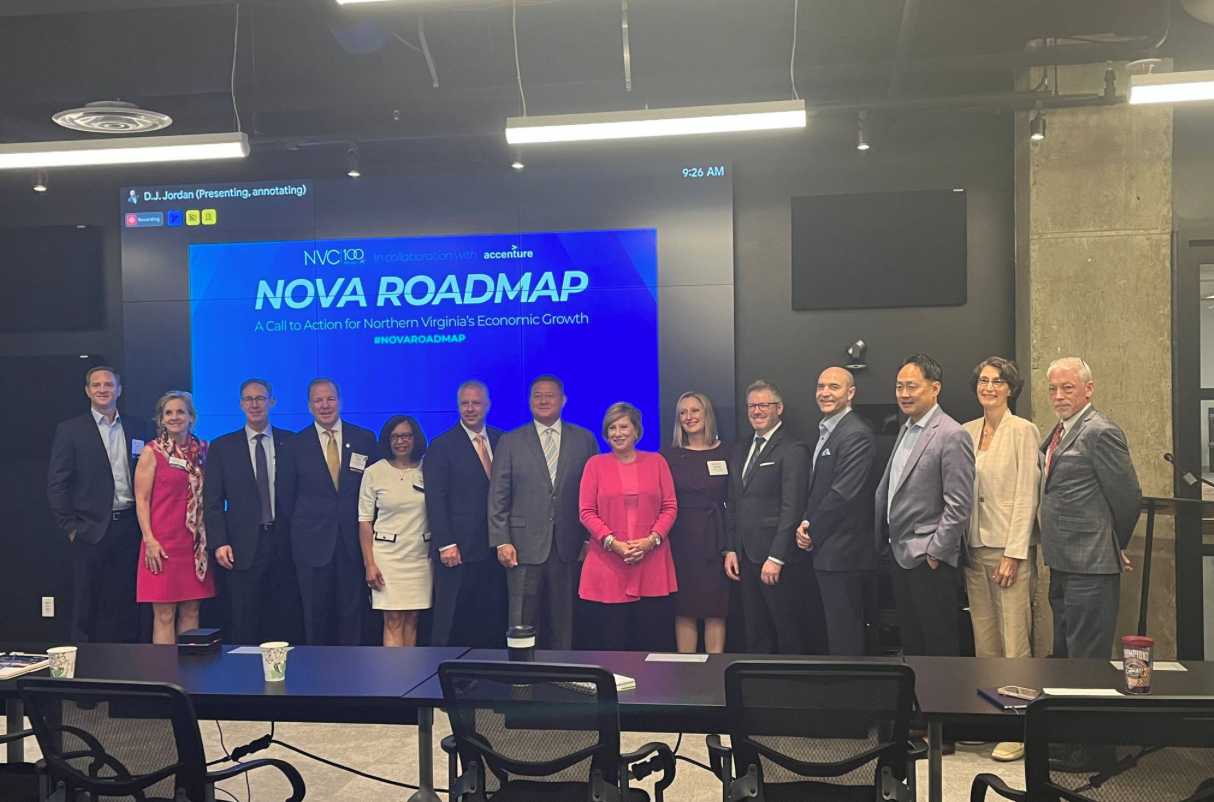
The Northern Virginia Chamber of Commerce (NVC) and consulting firm Accenture released the NOVA Roadmap yesterday (Monday) at a press conference, calling it a “bold, actionable vision to reimagine the region’s economy.”
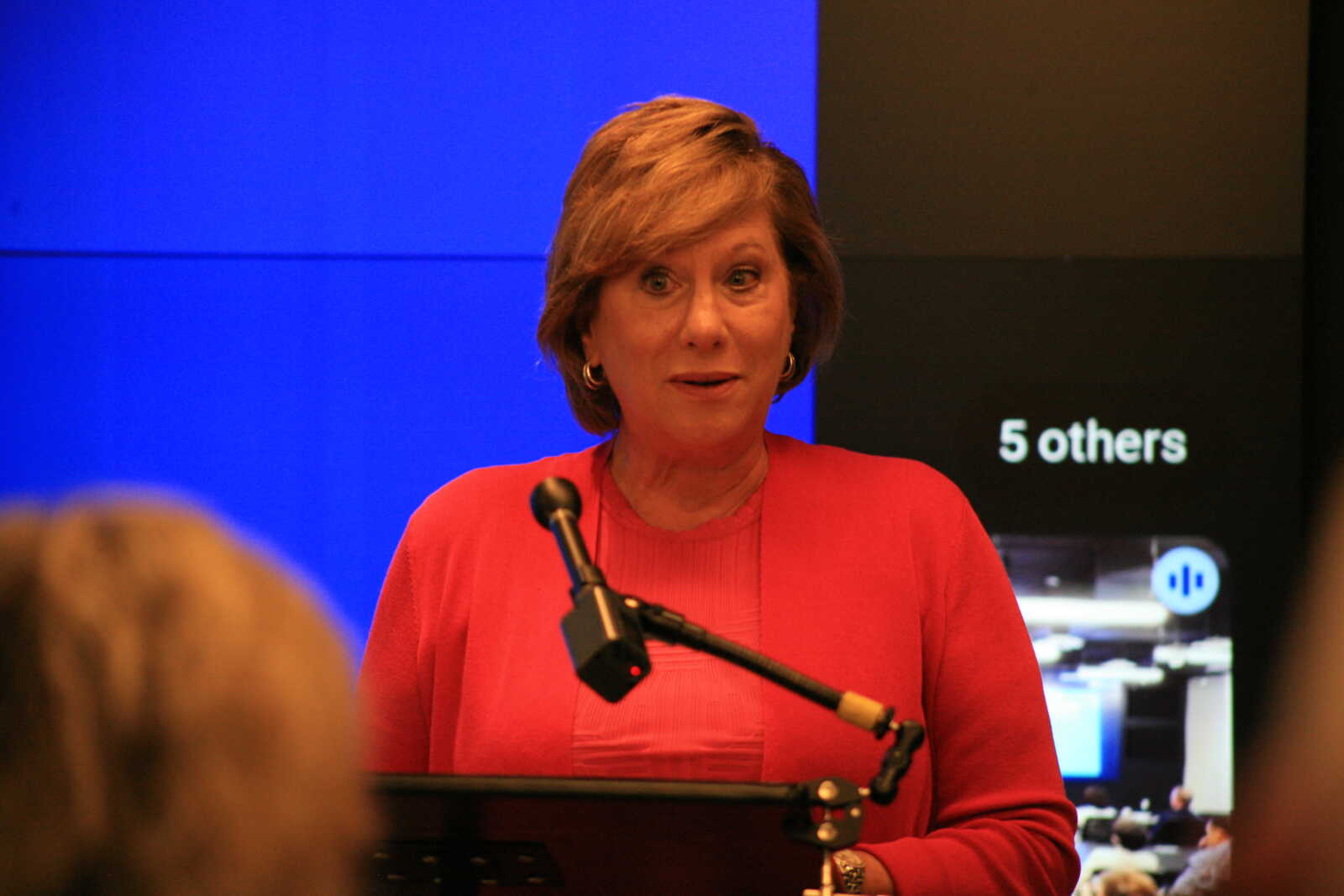
“It’s time to rebrand Northern Virginia as a destination of choice for future-focused innovative businesses,” NVC President and CEO Julie Coons said. “‘Wait and see’ is not an option… We must act boldly.”
The roadmap echoes comments made by the Fairfax County Board of Supervisors Council for Economic Opportunity last month. Like many in the Board of Supervisors meeting, the NVC and Accenture leaders were bullish on the future of “artificial intelligence” as part of that reinvention.
The roadmap calls for the region to “cultivate industries with high-growth potential and global demand,” particularly in AI, quantum computing, space, semiconductors, biotech and robotics.
According to the report:
Consider the potential impact of AI, for example. AI is projected to contribute at least $3.8 trillion to the U.S. economy by 2038, based solely on productivity gains. If Virginia captures just 2 percent of this, it could generate $90 to $150 billion in economic value.
David Metnick, managing director at Accenture, said the proximity of several universities, like George Mason University in Fairfax and the Virginia Tech campus in Alexandria, could help boost Northern Virginia’s ability to deliver in developing sectors.
“A lot of universities empower the region already,” Metnick said. “We have to move quickly to get private and public sector stake into those spaces to drive that forward.”
Headquartered in Ireland with a Northern Virginia office in Arlington, Accenture provides a variety of technology, business and financial services — including support for generative AI, which its website calls “the number one driver of business reinvention.”
While AI is a burgeoning market, it’s also a controversial one. Last week, X’s Grok AI chatbot spouted a series of antisemitic remarks and described itself as MechaHitler. Dozens of lawsuits alleging copyright violations by AI companies have also been working their way through the court system.
Even as the NOVA Roadmap calls for assistance in preparing a workforce with skills to succeed in a new economy, AI has been linked with layoffs. Matt Kull, chief information and digital officer at Inova Health System, said at the Council for Economic Opportunity’s June 3 meeting that AI could replace up to 40% of the work currently being done in hospitals.
Inova later clarified that the change won’t result in a decrease in the workforce.
“[The] potential 40% reduction was not related to a reduction in staffing, but rather to reducing the administrative burden of non-clinical tasks such as charting, note-taking and documentation, so our care teams can focus more fully on what matters most: our patients,” an Inova representative said. “By streamlining workflows and improving efficiency, AI will allow clinicians to spend more meaningful, face-to-face time with the people they care for. AI in healthcare is designed to enhance, augment, and support providers – not replace them.”
“We’re certainly aware of the potential for a shift in the labor force,” Coons said. “We’ll see a heavy focus on retraining, upscaling, and cross-skill-scaling our workforce to be able to thrive in this new environment. This report does reflect a desire to keep our knowledged workers here.”
The AI boom has also raised environmental issues as well, putting a significant strain on the national electric grid and water supplies.
The report says Northern Virginia needs to modernize its digital infrastructure to handle the demand.
To sustain its leadership position in the AI economic boom, Northern Virginia must strengthen the power grid, scale renewables and battery storage, and adopt on-site small modular reactors (SMRs). All are fundamental to modernizing the digital infrastructure. Failure to do so will constrain the region’s ability to create and leverage the economy of the future.
“Northern Virginia is certainly leading the way on rethinking and deploying energy to the data centers in a sustainable way,” Metnick said. “Leading the green economy and reinventing the use of water and clean energy.”
The report said Northern Virginia should work to emerge as an “AI corridor.”
“The report does highlight that we believe there will be a net positive impact over time,” Metnick said, “that it will create more jobs vs less, and now is our time to lean into what precisely that means.”
Another goal on the roadmap is “attract sustained investment,” which it says should take the form of reforming Virginia’s tax code to be less complex.
To thrive in the new economy, the region must make it easier for businesses of all sizes to do business here. In addition to addressing the complexity and inconsistency of the tax environment, the region must also modernize how government interacts with private enterprises in areas like licensing, procurement, and regulatory compliance. Doing so reduces a significant bottleneck for high-growth firms—particularly startups, scale-ups, and advanced industries—that require fast approvals, flexible contracts, and predictable timelines.
The roadmap encourages simplifying and modernizing the tax administration and streamlining the regulatory and permitting process. The roadmap also encourages more public-private partnership mechanisms.
While not addressed in the report, a press conference attendee asked Coons and Metnick about Virginia’s “right to work” laws that prohibit labor unions from requiring workers to join when they’re hired, making it more difficult for labor unions to thrive.
Coons said while right-to-work advocacy isn’t included in the roadmap, it’s an ongoing priority of NVC:
It is a long-standing position on our part. We are engaged in a coalition to ensure that Virginia’s right to work laws do not end. If I were talking to any legislator, I would tell them ‘now is not the time to rethink our right to work status.’ There are near-state competitors who have similar right to work provisons that, if ours were weakened, it would not be difficult for businesses [currently in Virginia] or new businesses to start there. We continue to think it is terribly important.
Coons said many of the goals should be achieved over the next five years, but work toward that goal needs to start immediately. The full roadmap is available online.
