


Leaders from across the D.C. region voted on Wednesday (Jan. 14) to ask Congress and the Trump administration to bring back predictability when it comes to funding homelessness response services at the local level.
“These programs provide critical support to thousands of our neighbors,” said Christine Hong, who chairs the Homeless Services Planning and Coordinating Committee of the Metropolitan Washington Council of Governments (COG).
Late in 2025, the U.S. Department of Housing and Urban Development (HUD) withdrew guidelines for upcoming “continuum-of-care” funding for services that support those without housing. A federal judge issued a preliminary injunction on Dec. 19 blocking restrictions on the funding while the matter makes its way through the courts.
Despite that short-term victory, local leaders say uncertainty about the future has had a chilling impact on organizations and governments working to support those without housing.
“When that funding is delayed or disrupted, it creates immediate operational risks for providers and immediate stability risk for people who depend on that housing and services,” said Hong, who is chief of housing services for Montgomery County in Maryland.
Disruptions in services “can ripple very quickly,” she said. “Even a short delay creates a real risk. Providers can be forced into emergency situations.”
Members of the COG board of directors voted unanimously to ask congressional leaders and HUD to maintain the expected flow of funding for 2026 as new rules are put in place for the future.
There was no opposition to the resolution voiced by any COG members.
“Protecting the funds is critical,” said Andrea Bailey, a member of the Prince William Board of County Supervisors.
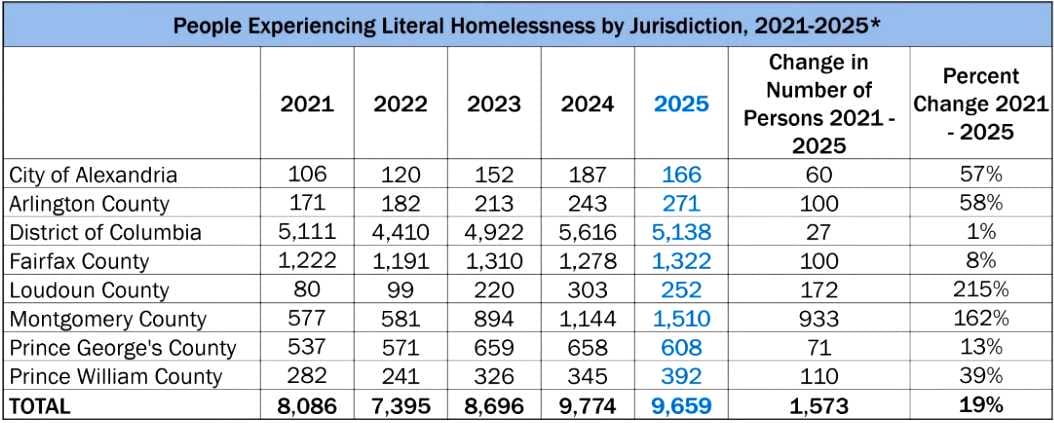
COG’s 2025 point-in-time survey of homelessness, conducted last January, found nearly 9,700 individuals living in shelters or the streets across the Washington region. Though down slightly from 2024, the 2025 figure was up 19% regionally since 2021.
In Fairfax County, the total count of 1,322 in January 2025 was up from 1,278 in 2024 and has risen 8% since 2021.
Those numbers are simply a one-time snapshot, Hong said, noting that local governments and safety-net agencies “service tens of thousands over the course of the year.”
The 2026 point-in-time count will be conducted later this month. Results will be announced in the spring.
In fiscal year 2024, the region received $77.4 million in continuum-of-care funding from the federal government. Fairfax County’s share was $12.4 million.
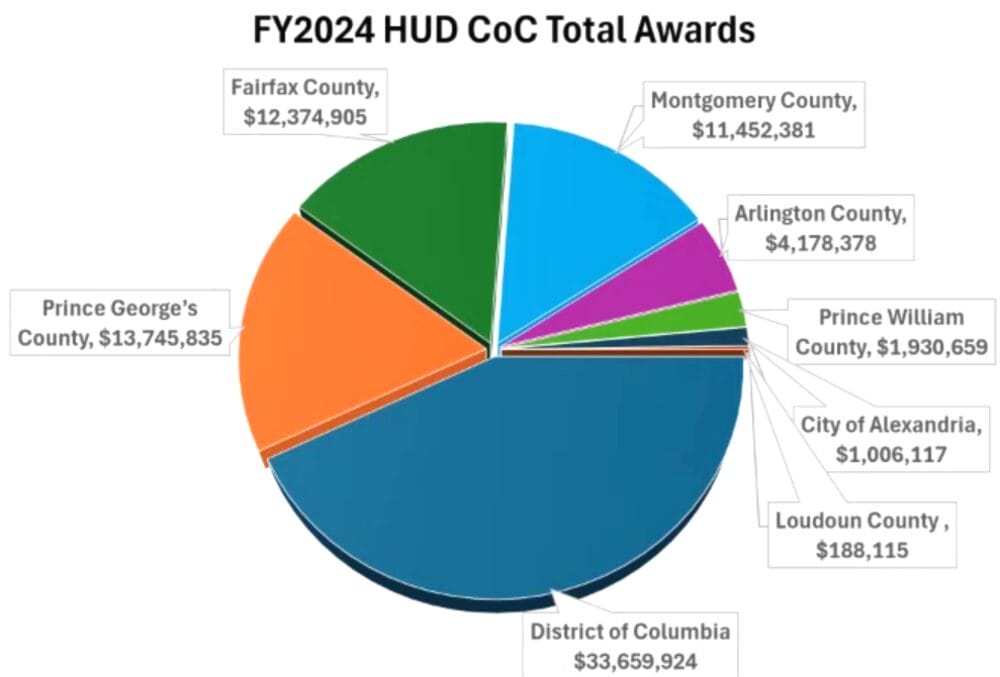
While not all that funding is at risk this fiscal year, any cuts will be felt, Hong said.
The harm “will be very real,” she said of funding reductions. “It risks retraumatizing all the people we’ve worked so hard to house.”
Director David Snyder — representing the Falls Church City Council — said homelessness services are just one area where the Trump administration has moved to cut funding needed by localities. He pointed to issues like emergency management, transportation, the environment, “and on and on.”
“Do we have a good inventory of the slashing that’s being done and the impacts on local governments?” Snyder asked COG staff.
“We do what we can,” the organization’s executive director, Clark Mercer, replied.
But it’s not easy, he said.
“Every week there is something new,” he said of government cuts. “We are doing our best. It’s on our radar screen that we need to do a deeper dive.”
Takis Karantonis, a member of the Arlington County Board, said it would be a mistake to think chaos created by the Trump administration related to funding is inadvertent.
“This is not a dysfunction. There is a purpose attached,” Karantonis said. “They’re maximizing the pain.”
Like Snyder, Karantonis said regional leaders needed to remain vigilant for cuts in other federal services.
“I don’t believe this is the last time we’ll have to deal with this,” he said.
