

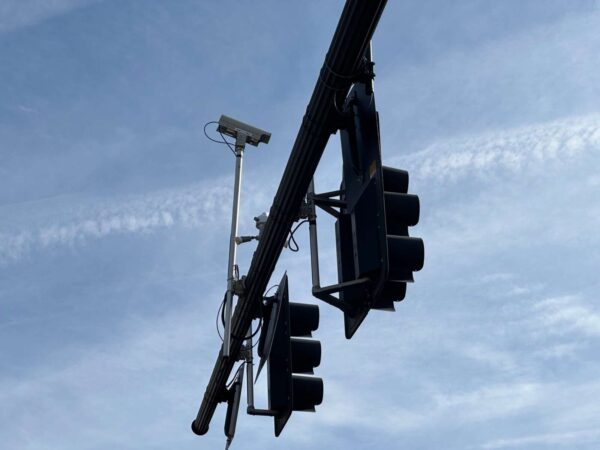
Two bills that would have dramatically changed local governments’ ability to enforce traffic laws have changed course despite bipartisan support in Richmond.
S.B. 297 and S.B. 306, authored by state Sen. Mark J. Peake (R-8), would have repealed the authority of localities to install speed-monitoring and red light cameras, respectively. But as of Monday (Feb. 2), the possibility of a ban has been stripped from both bills.
Substitute bills introduced by Peake on Monday instead cap the fees that third-party camera vendors can impose, limiting them to collecting only the civil penalty for the traffic infraction.
“We’re going to prevent them from charging any extra administrative fees to people who are charged with the violations, other than whatever the applicable court costs would be,” Peake, who represents Lynchburg and parts of south central Virginia, said Monday.
State Sen. Jennifer Boysko (D-38), who represents Herndon, Great Falls and McLean, was one of two Democrats to support the bills during a Senate Transportation Committee hearing on Jan. 22, voting to report both pieces of legislation to the full Senate.
Boysko didn’t explain her support of the repeals during the meeting, and a request for comment sent to her Senate office went unanswered.
Colleagues Dave Marsden (D-35) and Stella Pekarsky (D-36), who respectively represent the Annandale and Centreville areas of Fairfax County, both voted against advancing the bills.
During that committee meeting, Peake acknowledged that S.B. 297 didn’t have much support among lawmakers, but he introduced the legislation anyway to “to get [camera companies’] attention.”
Peake also expressed frustration with the idea of a third party taking its cut for maintaining any cameras, when instead that money would be better served staying inside Virginia, he argued.
“Allowing a locality to bring these cameras in, split the money with some out-of-state entity and then send it to some fund and use it for their general fund — there’s no responsibility for that tax, there’s no accountability for that tax,” Peake said.
Both bills have since been re-referred to the Senate Finance and Appropriations Committee, where they will need to be re-reported to the full Senate before passage.
Virginia has let localities use photo-monitoring or “red light” cameras to capture traffic violations at intersections since 2007. The General Assembly opened the door for speed cameras in 2020 but limited them to school and construction work zones.
Fairfax County has embraced the use of technology to enforce traffic laws, establishing a speed camera pilot program in 2023 that Fairfax County Police chief Kevin Davis called an attempt to “change driving behaviors.”
Expanding from eight initial locations, the county currently has active speed cameras in 20 different school zones and along Fairfax County Parkway, where construction continues on a widening project. Twenty more schools have been identified for future expansions of the program, according to the county’s website, with plans for another 30 cameras in fiscal year 2027.
“This program, in coordination with the Police Department and Fairfax County Public Schools, is a critical tool to deter dangerous behavior and ultimately save lives,” Board of Supervisors Chairman Jeff McKay said in 2023. “As you drive in our neighborhoods and school zones, the message is clear — please take a moment to slow down.”
Other local jurisdictions have also welcomed cameras for enforcement purposes. Fairfax City has a photo enforcement program with speed cameras and 10 red-light cameras, while Herndon officials are weighing whether to add red light cameras to the police department’s repertoire.
