


The Fairfax City Council recently approved an updated waste management plan that it says is needed due to projections that landfills across Virginia may reach capacity in less than 20 years, a rising population, and soaring costs for disposing of municipal waste.
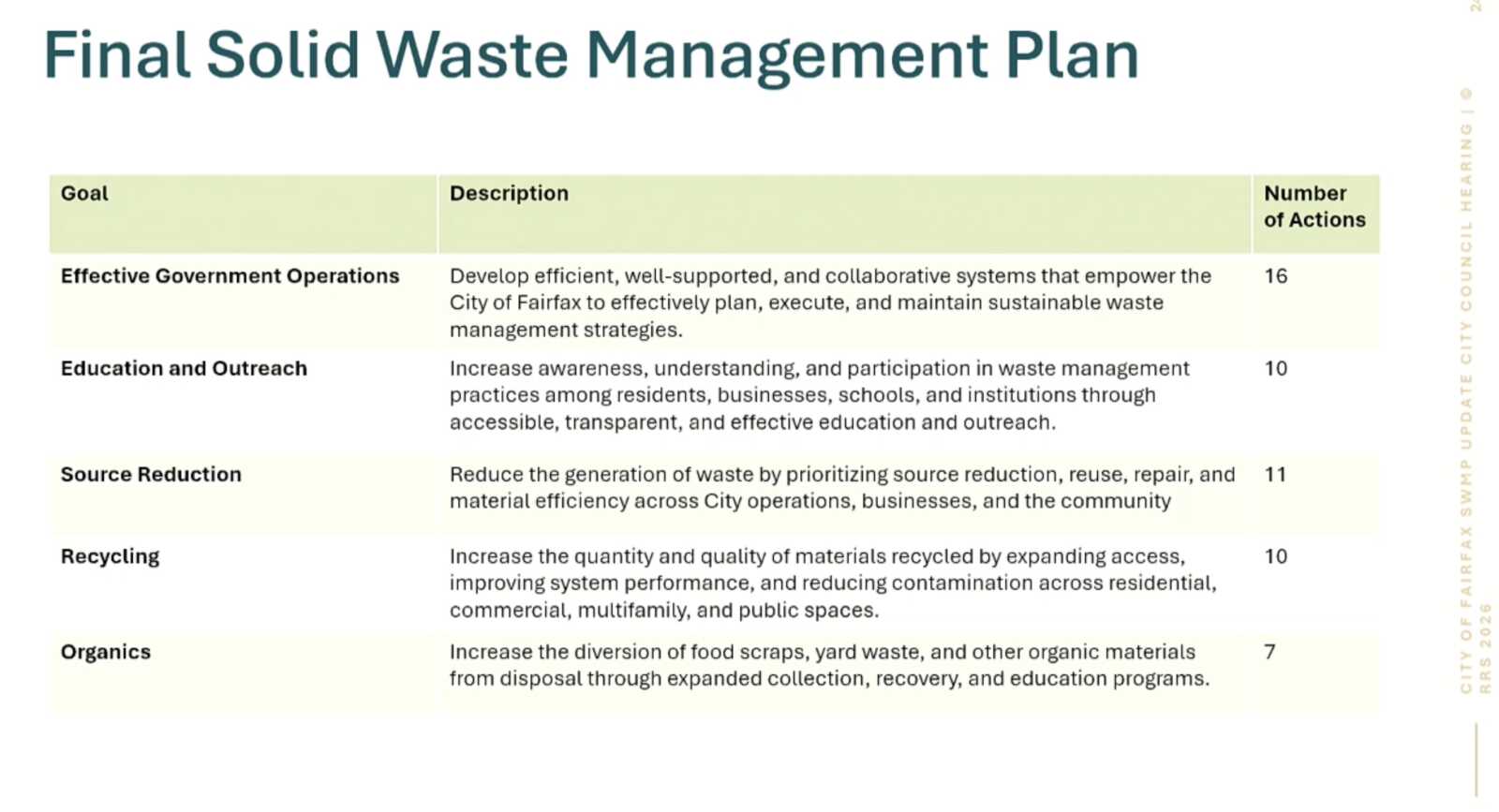
Council members unanimously voted May 12 to accept the 87-page plan with 54 actions planned across two decades. The plan emphasizes developing effective government systems; education and outreach to city residents; reducing waste overall and emphasizing reuse; increasing the amount and quality of items recycled; and resource recovery for food and yard waste.
“The city’s population is projected to increase from approximately 24,020 in 2020 to nearly 40,000 by 2050,” said Helen Lee, a senior consultant with RRS, a company that helped develop the plan. “More people means more waste generated, which makes it imperative that our waste management, infrastructure and programs scale accordingly.”
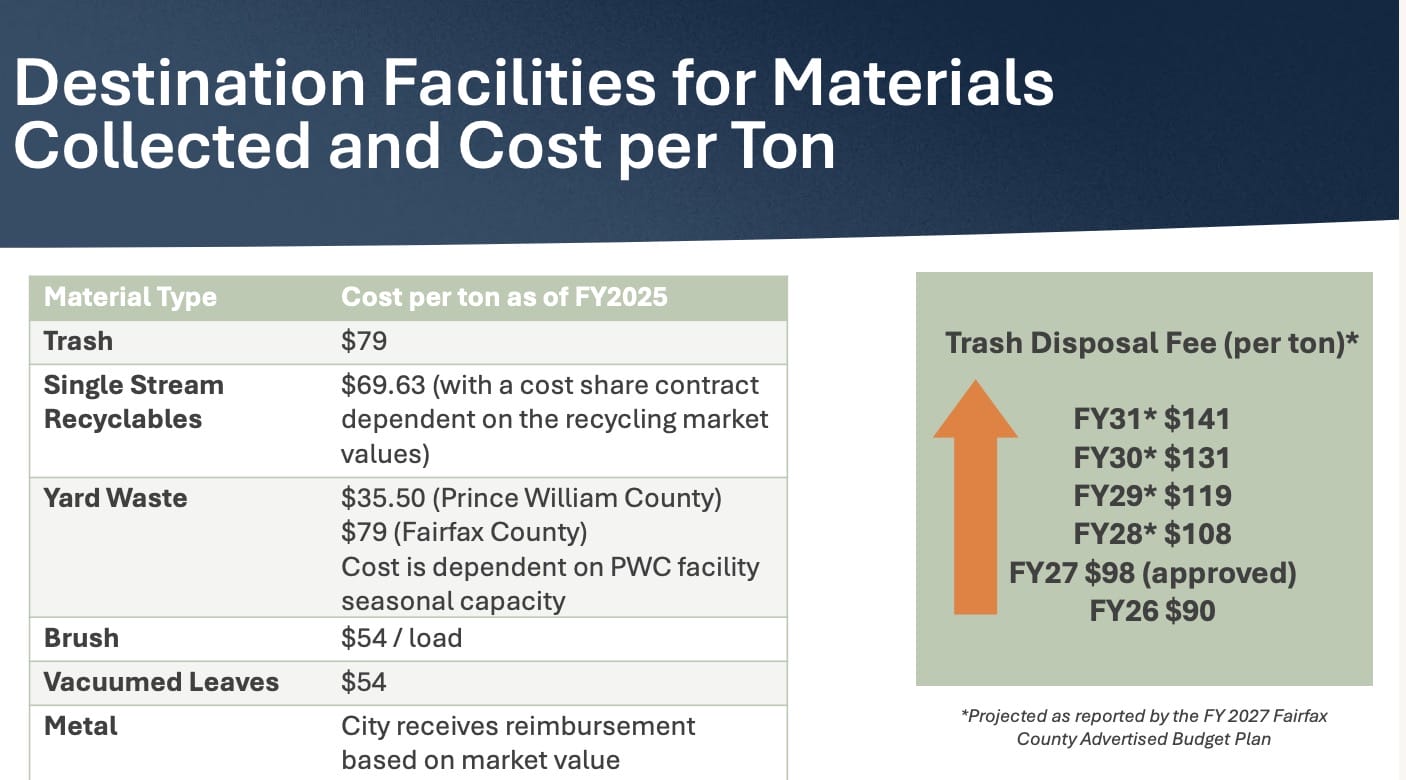
State law requires that cities, towns, and counties update their waste management plans every five years. But in their presentation, staff noted that economic factors created a need for the city to act: municipal solid waste costs have increased 73% since 2007 — from $52 per ton to $90 per ton in fiscal year 2026.
That kind of financial pressure makes the update “not just an environmental imperative, but a fiscal one,” said Lee.
Some of the shorter-term initiatives the city will undertake include working with businesses to reduce their waste and create “take-back programs” for recycling and reuse; applying for grant funding to help fund waste reduction projects; as well as piloting a reusable bag donation program at farmers’ markets, grocery stores, and the library.
Longer-term initiatives could include helping schools and public buildings implement waste reduction programs; establishing sustainability volunteer programs; and creating an enforcement system for residential curbside recycling, such as “Oops” tags put on carts with improperly recycled items.
Council members asked about the plan for plastics, increasing composting — potentially in city schools — and potentially offering glass recycling once or twice a month.
Staff replied that the plan addresses plastic by evaluating market conditions for recycling.
“As far as the residential assessment, we’re looking at glass, construction and demolition debris, and yard waste,” they said.
Staff will return in June to discuss a timeline for composting.
“We’ll be looking at options like curbside composting, adding additional composting centers, etcetera,” said Stephanie Kupka, the city’s sustainability program manager. “So, that’s something we’ll be looking into, and we have funding to do so.”
“The businesses in the city obviously pay for commercial trash pickup,” said Mayor Catherine Read. “But I’ve had restaurants ask me about glass recycling, because they go through so much broken barware and wine bottles and just so much glass gets dumped and carried away, which is not something that really our solid waste management program addresses, because it’s a contract between commercial businesses and the commercial carrier.”
She asked if businesses could be incorporated into a city-run glass recycling program.
Staff replied that the city is looking into a residential and commercial recycling assessment that would address some of those challenges, and that some recycling facilities in the region are starting to consider allowing glass back into blue recycling bins.
After approving the plan, the City Council voted on several unrelated items, including unanimously approving $11 million in revenue bonds to finance maintenance related to the city’s sewer system, including paying for its portion of capital improvement costs at Fairfax County’s Noman M. Cole, Jr. Water Recycling Facility in Lorton.
A short-term rehabilitation project for the facility is currently on track to wrap up in March 2027, providing safety and operational upgrades for the next 15 years, according to the Fairfax County Department of Public Works and Environmental Services.
At the May 12 meeting, the city council also discussed the possibility of raising members’ and the mayor’s pay and allowing more accessory dwelling units in the city.
