

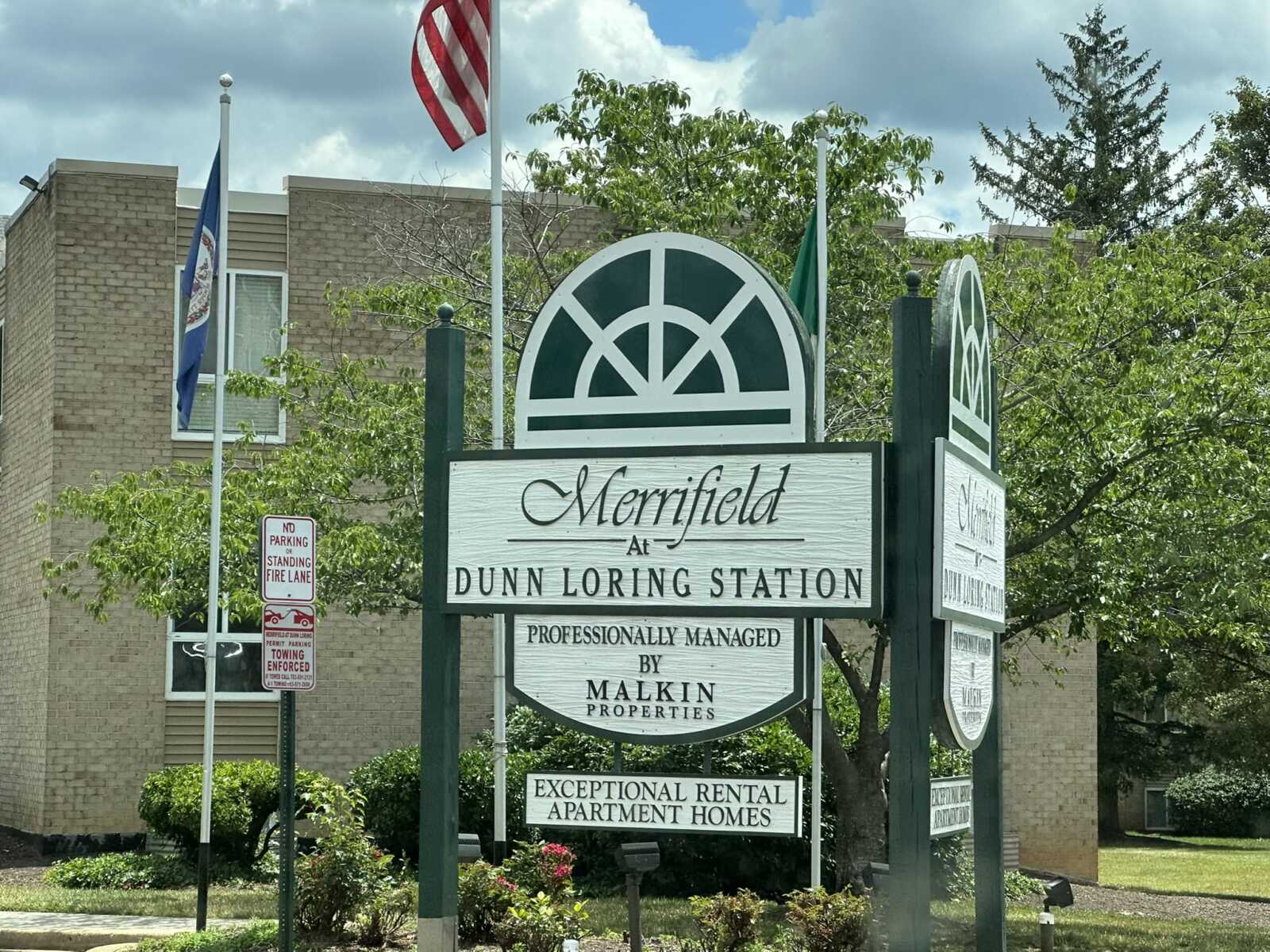
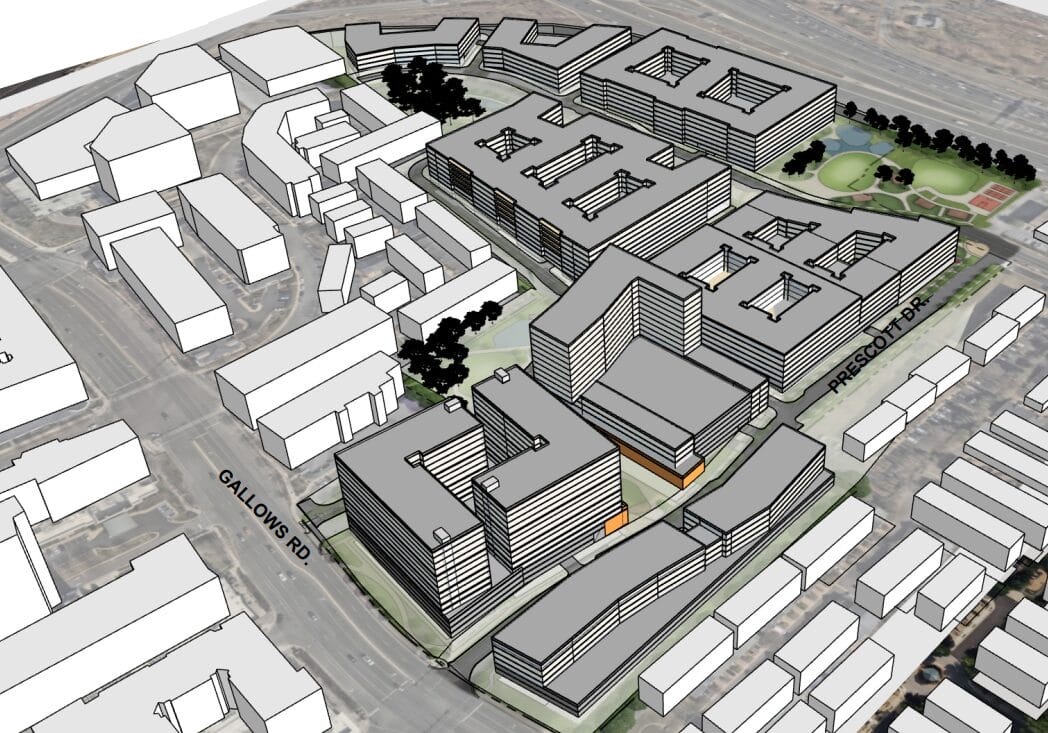
The owner of the Merrifield at Dunn Loring Station Apartments is seeking to transform the 1960s-era residential neighborhood into a mixed-use development befitting its proximity to Metro.
Malkin Properties’ proposed redevelopment would replace the 706 existing garden-style apartments at 8130 Prescott Drive with up to 2,975 multifamily units — a more than fourfold increase — complemented by 25,000 square feet of “neighborhood serving” retail, according to a rezoning application submitted on Monday (June 1) to Fairfax County.
“The redevelopment will provide additional housing opportunities within the Merrifield Suburban Center while incorporating appropriate transitions to ensure compatibility with surrounding uses,” Antonio Calabrese, a real estate attorney and partner at DLA Piper, said in a statement of justification for the application.
The 3-million-square-foot development has grown in intensity since Malkin first proposed overhauling the 34.7-acre property in 2022 as part of the county’s biennial site-specific plan amendment (SSPA) process.
In its nomination, the property owner put forward a concept for 1.5 million square feet of mixed-use development, including 2,300 residential units and up to 700,000 square feet of nonresidential uses. The plan showed a mix of mid-rise and high-rise multifamily residential buildings, stacked townhouses and a five-story building that could be turned into housing, office or a hotel.
Though some area residents questioned the scale of that proposal, the Fairfax County Board of Supervisors accepted the nomination and authorized staff on April 11, 2023 to review a potential comprehensive plan amendment to allow mixed-use residential development. A draft hasn’t been released yet, but the county has scheduled a virtual community meeting on the amendment for June 25.
The SSPA will now be evaluated in conjunction with the newly filed rezoning application, which seeks to shift the property from a purely residential zoning district to the Planned Residential Mixed-Use (PRM) District.
According to the application, the Merrifield at Dunn Loring Station Apartments currently consist of more than 50 individual buildings that were constructed in 1968. Malkin intends to replace them “in multiple phases over a market-dependent period,” allowing unaffected homes and amenities to remain during construction.
“The Applicant will work collaboratively with existing residents to provide clear notice of phasing and construction activities and to coordinate preferred relocation plans, including on- and off-site residential options,” Calabrese wrote. “In addition, the Applicant will continue outreach and coordination with surrounding communities and neighboring properties throughout the redevelopment process.”
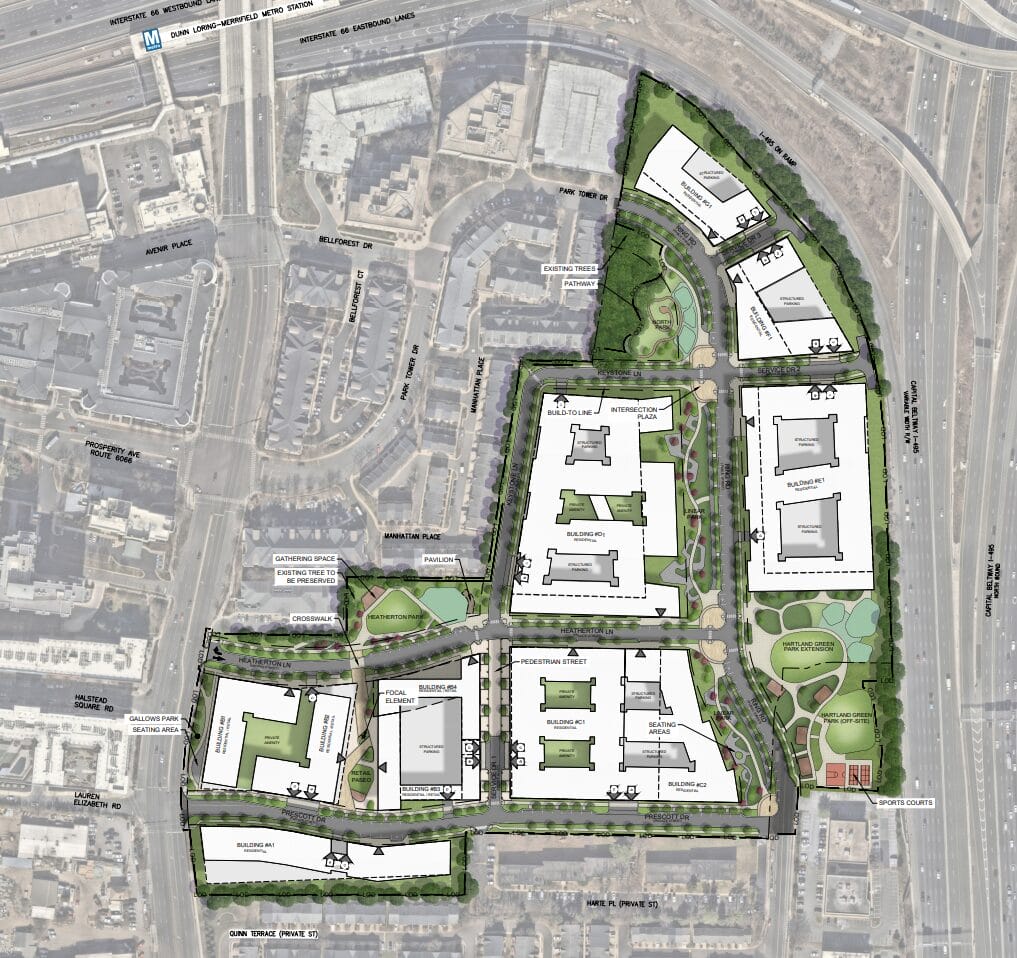
To replace the existing homes, Malkin has proposed seven different blocks of multifamily residential development, with individual buildings ranging in height from 55 feet or five stories to 150 feet or 13 stories. The retail space would be concentrated in four buildings in Block B, located on the west end of the site along Gallows Road.
Block B would feature a linear park along Gallows Road with an open lawn, outdoor seating and concrete pathways, along with a paseo or promenade with benches, planters and a gathering space to lead pedestrians toward the ground-floor retail.
“The retail aspect of the property is not meant to compete with the Mosaic District or the retail around the Metro Station,” the application says. “It is intended to be an amenity and/or convenience, not a destination, and the space will accommodate everyday use as well as informal events and community interactions.”
Totaling 7.8 acres, the other proposed urban park spaces include a Heatherton Park north of Block B, a North Park with a cycle track near the Westbriar Plaza Condominiums, a linear park on the west side of a new Ring Road connecting Hartland Road to Park Tower Drive, and a 1.3-acre expansion of the Fairfax County Park Authority’s planned Hartland Green Park.
A master plan approved for the park back in 2012 called for “small-scale recreational elements,” including a basketball half-court, a playground, a rain garden and an open lawn with “skateable” art, on the roughly 1-acre parcel at the curve of Hartland Road just west of the Capital Beltway (I-495).
The expansion will turn Hartland Green Park into a “new and important pedestrian and bike accessible community amenity,” the application says, envisioning a variety of amenities, including multi-use lawns, sport courts, walking paths and seating areas.
The Ring Road would be the development’s primary contribution to Merrifield’s transportation network, providing a north-south connection with two 11-foot-wide travel lanes — one in each direction — as well as on-street parking and landscaping panels separating the road from 6-foot-wide sidewalks and a 10-foot cycle track on the west side.
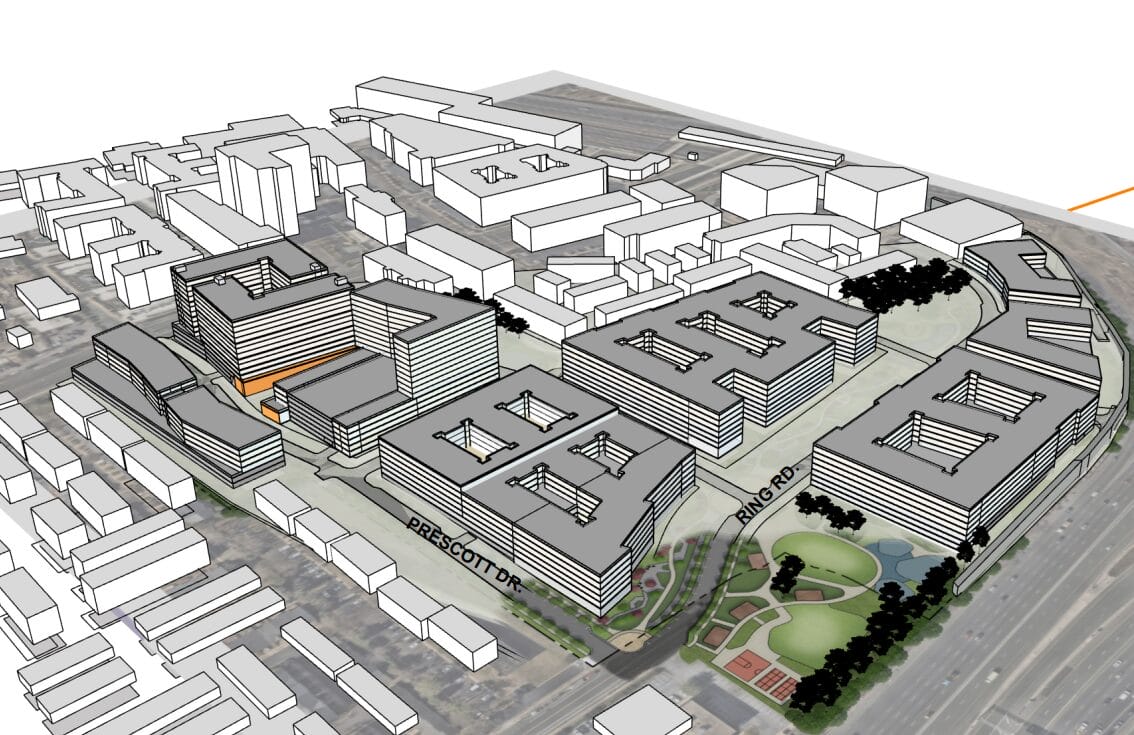
The new public road “will improve internal circulation, disperse vehicular traffic, and strengthen pedestrian and bicycle linkages to surrounding neighborhoods and the Metro Station,” Calabrese wrote, though the homeowners’ association president for the nearby Vienna Crossing townhomes had expressed concern during hearings on the SSPA nomination in 2023 that the road would send more traffic into his neighborhood.
Other proposed transportation changes include a realignment of Prescott Drive with Lauren Elizabeth Lane, additional sidewalks, and the inclusion of rideshare pick-up and drop-off areas on “key east-west streets” like Prescott and Heatherton Lane.
In the application, Calabrese noted that the redevelopment would be consistent with Fairfax County’s plans for the future of the Merrifield Suburban Center, where residential projects are also being considered to replace the nearby Prosperity Business Campus and the Alliance Center commercial condominiums to the south near the Mosaic District.
Near the end of last year, construction started on Elms Dunn Loring, an apartment building with retail at 2722 Merrilee Drive that was approved by the county board back in 2020.
“Overall, the Merrifield Suburban Center continues to transition from a conventional suburban development pattern,” Calabrese wrote, “to a more urban, mixed-use environment that supports a broader mix of housing types, increased residential density, enhanced walkability, and a stronger relationship to regional transit infrastructure, while maintaining appropriate transitions to adjacent lower-density residential areas.”
