


Like the county government, Fairfax County Public Schools is preparing for a challenging financial year ahead — one that could require further reductions to staffing and other cuts.
With spending commitments for fiscal year 2028 outweighing anticipated revenue, the school board and superintendent will need to identify cost savings and potential reductions, according to FCPS Chief Financial Officer Leigh Burden.
“We are expecting that the county transfer and state funding increased revenue will be less than what it costs us for our collective bargaining agreement, healthcare, retirement, contractual, multi-year investments, and the Special Education Extended Day,” Burden told the school board’s budget committee on Sept. 8, citing advice from the county’s Board of Supervisors.
That’s because Fairfax County — whose public school division is the ninth largest in the country — is experiencing continued economic pressures following years of cuts. Additionally, health care costs are soaring nationally, and FCPS expects it will be no exception to that trend.
“Early indications suggest that fiscal ’28 will be a difficult budget year, and the county has suggested as much, of course, in their budget guidance,” said Burden. “If you add inflationary pressures, instability in Washington, energy demands, and it being the second year of the state biennium [budget], where we always get less funding than in the first year, you have a recipe for insufficient revenue in the face of rising costs.”
While FCPS prides itself on exceeding the Virginia Department of Education’s Standards of Quality, which set requirements around operational concerns such as class sizes, it may need to reduce to state levels in some areas, she added.
According to Burden’s presentation, FCPS averaged approximately $135 million in reduced or avoided costs over fiscal years 2026 and 2027, which began on July 1 of this year.
Officials expect the level of cuts needed for FY 2028 will be closer to the $153.9 million slashed in FY 2026 — when less-than-requested funding from the county government necessitated a renegotiation of pay raises for unionized employees — than the $117.6 million cut for this fiscal year.
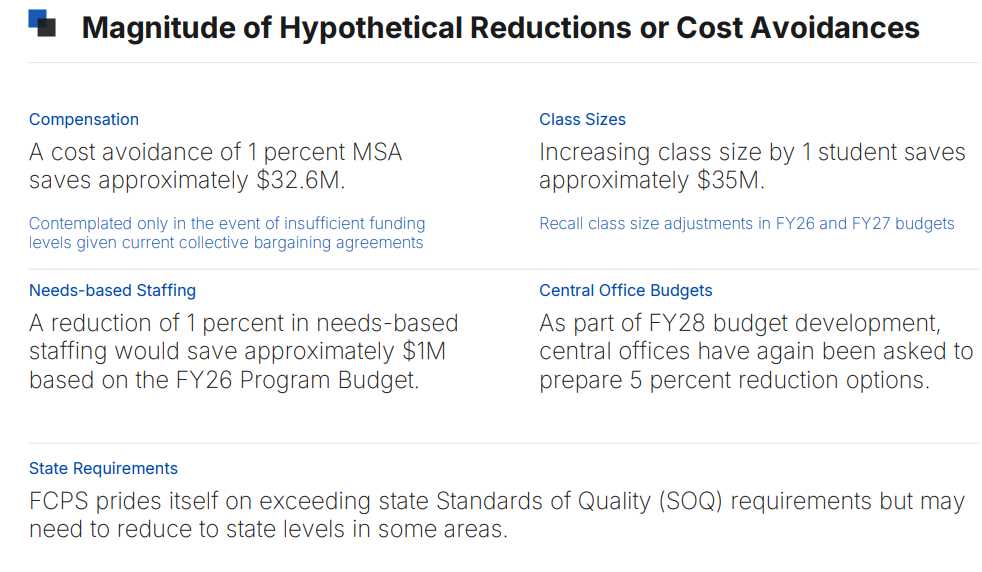
Hypothetical reductions could affect staff compensation, needs-based staffing, class sizes, and central office budgets, though Burden stressed that the slide was intended to show the magnitude of potential budget cuts, not to present them as a recommendation.
“Nobody wants to do any of these things, but there will have to be things that are considered,” Burden added. “Increasing class size by one student saves approximately $35 million. And again, as part of the fiscal ’28 budget development, we have already asked central office to prepare 5% reduction options.”
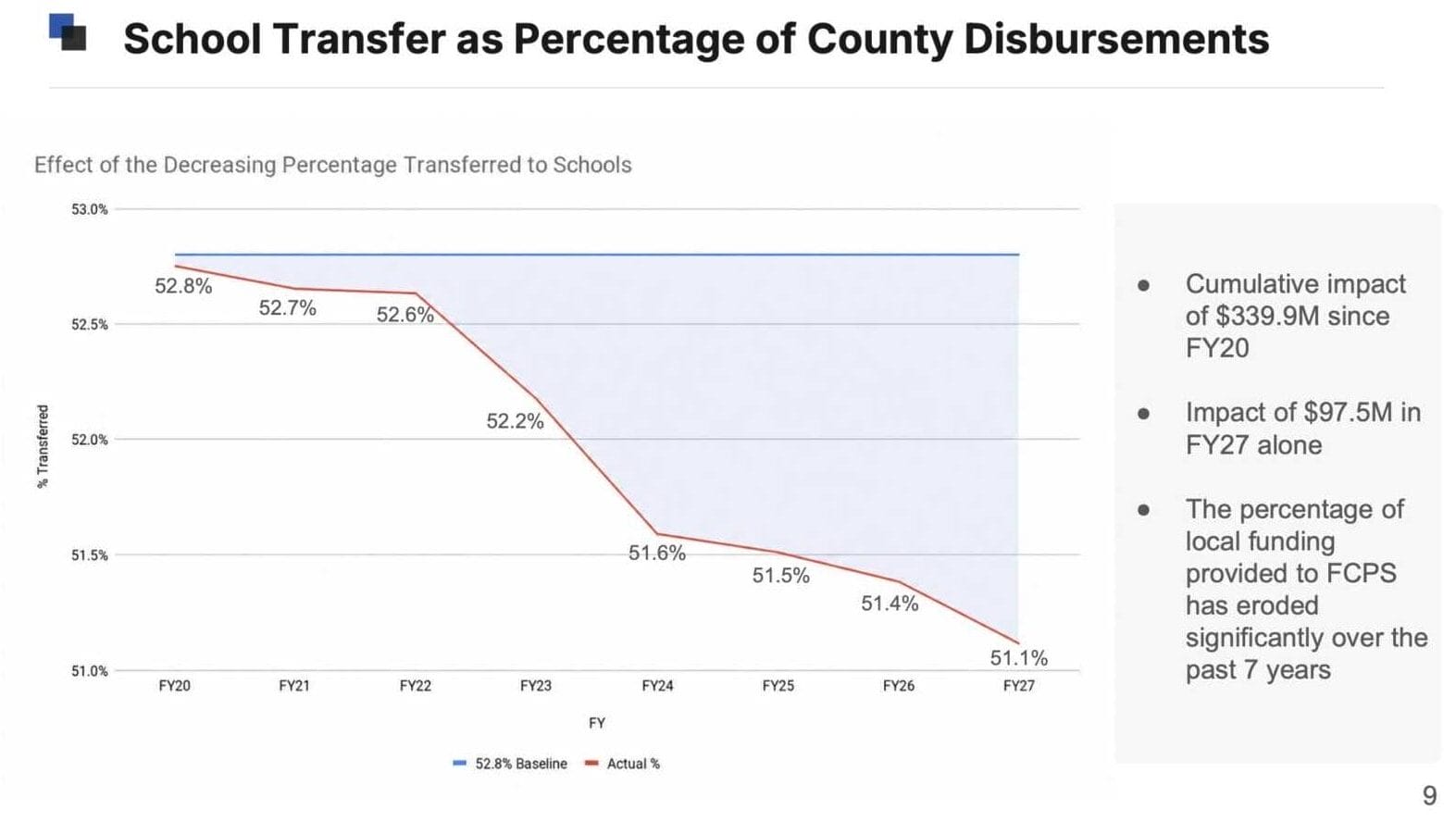
FCPS has experienced challenges in recent years in part because the county has made small decreases in the percentage of funds it disburses to the school system: from 52.8% in fiscal year 2020 to 51.1% in fiscal year 2027.
While a 0.7 percentage-point drop seems small, that represents “an erosion of nearly $340 million, with a nearly 100 million in fiscal 27 alone,” Burden said.
While that doesn’t necessarily mean FCPS is receiving a smaller budget each year, its share represents less of the county’s overall revenue, while the county’s share has gotten larger.
When the percentage changes every year, that makes it difficult for the superintendent to plan, one school board member noted.
Among other impacts, the shift in county funding for FCPS has put the future of Middle School After School programs in limbo.
“Last year, the Middle School After-School programs [were] cut from their side of the house and put into our transfer, dropping our total transfer amount asked for,” Hunter Mill District Representative Melanie Meren said.
Supervisors and school board members have been locked in a back-and-forth over the county’s desire to recoup the $3.9 million it previously spent on the Middle School After School program. Originally started as a gang-prevention initiative, the program had more than 23,000 middle-schoolers enrolled during the 2025-2026 school year.
Springfield District Representative Sandy Anderson has proposed a compromise where, instead of introducing a participation fee, FCPS could seek voluntary donations and public-private partnerships to cover some of the program’s $11 million annual operating costs, FFXnow previously reported.
A couple board members said working more collaboratively with the county supervisors, who ultimately make the decision on how much to fund FCPS, would be key.
Some members also expressed concerns about the idea of cutting needs-based staffing — or the possibility of not honoring the collective bargaining agreement agreed to in December 2024.
“When we bargained a three-year agreement, we didn’t anticipate the percentage of revenue going down over the third year … Right now, given the current 51.1%, that, I think, puts our ability to meet that CBA requirement in a bit of jeopardy at this point,” Superintendent Michelle Reid said.
Reid will deliver a fiscal forecast in November and propose a budget in January. The school board will then vote to adopt Reid’s proposal, with or without amendments, in February before County Executive Bryan Hill presents his advertised budget that month to the Board of Supervisors.
The committee meeting was just the start of the budget process, noted Seema Dixit, the school board’s Sully District representative.
“The information here is for the community and all our stakeholders to kind of see where we are at,” Dixit said. “It is not to say somebody is not doing the job and not giving us money. It is simply the fact of the matter where we stand.”
“I’m a small business owner,” she added. “I’m an employer, and in my small company, the rise of healthcare cost is 59% for next year. So, and FCPs can bargain much more than me … as a large division, but it is a real issue. It’s all over the country. You can ask any employer; they’ll tell the same thing.”
