

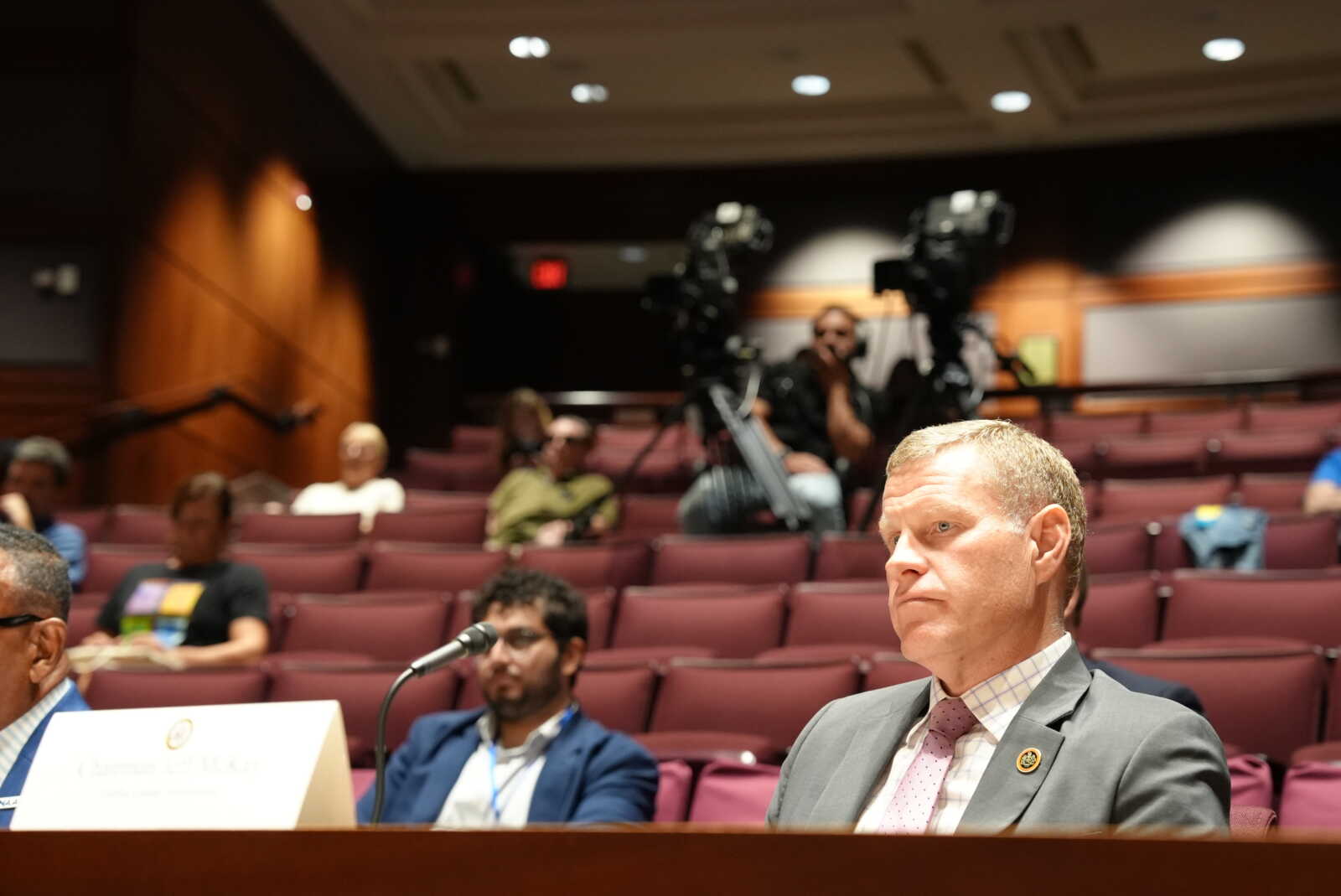
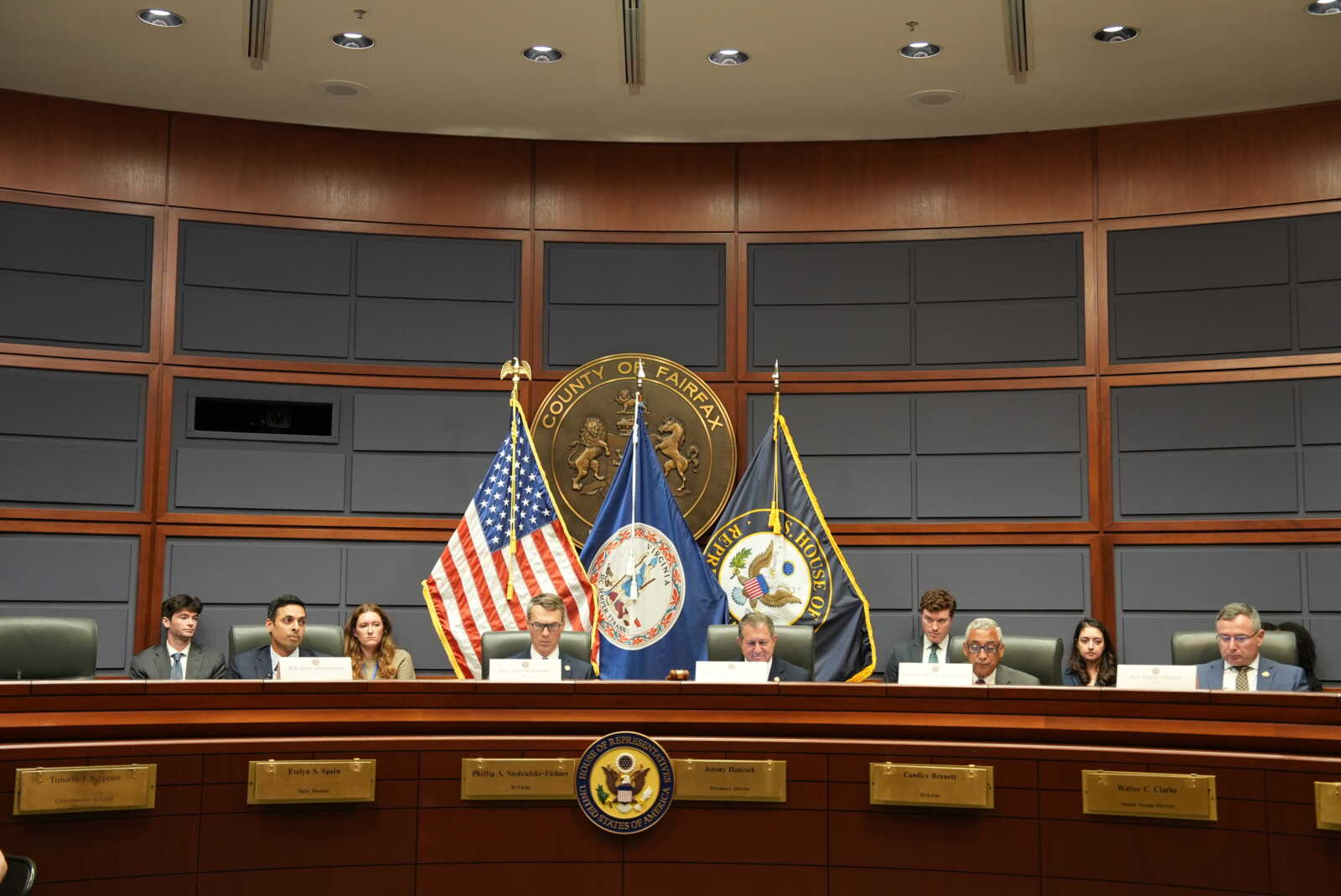
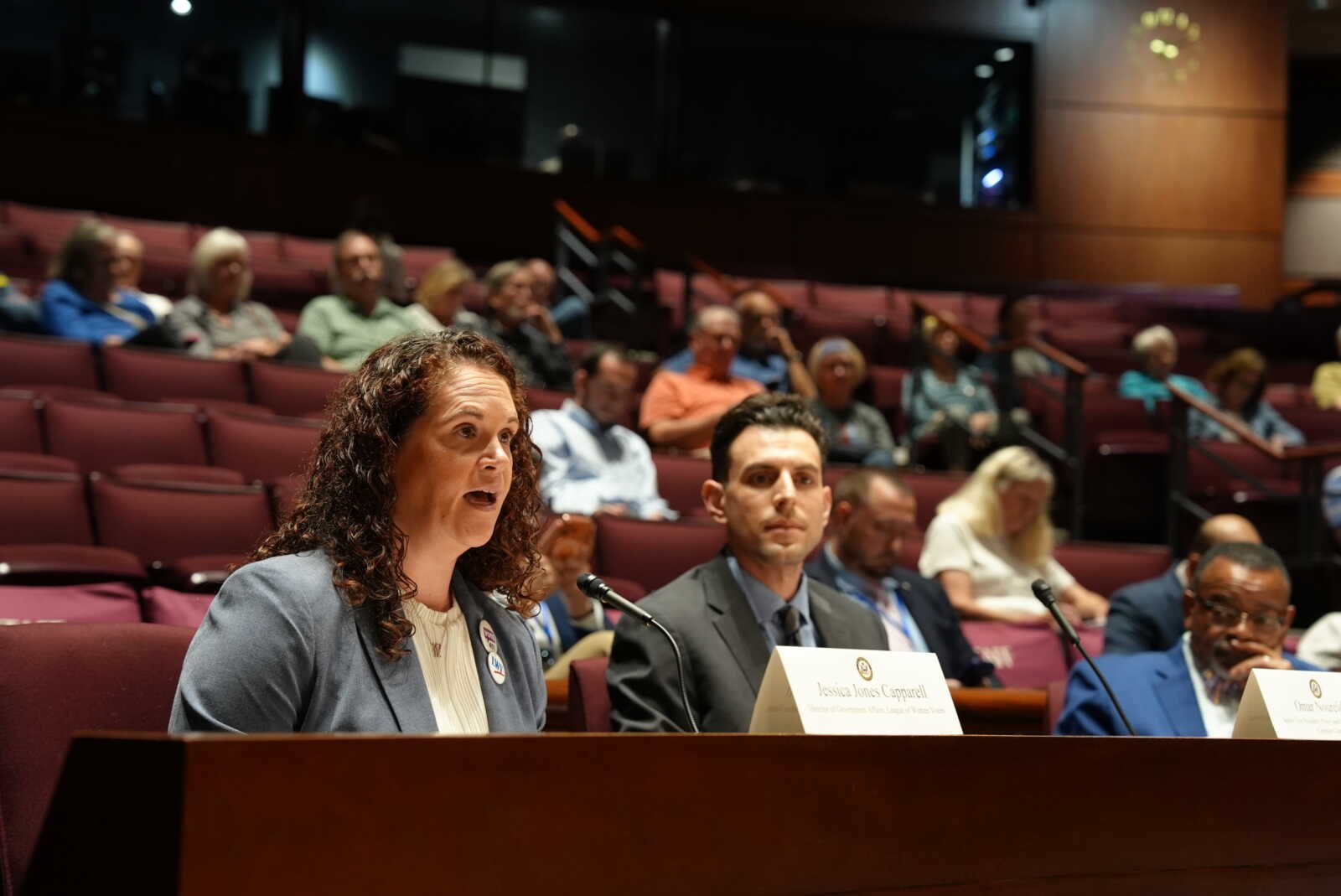
Members of Northern Virginia’s Democratic congressional delegation convened at the Fairfax County Government Center last Thursday (Oct. 1) for a forum to address concerns about the upcoming November elections.
The “shadow hearing” called by House Democrats, who lack the legal power to subpoena or control formal hearings due to the party’s minority status in the chamber, was led by Rep. Joe Morelle (D-New York), a ranking member of the Committee on House Administration, and Fairfax County’s own Rep. James Walkinshaw (D-Va.).
Also attending were fellow Virginia Reps. Jennifer McClellan, Suhas Subramanyam, Bobby Scott and Eugene Vindman.
“We’re about five weeks from Election Day, and across the country, voters are hearing about new documentation requirements, mail-in ballots, about federal agents at polling places, about court decisions that have weakened the Voting Rights Act,” Walkinshaw said.
In advance of the hearing, lawmakers cited a new survey from the Shorenstein Center that suggests the public’s confidence in counting mail-in ballots is low: 63% of respondents said they were concerned about their ballot being counted accurately, and 58% believe there are “some” or “a lot” of people voting by mail who aren’t eligible.
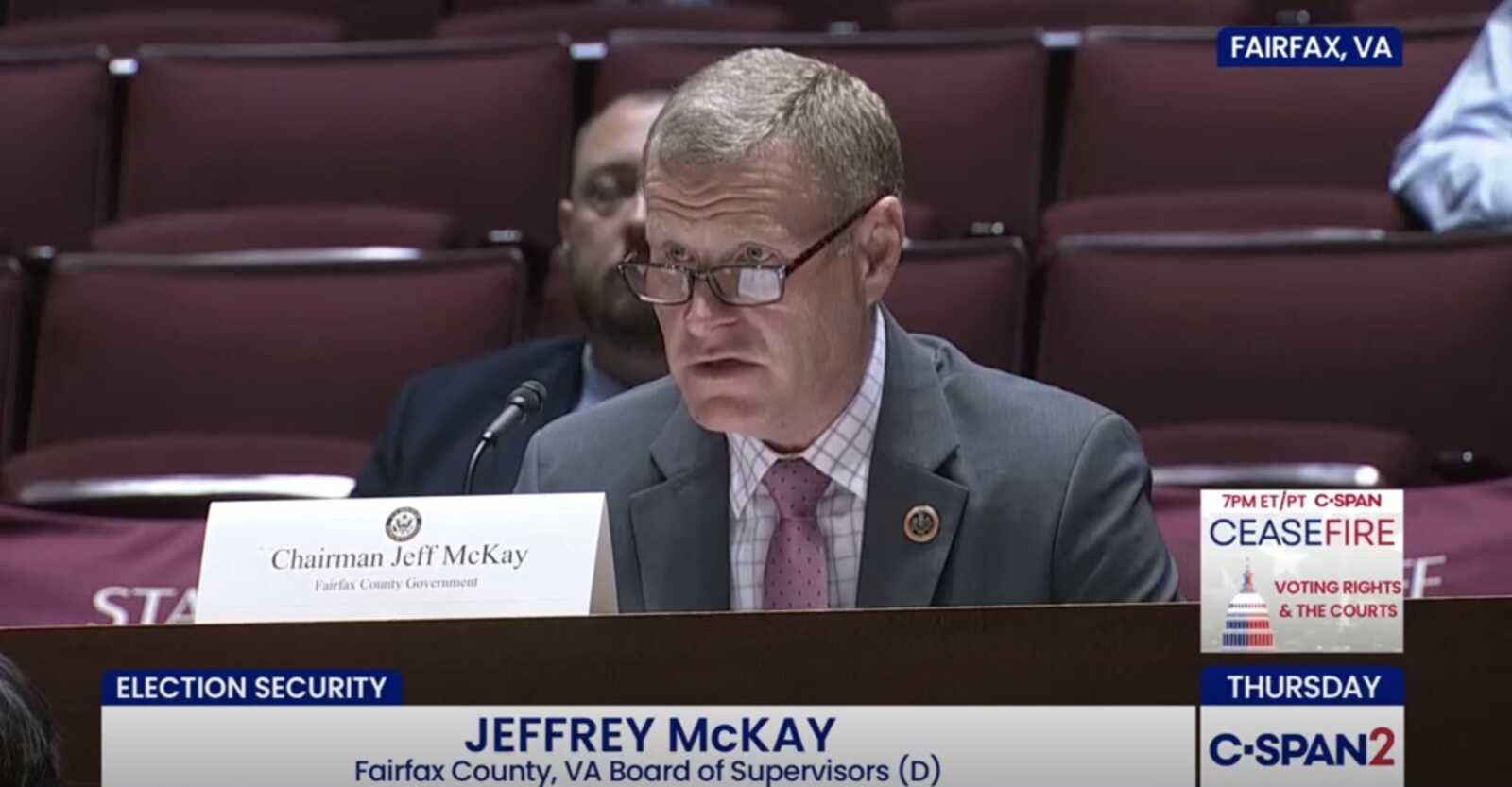
Those were concerns that some of the speakers sought to allay. Fairfax County Board of Supervisors Chairman Jeff McKay said that security “is built in multiple layers of every step of the process.”
Since Fairfax County voters mark ballots by hand, there’s a physical record of every vote, he said. After the polls close, election results are securely transported by election officers and “uploaded to an air-gapped election management system, never connected to the internet.”
“The Office of Elections maintains a strict chain of custody procedures,” McKay said. “Two election officers oversee movements of ballots and election media with transfers documented. Election officers include individuals representing both major political parties, and parity is maintained as feasible under state law. Voting equipment is secured with tamper-proof seals, ballots are securely stored, and access to early voting locations and equipment is strictly controlled.”
“Our experience,” he added, “also shows election security and voter access do not have to come at the expense of one another.”
According to the Virginia Public Access Project, 44,779 people in Fairfax County had already voted early, as of Oct. 4. That’s a sizable upswing from 2022.
Still, only 49% of respondents to a national survey conducted by the University of California San Diego’s School of Social Sciences said they expect the 2026 general elections to be “free and fair.”
Locally, people who have concerns about mail-in ballots can drop theirs off, once complete, in a locked ballot drop box, monitored by 24/7 cameras and staffed during voting hours, in front of the Fairfax County Government Center.
There have been “absolutely no” cases of tampering, McKay said, adding that as part of the carryover budget adopted on Sept. 15, the board approved $45,000 to install 24/7 ballot drop boxes at the Mount Vernon Governmental Center and the North County Government Center in Reston.
The hearing also touched on various political fears around voter suppression.
“I’ve heard a lot of constituents concerned about ICE being at polling locations,” Subramanyam said.
“Currently, there are three separate lawsuits challenging a DHS policy that authorizes armed ICE agents to go to polling places to conduct immigration enforcement operations during the 2026 midterm elections,” replied Skye Perryman, CEO and president of the legal advocacy organization Democracy Forward. “Let me be clear: this violates federal law and threatens our elections.”
While former White House strategist Steve Bannon has suggested ICE “surround the polls” this fall, the White House has downplayed the possibility.
In an interview published on the same day as the hearing, President Trump said he hasn’t “thought of it” when asked whether he would dispatch ICE agents to polling places, though he also declined to rule out declaring a state of emergency via the Insurrection Act in the lead-up to the midterms.
Department of Homeland Security Secretary Markwayne Mullin said in September that ICE agents won’t “patrol” polling places, but could respond to “specific threats.” White House “Border Czar” Tom Homan also said last week that he’s not “aware” of any plans to send ICE, although he added that the prospect was “a question for DHS.”
Still, the UC San Diego survey suggested that large numbers of Americans, regardless of political affiliation, expect ICE to be at the polls in November, though whether they saw that as a positive or negative mostly depended on whether they were a Democrat or Republican.
Thirty-nine percent of Asian American and Pacific Islanders, 31% of Hispanics, 24% of Black respondents, and 9% of white respondents said that, despite being citizens, they were concerned going to the polls could put them at risk of being questioned by immigration officers.
At last week’s hearing, Democrats and speakers called as “witnesses” also discussed what might happen in the event of a challenged election.
Law enforcement agencies across the region are meeting “to talk about plans and things that might have to be done should the election be challenged and should there be unrest in the community,” McKay said.
Resolving confusion is key to election integrity, said Jessica Jones Capparell, director of government affairs for the League of Women Voters.
“Uncertainty about deadlines, conflicting instructions, or repeated claims that elections are unreliable can discourage voters, sometimes causing them to give up altogether,” she said. “When confusion goes unresolved, it leads to disengagement.”
“Trust is built locally, with clear, nonpartisan information from sources voters know,” she added. “That’s why the league works not to just protect systems, but to ensure that every voter has access to trustworthy local information. At the end of the day, voters set the course for our democracy.”
Early voting in the Nov. 3 elections has been underway in Fairfax County since mid-September. In addition to determining the makeup of the next Congress, voters are weighing three referendums to amend Virginia’s constitution, proposed bond funding for capital projects, and mayoral and council races in Herndon and Fairfax City.
