

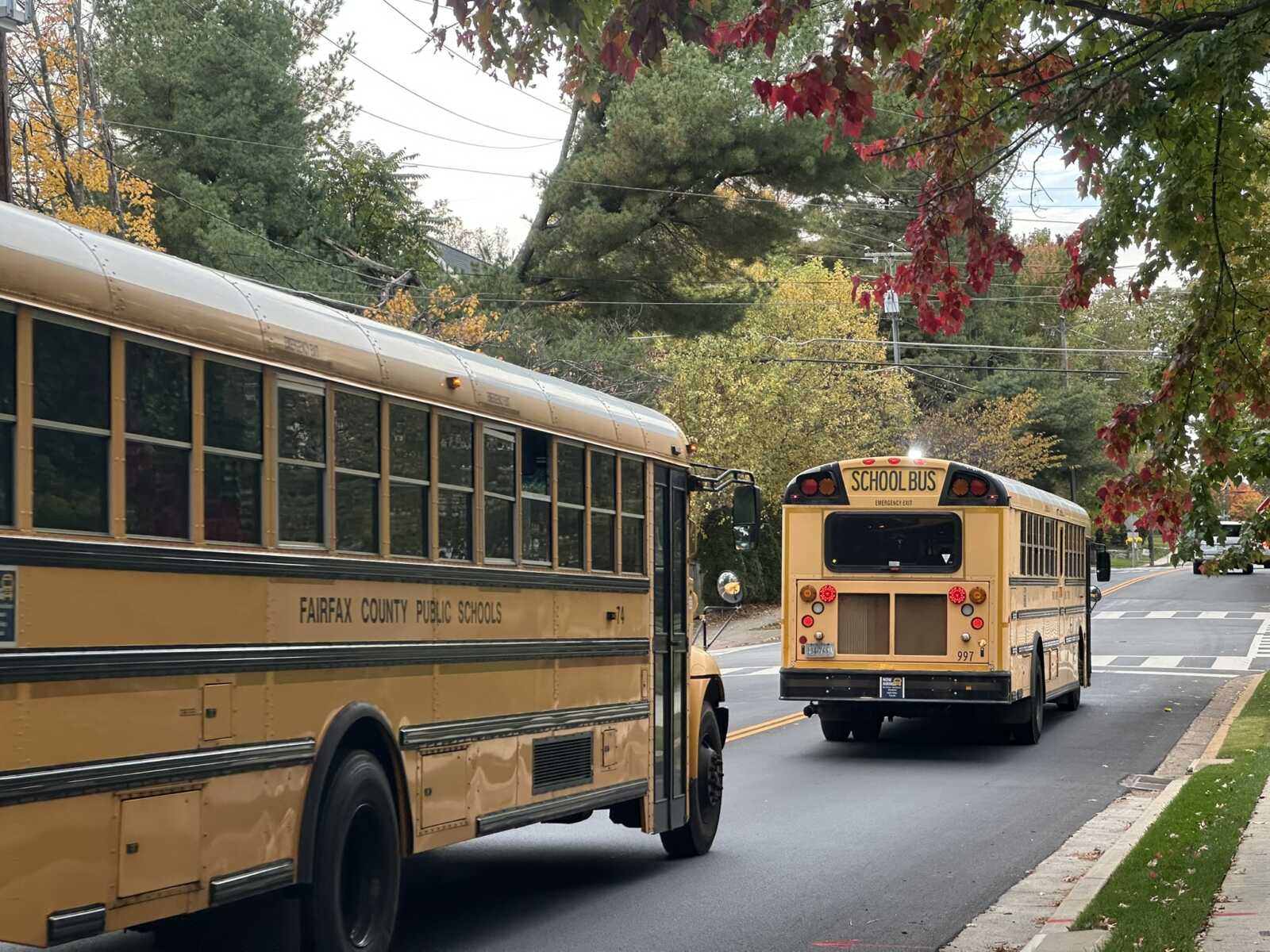
Fairfax County Public Schools students, parents and staff will want to keep an eye on their email inboxes tomorrow (Tuesday): that’s when the school system plans to send out a survey on a potential overhaul of school start times.
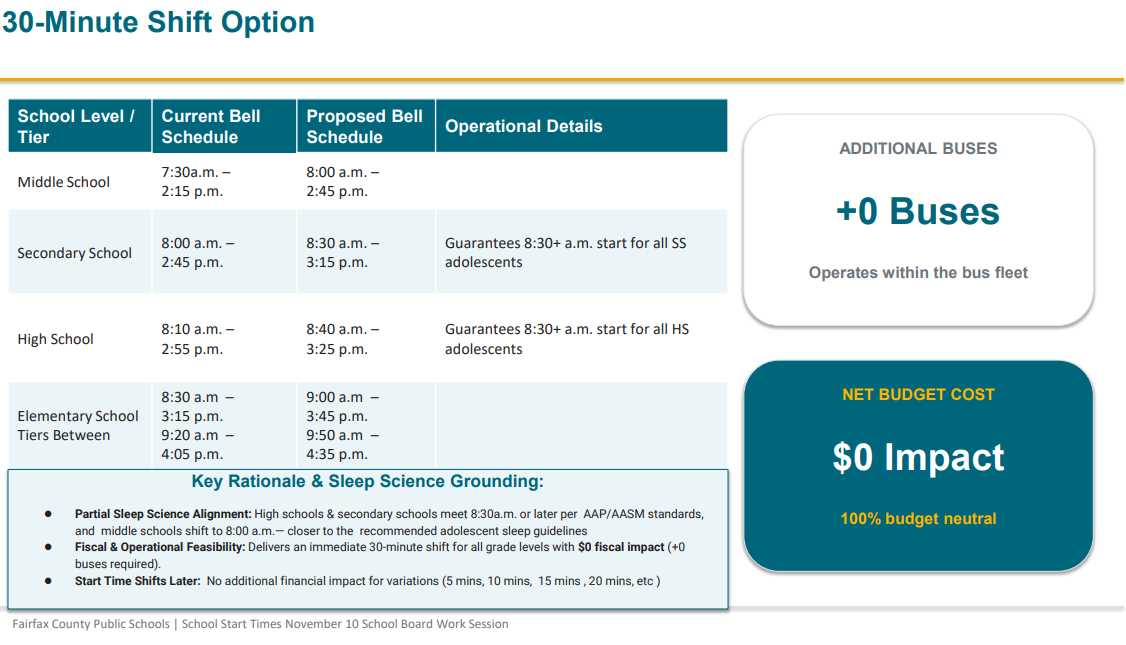
As directed by the Fairfax County School Board at a work session last week, the survey will ask respondents whether they would prefer to push back start times for all students by 30 minutes or to keep the current schedule, which has middle schools starting classes at 7:30 a.m.
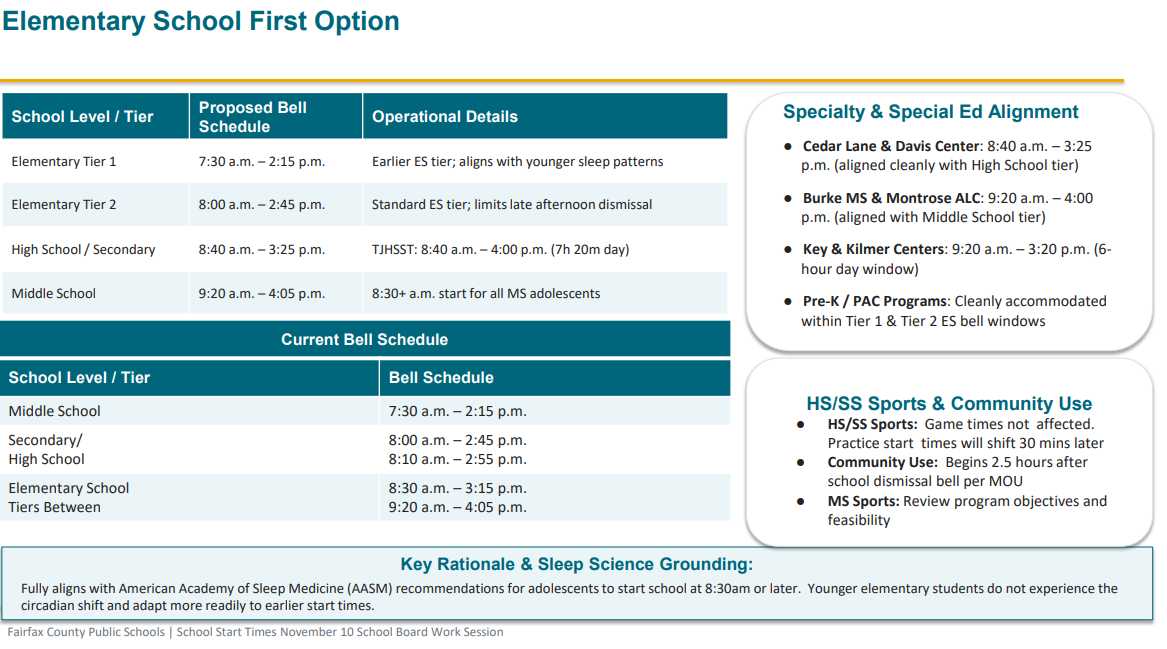
The 30-minute shift was recommended by FCPS staff to the school board at its Nov. 10 work session as one option for revising start times, along with an alternative that would have elementary schools start the day first, followed by high and secondary schools, with middle schools opening last at 9:20 a.m.
Early pickups, child care disruptions among concerns
According to FCPS Chief Operating Officer Andy Mueck, the “elementary first” option would align with recommendations from the American Academy of Sleep Medicine, which says middle and high school should start at 8:30 a.m. or later to accommodate an internal circadian rhythm shift that leads adolescents to naturally prefer later bed-times.
However, school board members quickly dismissed it as a non-starter. On top of carrying an estimated annual cost of over $1.6 million to support 20 additional bus drivers, the approach would require some of the youngest students to catch a bus as early as 6:15 a.m. to make a 7:30 a.m. start time.
“This is not a time where we have $1.7 million. So, to me, that’s entirely off the table,” School Board Chair Robyn Lady, who represents the Dranesville District, said, referring to the budget challenges facing FCPS.
Springfield District Representative Sandy Anderson noted that early pickup times would be particularly troublesome for elementary school students in Clifton, who have to be bused about 45 minutes away because the town’s public elementary school was shuttered in 2010.
The school board also appeared hesitant to throw its full support behind the 30-minute shift, with Mason District Representative Ricardy Anderson saying a 9:50 a.m. start time for elementary school is “a bit hard to stomach” and others expressing concern about the impacts on after-school programs, Fairfax County’s School Age Child Care (SACC) services and other child care plans.
“My initial sense is that the proposed benefits don’t outweigh all those costs and disruptions,” Braddock District Representative Tom Dannan said. “I’ve received a lot of emails asking about the impacts on SACC and after-care and so forth.”
Moving start times back by 30 minutes would bring middle school students closer to the sleep academy’s recommendations, and the change would have no new budget impacts, Mueck said, adding that smaller increments of anywhere from five to 25 minutes could be considered.
FCPS leaders have been planning for more than a decade now to adjust middle school start times, ever since the school board voted in 2014 to bump high schools back from 7:20 a.m. to 8 or 8:10 a.m.
According to at-large board member Ilryong Moon, who was also on the board for the 2014 vote, FCPS only had the budget at the time to tackle one study, so the different grade levels couldn’t be addressed simultaneously. However, various interruptions, from leadership changes to the COVID-19 pandemic, delayed work on a study of middle school start times until 2023.
The consulting firm Prismatic Services presented recommendations in December 2024 that also faced a generally cool reception from the school board, which called for proposals that were cost-neutral, didn’t negatively affect high school start times and didn’t create “civil twilight” issues with students walking to bus stops in darkness.
While the elementary-first and 30-minute-shift options emerged as the “most optimal” of those available, neither secured a full-throated endorsement by the school board or clear majority support from the community in a survey sent out in fall 2025. The school board then voted in October 2025 to postpone considering any start time changes until after FCPS completed a system-wide boundary update early this year.
FCPS isn’t launching its public survey until tomorrow, but several school board members said at last week’s work session that they had informally polled their constituents and found a general preference for the status quo.
Sully District Representative Seema Dixit said she sent out a survey that received 623 responses in 24 hours. About 60% indicated a preference for sticking with the current bell schedule, though only a “small” portion of respondents were parents of middle school students.
“They just have so much uncertainty going on right now in finances, [the] economy, in the gas prices and everything else,” she said, noting that many respondents raised concerns about the stability of their child care arrangements and work schedules. “Even though I really want this to happen for our middle schools, at this point, I would like to say my community is talking about staying [with] what we have right now.”
Providence District Representative Karl Frisch urged FCPS staff to provide disaggregated results from the upcoming survey so the school board can see how opinions vary by grade level, demographics and other factors.
“I accept that there’s no perfect solution here, and that someone is going to be disappointed,” Frisch said. “That does not mean that we shouldn’t try, however, to find a solution that is most agreeable and that aligns with the science.”
Legislation could complicate FCPS plans
Further complicating the discussion is potential legislation in Congress to make Daylight Saving Time permanent and in the Virginia General Assembly to establish “healthy start times” requirements for schools.
The federal bill, known as the Sunshine Protection Act, passed the House of Representatives on July 14, but the Senate has yet to take up the bill, in part due to skepticism from some senators, particularly in northern and Midwestern states. Opponents have noted that the U.S.’s previous attempt to make Daylight Saving Time permanent in the early 1970s was so unpopular that it was repealed in less than two years.
According to FCPS staff, students at over 95% of the system’s 9,320 elementary school bus stops would board before dawn from early December through early February, affecting an estimated 46,500 more elementary school students than the current schedule if DST becomes permanent.
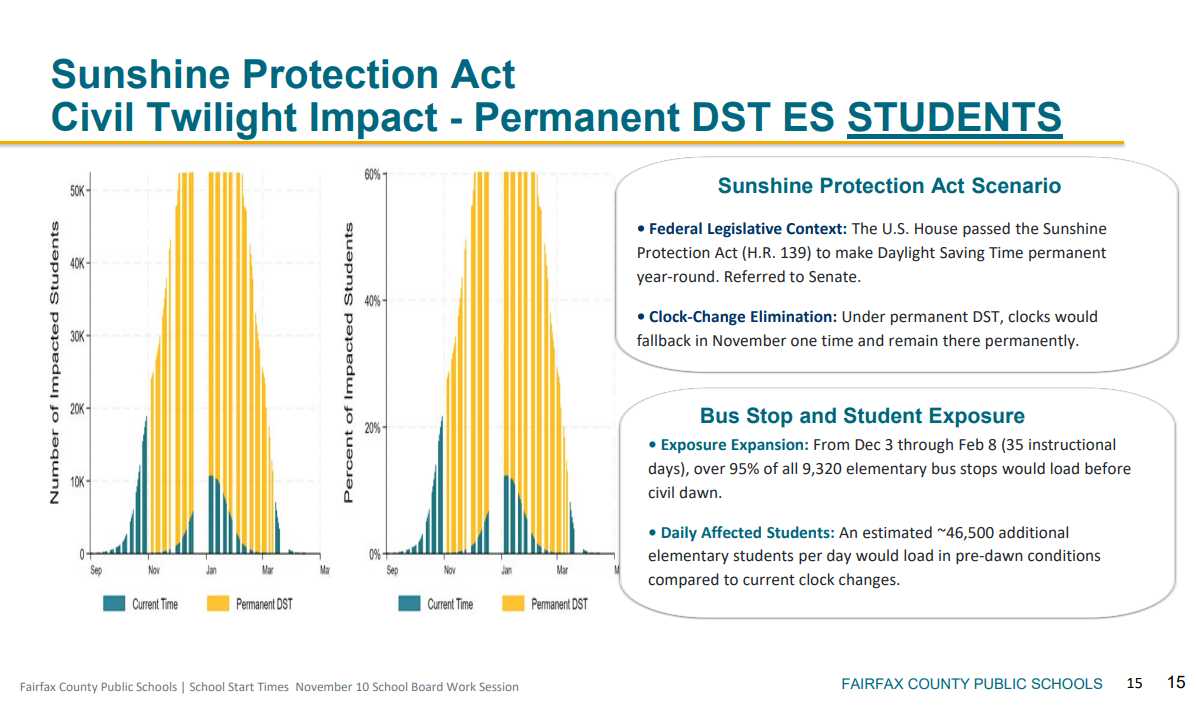
Based on that data, Hunter Mill District Representative Melanie Meren suggested that the school board might need to add a position on the Sunshine Protection Act to its federal legislative program, which lays out its advocacy and policy priorities for Congress.
“Certainly, I think that’s something we need to add to our program … to ask our legislators not to be in favor of that from a school’s perspective, because it seems to put a lot of kids in danger,” Meren said.
Del. Laura Jane Cohen (D-15) and state Sen. Stella Pekarsky (D-36), who both served on the Fairfax County School Board before they were elected to the General Assembly, are crafting state legislation to promote healthy school start times for the 2027 legislative session starting in January, Sandy Anderson confirmed to FFXnow.
While immediate details on the proposed bill weren’t available, Sandy Anderson told her colleagues that the 30-minute shift schedule likely won’t comply with the standards in the bill.
“If it goes through the way that they’re expecting it to, divisions would be required to implement this by 2030-31,” the Springfield District representative said, noting that the measure might contain a “carveout” exempting rural districts.
Five of the school board’s 12 members expressed support for again pausing the start time review to see what decisions are made at the state level, and FCPS Superintendent Michelle Reid suggested that “whatever shift we want to make, I think we only want to make it once.”
However, other board members were apprehensive about the prospect of another delay, especially one that could wind up being unnecessary if the General Assembly doesn’t end up taking any action on school start times.
Ricardy Anderson said the need for later middle school start times feels particularly urgent to Mason District families, whose children attend middle school from sixth through eighth grade instead of the two years seen everywhere else in the county.
“What I’m hearing is these are the reasons why this is probably not going to go anywhere,” she said. “This is something that everybody on this board has spoken passionately about doing the right thing for kids, and I’m just seeing that just wither away, and that is that’s challenging for me to hear.”
The school board agreed to let staff move forward with a survey allowing participants to choose between a 30-minute shift and the current schedule, with some context noting that any change could be put on hold depending on what happens at the federal or state level.
The survey will close on Dec. 1, giving staff just enough time to share the results with the school board at a formal briefing on Dec. 3. A vote on new start times could take place at the board’s meeting on Dec. 17.
That timeline would allow FCPS to notify the community of any changes in January so families of both students and staff can make necessary arrangements, Reid said, if the new schedule is implemented for the 2027-2028 school year.
