


Fairfax County school officials fear Virginia’s new accreditation system could disproportionately harm schools with large populations of English learners and students with disabilities.
Adopted last month by the Virginia Board of Education, the School Performance and Support Framework places more weight on standardized test scores and graduation rates — a move state officials argue will hold schools to higher educational standards and improve accountability.
Fairfax County Public Schools board members and administrators agree accountability is important but argue the new measures may fail to support students who need extra time to learn due to language barriers or disabilities.
They also worry the increased emphasis on advanced coursework, such as Advanced Placement (AP) and International Baccalaureate (IB) programs, could widen the gap between well-funded and under-resourced schools.
“With shifts in how student academic, readiness, and graduation outcomes are measured, there is the potential for misrepresenting the overall health of FCPS schools and over-identifying schools as underperforming and needing external support,” FCPS Superintendent Michelle Reid told FFXnow.
According to Virginia Department of Education officials, the revised plan is part of an effort to improve accountability, transparency and student outcomes across the state’s schools. Under the Every Student Succeeds Act (ESSA) adopted by Congress in 2015, it still needs the U.S. Department of Education’s approval before it can be implemented.
Key changes in the new plan
Virginia’s new system unifies how schools are assessed by combining accreditation and accountability standards into a single framework.
According to the revised ESSA plan, accreditation reflects a school’s compliance with academic performance indicators such as test scores, absenteeism, and graduation rates, while accountability ensures schools receive support based on student performance and readiness for life after school.
The previous accreditation model considered factors like standardized test pass rates, absenteeism, and graduation rates to determine whether a school met the state’s standards.
While the state will use mostly the same factors for evaluating schools as before, the new framework gives greater weight to students’ mastery of reading, math, and other subjects, as shown by standardized test scores, compared to their growth or improvement over time.

Another notable shift is the change in the time frame for English Language Learners (ELLs) to achieve English proficiency. Previously, ELLs had up to 11 semesters (5.5 years) to demonstrate proficiency, but now they only have three semesters (1.5 years) before their test scores are factored into their school’s overall performance.
The new system will also track smaller student groups more closely. For example, the minimum size for reporting the performance of special education students has been reduced from 30 to 15 students, allowing for earlier identification of challenges within these groups.
In high schools, more weight will be given to graduation rates, along with markers of post-graduation preparedness. That includes measuring participation in advanced coursework such as AP classes and the number of students earning career certifications in fields like technology or healthcare.
Schools will get one of four performance labels to reflect how well they’re meeting the state’s academic expectations: “Distinguished,” “On Track,” “Off Track” or “Needs Intensive Support.”
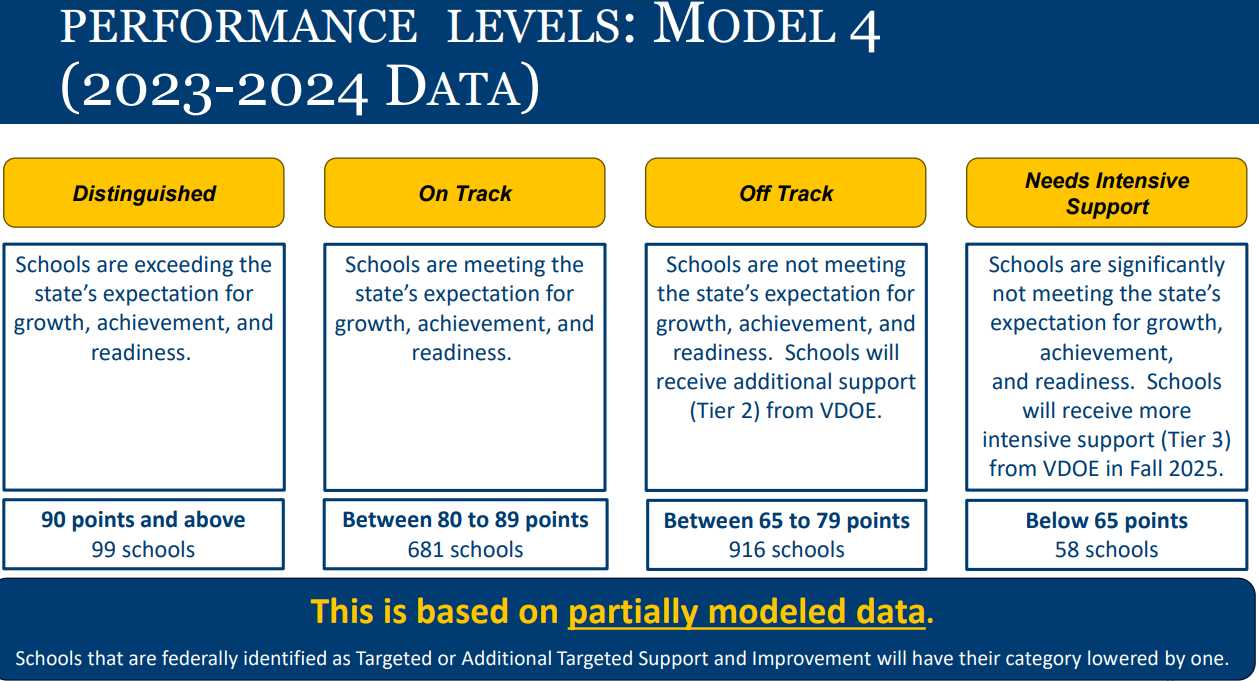
Schools labeled as off-track or in need of intensive support will receive more direct help from the state. Those needing the most assistance will get personalized support from the VDOE Office of School Quality, which could include corrective action plans, professional development for teachers and specialized academic programs aimed at boosting student performance.
Schools with vulnerable groups face heightened scrutiny
State education officials say the new accreditation system aims to tackle learning loss and absenteeism exacerbated by the COVID-19 pandemic, holding schools accountable for student performance.
But some Fairfax County School Board members say the changes could disproportionately impact schools with higher numbers of English learners and students with disabilities.
Braddock District Representative Rachna Sizemore Heizer argues the new accreditation model may not reflect a school’s quality. Shortening the time for English learners to become proficient, for example, could lead to students getting tested before they can fully show what they know in English.
“That’s a huge setup for failure,” Sizemore Heizer told FFXnow.
VDOE officials countered that the new system brings the state in line with federal requirements, which already track English learners after three semesters.
“Virginia has long been an outlier nationally by choosing to exclude English Learners from state accountability measures for five-and-a-half years,” the department said in a statement. “The current system excludes an English Learner entering Kindergarten this fall for their entire K-5 time in elementary school. It is unacceptable to exclude English-learning elementary schoolers and not know what supports they need at their school for their entire K-5 school career.”
Sizemore Heizer acknowledged the concerns from state officials but suggested that English learners should take standardized tests in their native languages until they reach proficiency to better assess their understanding of the material.
“If you really want to say after three semesters, ‘We want to see what their knowledge is,’ at least let them take it in their native language,” she said. “And then once they graduate from multi-level services or get to 11 semesters, then have them take it in English.”
School board members also voiced concerns that placing greater emphasis on the four-year, on-time high school graduation rate in school accreditation could disadvantage students with disabilities who require additional time.
Under the federal Individuals with Disabilities Education Act (IDEA), students with disabilities can stay in school until age 22, giving them up to eight years to complete high school and earn a diploma.
However, the new accreditation model will count students who graduate within six years of starting high school — including those with disabilities who earn an Applied Studies diploma, which previously didn’t count toward the four-year graduation rate used by federal standards.
Reducing the recognized graduation window to six years for students with an Individualized Education Program (IEP) — a group that includes around 20,000 students in FCPS — could discourage schools from letting them to take advantage of the eight years allowed by federal law, Sizemore Heizer says.
“It’s a back door to disincentivizing schools from ensuring that students are able to stay in school for multiple years,” she said. “That makes it harder for those students because they don’t get the time, or maybe additional skills training or certification training or slowing down for academic courses so they have a better chance of passing these [Standards of Learning tests].”
VDOE officials, however, say the new model accounts for students with disabilities and encourages them to graduate on time within their cohort.
“The goal for all students is to achieve graduation, and students with disabilities regularly graduate on time in the same cohort as their neurotypical peers,” VDOE officials said.
Additionally, Sizemore Heizer says increased the emphasis on AP and IB courses, as well as Career Technical Education (CTE) credentials, could make it harder for under-resourced schools to meet the new standards.
“I’m happy we’re encouraging our students to take more challenging classes, but our middle school teachers don’t necessarily have the certifications to teach those advanced courses,” she said.
Without more state funding, it may be difficult to provide the necessary resources and support for schools to meet the new standards, particularly for offering advanced coursework and supporting English learners and students with disabilities.
“This is a massive shift in a year for standards that aren’t fully flushed out and aren’t implementable because we have to do this with our teachers,” she said. “If you really want to be thoughtful about partnering with us — about pushing with us, all of us, right? You do a phased approach — do a thoughtful approach.”
Ongoing concerns about state funding
For months, Fairfax elected leaders have pushed for the state to increase public school funding after a recent study conducted by the Joint Legislative Audit and Review Commission estimated that FCPS was shortchanged by more than $500 million annually.
Last year, the General Assembly allocated $418 million in one-time funding for Virginia schools to combat learning loss and boost academic outcomes following a rise in absenteeism and poor SOL results, particularly among Black and Hispanic students.
VDOE officials also say the current biennial budget includes an additional $2 billion in new funding for K-12 education above previous years to support students with specific needs, including students with disabilities, English Language Learnersand lower-income students.
“With Virginia’s growing English Language Learner population, the budget provided $72.1 million to lower the English Language Learner teacher staffing ratio to help these students advance rapidly,” VDOE officials said.
Still, Hunter Mill District School Board Representative Melanie Meren argues that the funding increases, while a step in the right direction, fall short of addressing the chronic underfunding that has plagued FCPS for years.
“Each student in Fairfax is due $1,900 from the state,” Meren said. “At a minimum, that would bring us up to the national average of per-pupil spending.”
Meren also says the VDOE hasn’t provided enough clarity on how the new funds will be distributed locally, leaving schools unsure about how to meet the specific needs of their students.
She warned that the combination of underfunding and higher performance expectations will further demoralize teachers and worsen Virginia’s ongoing teacher shortage, an issue challenging schools nationwide.
“These are all ways to shake the foundations of public education,” Meren said.
