


Reston Association is weighing another increase in its annual membership fee, as staff hammer out a new budget for the coming year.
In an initial draft presented to the Board of Directors on Aug. 28, RA Chief Financial Officer Ed Vroom proposed raising the assessment to $923 in 2026 — an increase of $75 or 8.8% from the current rate of $848 — to keep up with rising capital project costs and inflation, among other challenges.
The increase would be the start of a five-year push to raise the revenue that goes to capital projects up from approximately $2.65 million to the $3.75 million that a capital working group recommended contributing annually.
“We’re ramping that up over the next three years to try and make it a little more palatable,” Vroom told the board at its joint meeting with RA’s fiscal committee.
According to Vroom, the nearly $25 million budget proposed by the homeowners’ association for 2026 is being driven in equal parts by the increased costs of maintaining and renovating Reston’s aging facilities, inflation, and other factors, including suggestions for improvements or new services from members.
Facility upkeep costs rise
Notable capital projects on the horizon include needed repairs for the Lake Newport swimming pool, which has been “losing water at a rapid rate,” RA Chief Operating Officer Peter Lusk said.
RA had allocated $580,000 in last year’s capital improvement program (CIP) to update the pool’s whitecoat and tiles, but engineering consultant FEA, which has been assessing the conditions of all RA’s facilities, and pool manager Titan Pool Service both recommended setting aside an additional $500,000 to fix the leaks.
The association already spent around $40,000 of the allocated funds on crack repairs this spring to ensure the pool was available for the summer. Lusk says additional testing will be conducted this month, potentially refining the projected cost, and staff will return to the board later in September or in early October with recommendations.
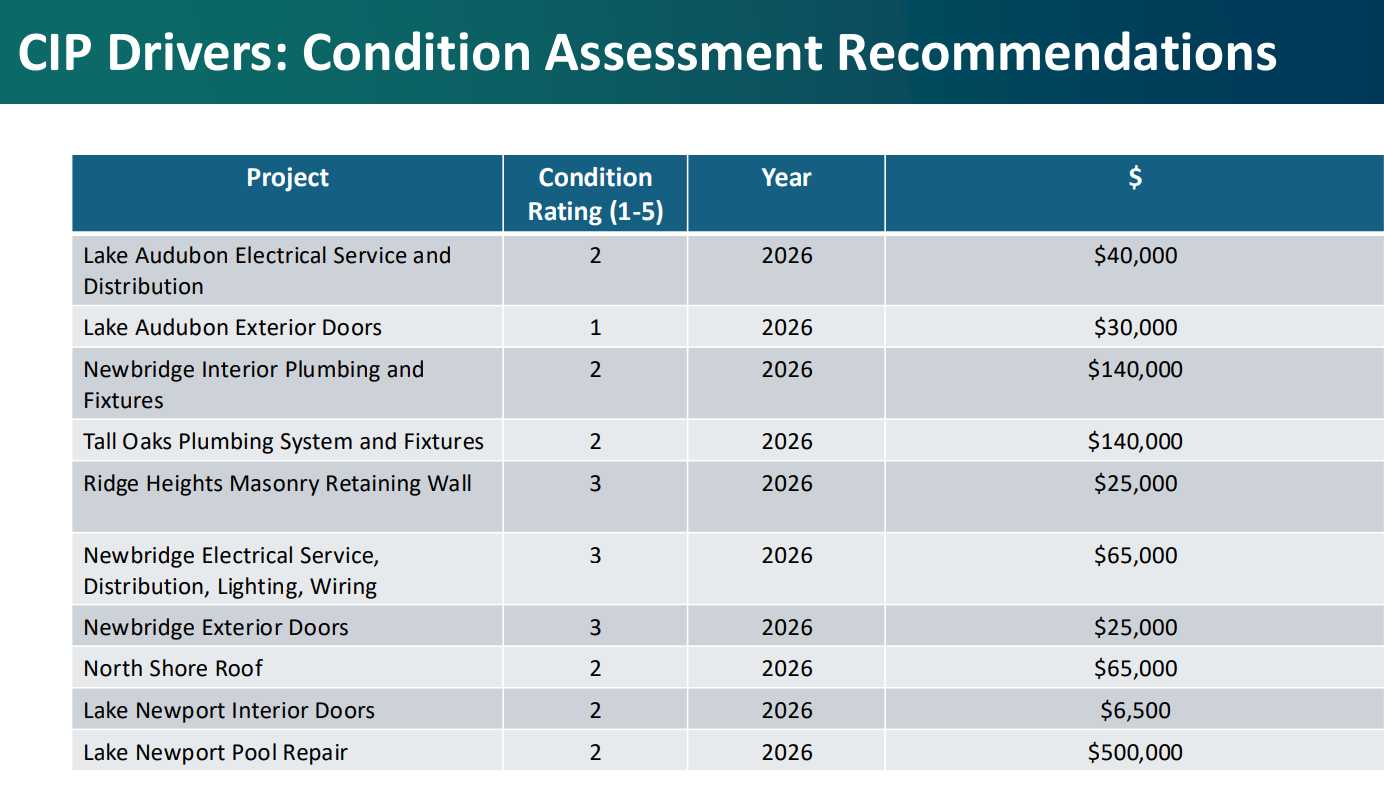
The proposed 2026 CIP also includes $300,000 to demolish the existing Lake Newport tennis courts, which are in line for a renovation. However, most of the funding for that project — $1.6 million — is now being pushed to 2027, Lusk reported.
“There are two reasons for that: one to try to keep the assessment at a place where we thought we could have a solid conversation with the board,” he said, “and two, because based on permitting and site plans and other things, it would probably be the fourth quarter of ’26 [before] we could do any work.”
After conducting a community survey this spring, RA hasn’t yet announced any definitive plans for what the renovation of the six-court facility at 11452 Baron Cameron Avenue might entail. The total expected cost of $1.9 million has increased from the $1.5 million estimated over two years in the current CIP.
Costs for the next phase of improvements for the Hook Road Recreation Area are also climbing. RA has committed $521,729 to the project so far, about $138,749 of which will remain after the first phase is completed.
Construction on the first phase — which involves an overhaul of the baseball field and an initial segment of a new walking path — is currently underway and on track to finish this fall.
RA is planning to devote $250,000 in the 2026 CIP to the second phase, which will install a permanent restroom and complete the pathway, but recent cost estimates for the restroom, however, have been “very unfavorable,” according to Lusk.
“We’ve gotten some cost estimates around two, three times that number,” Lusk said. “We’re not ready to make a recommendation at this time, but it will be a conversation piece this fall.”
Budget accommodates inflation, new staff
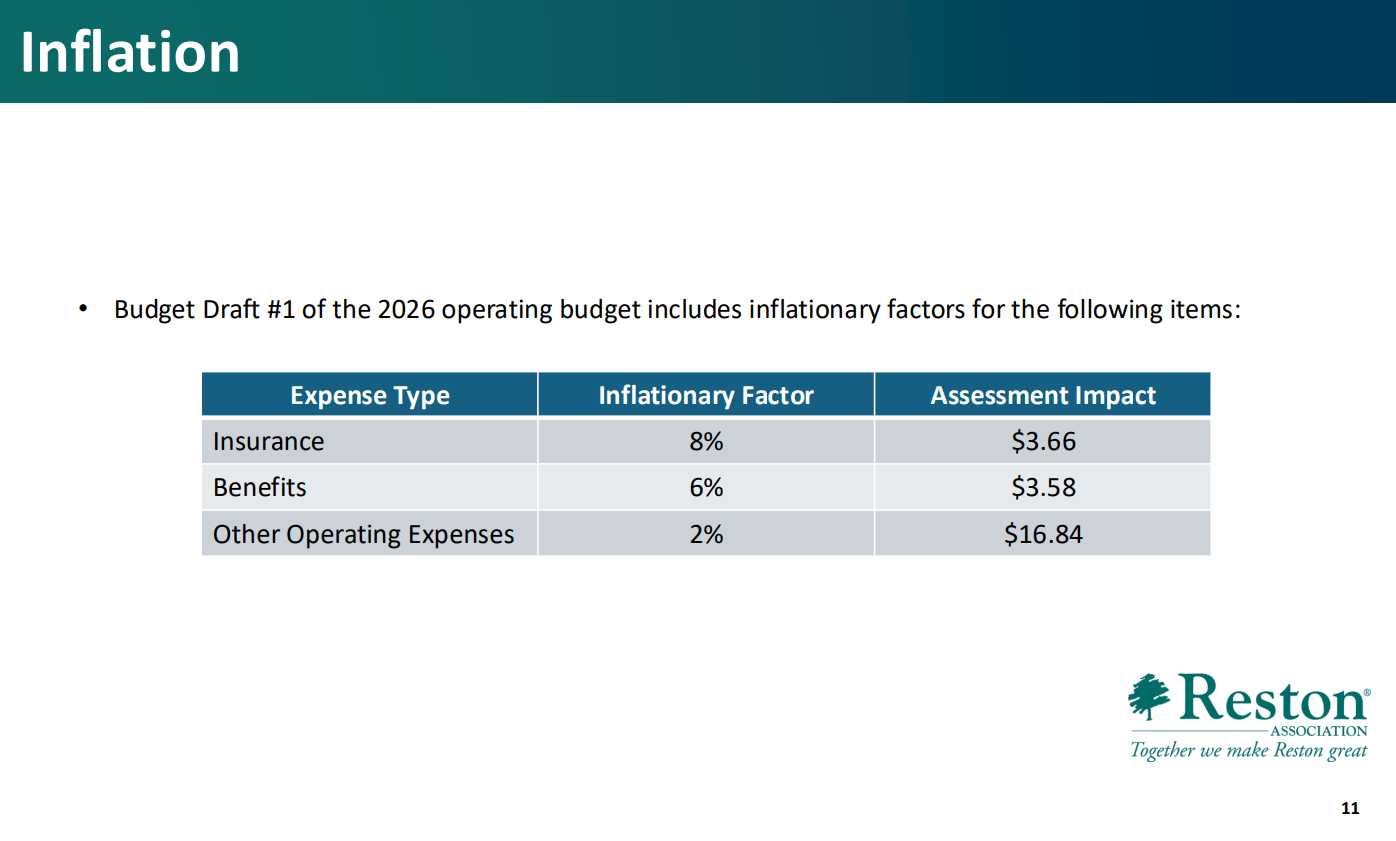
To prepare for inflation, the draft budget assumes a 2% increase in most operating expenses, including supplies and operating contracts, but for insurance and staff benefits, increases of 8% and 6%, respectively, are predicted.
Vroom says the inflation rate for property insurance stems from RA’s premium increasing 8% when it renewed its package this year.
“We are talking to other insurance brokers and are going to try to do better,” he said. “But given what we hear and natural disasters and the insurance market is very challenged these days, I don’t know that it would be a valid assumption to assume we’re going to do much better than that.”
The increased cost of benefits reflects rising medical, dental and vision rates, according to Vroom.
Some RA directors questioned whether a 2% baseline increase to accommodate inflation would be adequate.
“With tariffs and various things causing rising prices, I am a little concerned about that 2% level,” apartment owners’ representative Margaret Perry said. “You know more than I do, so I’ll trust you, but it does cause me pause.”
The proposed budget would also fund 4% merit-based pay raises for RA staff and shifts some funding for seasonal and part-time staff to two new full-time positions that will assist with managing facility rentals and summer camps.
According to RA staff, it has been “difficult” to retain temporary or seasonal staff to handle facility rentals, and the summer camp program has turned into a year-round responsibility due to more involved licensing regulations and increased participation.
“Some of the camps have the age of kids that actually qualify to be more of a daycare program than a summer camp program, so the licensing requirements have become more stringent,” Vroom said, citing a requirement that indoor facilities be available for rainy days as an example. “… Not to scare anyone, we haven’t come anywhere near this, but not meeting a licensing requirement and running a camp is actually a class 4 felony, so if we’re not on top of what we’re supposed to be on top of, the association could be at risk.”
Board mixed on assessment increase
The RA board had mixed reactions to the proposed increase in member assessments, which would be more than $200 higher than they were in 2021 if the $923 rate is approved.
Perry said she doesn’t see the suggested assessment as “unreasonable” but anticipates that members might find the increase “extremely difficult to swallow.”
Izzy Santa, the board’s vice president and an at-large director, concurred with that “trepidation,” noting that staff’s five-year forecast ramps up assessments to $1,092 in 2030 to achieve the recommended $3.75 million commitment for capital projects. She suggested RA could look at more “efficiencies,” including ways to incorporate technology more.
“I don’t think RA has had that digital transformation, and I would welcome that as a way to do more with less,” she said. “I do believe it’s going to be harder times, not easier times.”
Other directors argued that RA needs to plan for cost increases if it wants to maintain existing levels of service, let alone allow for any improvements in the future.
The association has explored expanded pool hours over the past two years, and for the 2026 budget, members expressed support for improving the water pressure at the Uplands pool, adding water bottle-filling stations and continuing a third phase of condition assessments, according to RA staff.
This fall, FEA is scheduled to review the Lake Thoreau, Shadowood, Dogwood, Glade and Hunters Woods pools, along with footbridges maintained by RA. The draft budget includes $50,000 to finish the assessments.
“I think the current proposed budget is based in good sense,” board treasurer and at-large director Matthew Mullenix said. “Looking ahead, there’s unavoidable costs, inflation, insurance benefits, and it also, I think, sticks to our values. Members told us clearly to maintain what we own, maintain the level of service for 15 pools, etcetera, and this budget is responsive to that.”
Community members are invited to share feedback on the proposed budget at a public hearing starting at 6 p.m. on Thursday (Sept. 11) before the board of directors meeting. RA will produce two more drafts based on board and member input before a final budget and assessment rate are adopted on Nov. 13.
