

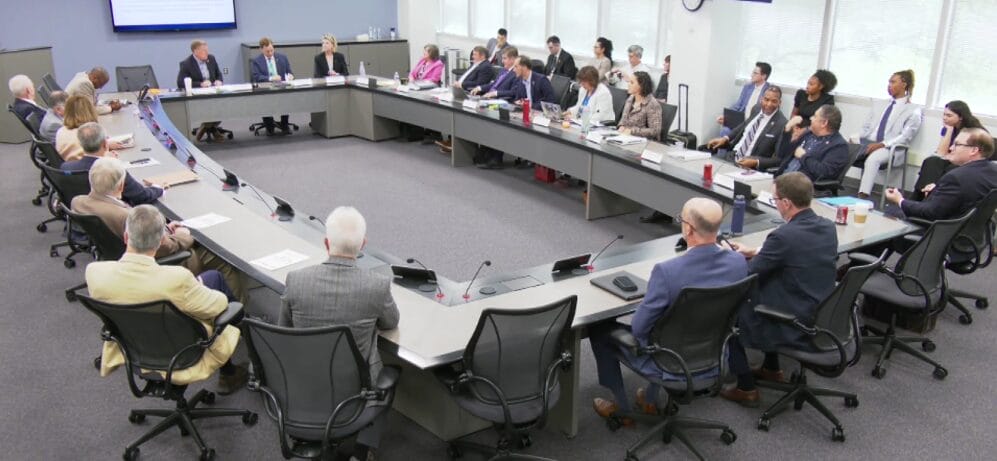
Fairfax Water’s efforts to reduce the amount of “forever chemicals” known as PFAS in local drinking water come with “potentially significant costs,” Fairfax County supervisors were told on Tuesday (June 2).
“PFAS, from where I sit, is going to be a generational issue,” said Jamie Bain Hedges, general manager of the water utility, during the 90-minute meeting between the Board of Supervisors and the Fairfax Water Board.
PFAS is shorthand for per- and polyfluoroalkyl substances. In wide use over the past 80 years, they are long-lasting chemicals whose components break down slowly.
According to the U.S. Environmental Protection Agency (EPA):
“There are thousands of PFAS chemicals, and they are found in many different consumer, commercial and industrial products. This makes it challenging to study and assess the potential human health and environmental risks.”
Fairfax Water provides service as a retail and wholesale supplier to 2.2 million people across Northern Virginia. It must monitor more than 90 contaminants found in drinking water, including PFAS.
In the presentation, Hedges said the Fairfax system meets all current requirements and is poised to meet future ones.
“Our customers can be confident in the quality of water we are providing them,” she said, noting that while the system currently doesn’t meet the federal government’s incoming limits on PFAS, “it’s just a little bit over” and can be reduced further.
To limit levels of PFAS, Fairfax Water is testing a number of strategies, working on “finding the one that is the most cost-effective in the long run for our customers,” said Hedges, who has led the water authority since 2021 and has been on its staff for more than three decades.
Virginia’s water suppliers also are attempting to win General Assembly passage of more restrictions on the use of chemicals and other materials that seep from the ground into the water table and work their way into intake pipes.
“PFAS that is removed at the source are PFAS that does not need to be removed [by Fairfax Water],” she said.
Franconia District Supervisor Rodney Lusk amplified that comment.
“This is a vital point,” he said of eliminating contaminants in groundwater, while acknowledging it was a “vexing and difficult” issue.
In mid-May, the EPA announced plans to rescind national restrictions on four types of PFAS in tap water and extend its compliance deadlines for water agencies to address perfluorooctanoic acid (PFOA) and perfluorooctane sulfonic acid (PFOS), two other major types of PFAS.
The proposal, still not finalized, would extend from 2029 to 2031 the period for compliance with PFOA and PFOS containment requirements. While environmentalists have expressed concern about the rollback in regulations, the delay has the support of the Association of State Drinking Water Administrators.
“EPA’s proposed extension of the compliance date and increased technical assistance will address the number of systems that would be out of compliance in 2029 due to not being able complete all of these tasks on time,” Alan Roberson, the association’s executive director, said.
In early 2025, Fairfax Water opted out of proposed national settlements with chemical companies and instead sued manufacturers of PFAS-laden foam used in firefighting equipment, stating that the offered compensation did “not begin to meet the costs of removing PFAS chemicals from the water we deliver.”
“Fairfax Water believes that its rate payers should not bear the enormous costs of PFAS treatment and clean up,” the water authority said in a Jan. 13, 2025 statement. “Those costs rightfully belong to the companies that profited from PFAS chemicals, while hiding the known harms to the environment and to human health.”
The EPA has finalized more settlement agreements since then, including one to clean up a DuPont facility site in Richmond, but regulators say the funding available for addressing PFAS contamination remains inadequate.
Hunter Mill District Supervisor Walter Alcorn said he expects the federal government will “flip-flop” on timelines and regulatory requirements as challenges of meeting deadlines become clear.
Fairfax, however, needs to address the issue as quickly as possible while not breaking the bank, he said.
“We need to get it out of our drinking water, and it looks like we’re doing that in a very smart way,” Alcorn said.
Board of Supervisors Chair Jeff McKay said he’s hopeful that, from the national down to the local level, “a compromise that works for everyone” could be ironed out.
Addressing PFAS is among “a number of upward pressures” that water systems locally and nationally have to address, Hedges told supervisors.
“Water treatment becomes more challenging and costly” over time, she said.
Concerns about the challenges have been raised before. At a meeting of the supervisors’ Environmental Committee in late 2024, Hedges estimated one-time and ongoing costs to address PFAS in Fairfax Water’s system could top a half-billion dollars.
Because Fairfax Water is funded entirely through user fees, those costs will be passed down to retail and wholesale customers.
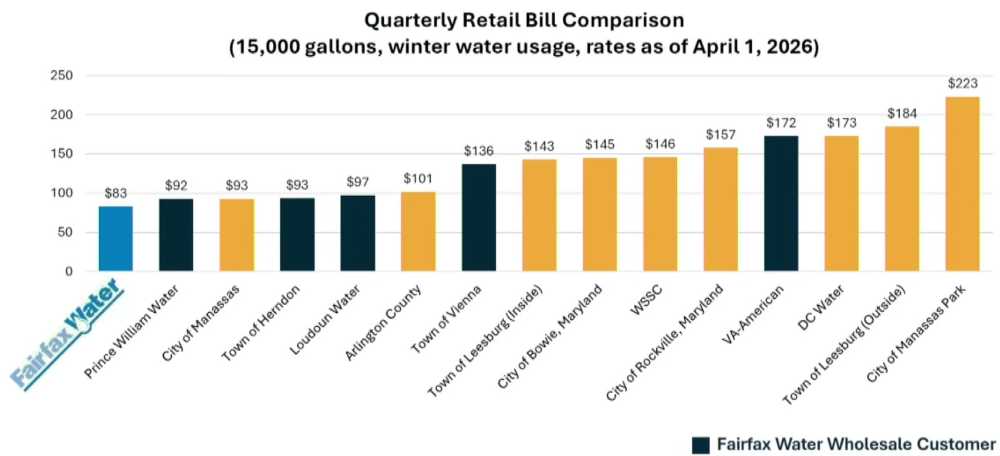
Fairfax Water currently has the lowest costs for customers in the metro area, according to data from the agency. More regulation and added compliance costs will push those rates up in coming years.
“We expect to be able to keep rates lower [than surrounding providers], but we will not be immune,” Hedges told supervisors on June 2.
In terms of regulation from the federal level, “we know more is coming,” said Mount Vernon District Supervisor Dan Storck.
