

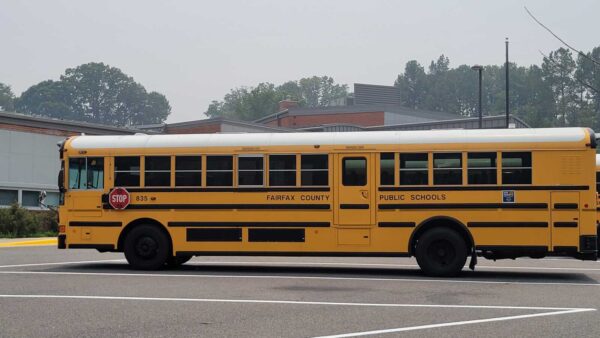
Going forward, Fairfax County Public Schools will prohibit the use of generative artificial intelligence by elementary school students, tablets and laptops in preschool and kindergarten, and student use of personal electronic communication and computing devices during instructional time.
The Fairfax County School Board approved the restrictions — which include a handful of narrow exceptions — at its July 16 meeting, along with several directives for the superintendent to report back to the board about the potential additional limitations on technology.
Possible changes include allowing parents to opt out of using FCPS-issued devices if a student has a documented medical or developmental need, and implementing a ban on YouTube, except for videos directly embedded in a teacher presentation.
Additionally, FCPS will conduct a pilot program to implement a “whitelist”-style firewall for students to access apps, extensions, and websites. Instead of the current system of banning problematic websites, a whitelist would allow access to a pre-approved list of sites, with necessary additions manually added by staff.
No generative AI for elementary students
The policy changes follow months of debate on the use of digital technology in classrooms, sparked in part by FCPS’ announcement last fall that it was partnering with tech company Open AI on a “ChatGPT for Teachers” pilot program.
“Embedded AI features, writing assistants, automated tutors, adaptive algorithms are operating on district-issued devices without a clear, comprehensive accounting or a formal policy adopted by the board,” Mount Vernon District Representative Mateo Dunne said when introducing the original motion. “Our students should not be an ungoverned test case while we try to figure out what is already in their hands.”
The discussion was complicated by the fact that many online tools have integrated generative AI into their products, even though the user may not open them with the intention of using the AI capabilities.
A simple Google search, for instance, now generally pulls up an “AI overview” in addition to a list of websites, unless the user intentionally includes the term “-ai.” Other common tools, such as the graphic design site Canva and many Adobe products, also include options to use generative AI.
Some school board members expressed concern that an outright ban on generative AI throughout all grade levels might be too broad, especially if the technology isn’t clearly defined.
“I could live with it through grade eight,” said school board chair Robyn Lady, who represents the Dranesville District. “But I don’t know what that means, because if a kid is writing a paper in Word, how do you turn off spell check? How do you turn off grammar check?”
The amended motion that ultimately passed directs Superintendent Michelle Reid to provide a comprehensive inventory of generative AI tools and solutions on FCPS-issued laptops and tablets by Jan. 14. The list will be based on FCPS staff’s definition of artificial intelligence.
However, Hunter Mill District Representative Melanie Meren argued that the measure did not go far enough.
“If there’s a distinction between generative AI like a chatbot, like a ChatGPT, and something like Canva or Adobe, I say they’re part of the same category,” said Meren. “Because if we allow this, that is saying that we are allowing cognitive offloading. We are allowing our students to take the easy way out when we are here to challenge them.”
While the original motion would have banned use by secondary school students entirely, the final plan establishes guard rails. Some board members specifically cited an award-winning app built by Robinson Secondary School students to analyze misinformation and bias in news stories as the type of project they would want to keep allowing.
The directive remains in place until the school board adopts a formal policy, likely one informed by the Educational Technology Review Committee (ETRC) it established this spring in response to parental concerns that FCPS has become overly reliant on technology.
Cutting back on devices
Pending the ETRC’s recommendations, the board also unanimously voted not to allow pre-K and kindergarten students to use FCPS-issued tablets or laptops. The ban won’t apply to students who use those devices for Individualized Education Programs, 504 plans, translation purposes, or multilingual education support.
“I trusted my ability to make this decision after reading dozens of books and articles about the impacts of technology,” said Meren. “Test scores are down. Writing is lacking for incoming college students. Mental health suffers. Children lose social and cognitive skills. These things happen because children are glued to screens that are unregulated and meant to be addictive, rather than using basic developmental tools like pen and paper, crayons and pencils, and face-to-face interactions.”
Meren also proposed directing Reid to develop a plan for storing devices when they’re not in use.
“We have frequently heard from parents, students, and educators about the problem of the unstructured screen time — the laptop sitting on the desk … Many teachers are already deliberate with technology,” said Meren. “So, let’s standardize this practice so that kids are not mindlessly browsing on laptops instead of engaging in learning with their teachers and their peers.”
While other members were largely supportive of the measure, some asked why a plan was needed at all.
The board would be unlikely to approve buying laptop carts, which can cost upwards of $700 each, systemwide, and re-introducing computer labs would be a complex endeavor. As a result, some members questioned whether the plan needed more detail beyond simply telling students to put their laptops away.
“If this is a plan to just put the laptops under the chair or in the back of the room, why does it have to be a plan?” asked Seema Dixit, who represents Sully District. “Couldn’t we just do this?”
Meren’s motion ultimately passed unanimously, except for an abstention by at-large member Ilryong Moon.
To further address distractions, the board also voted to prohibit the use of personal laptops, tablets, smartwatches and smartphones for school-related activities during the instructional day. Students had already been banned from using cell phones under a new state law that took effect on July 1.
While FCPS can control what goes on school-issued computers, it can’t control what happens on a personal device, noted Lady. As FCPS has cracked down on what happens on school-issued Chromebooks, more students have started bringing personal devices, presumably to get around restrictions.
“There’s no firewalls. There’s no way to control it,” said Lady.
The restriction doesn’t apply to students with an IEP or 504 plan that mandates or permits a device as a necessary accommodation.
School principals can also grant limited exceptions for students in specialized classes that require technology or software not available on standard FCPS-issued devices.
More limits on the way?
While many teachers use YouTube for educational purposes, the board unanimously directed the ETRC to evaluate a plan to block direct student access to the video platform through network-level filters. The plan would allow content directly embedded by a teacher within an approved educational platform.
On a 6-3 vote, the board also directed Reid to deliver a report by Dec. 10 on the feasibility of allowing students with a documented medical or developmental need to opt out of using FCPS-issued laptops and tablets.
“Not every student has a 504 plan,” said Dunne, who made the motion. “Not every student has an IEP. That’s costly, time-intensive, and there’s just a larger number of students who have ADHD or other conditions where having access to electronic devices makes their physical health, their anxiety, other issues demonstrably worse.”
Other members called the motion duplicative of the process FCPS already has in place for students with IEPs.
“This already is done with fidelity, and I don’t even understand what the need of the motion is because there’s a process to do this appropriately, and throughout my entire career, it’s been done,” said Lady, who spent 27 years working in FCPS.
FCPS will also implement a whitelist firewall pilot program at two elementary schools, two middle schools, and two high schools. The superintendent will present a plan for the program to the board in December.
“To be clear, we already own this technology,” said Dunne. “Our existing platform has this capability built in, and it’s a simple system configuration, not a costly new contract.”
FCPS Parents for Intentional Tech, a group that has led the calls for limits on technology, told FFXnow after the meeting that they count the evening as a move in the right direction:
“The approval of the 7 [educational technology] motions and the adoption of physical math textbooks for grades 6-12 mark a shift from a previously digital-focused classroom at FCPS. These changes move us closer to a more intentional tech classroom, although there is still much room for improvement and we will continue advocating for more.
“We appreciate school board members who have worked hard this past year to engage with stakeholders, including parents, teachers, administrators, and community members, and we look forward to seeing more progress on the development of tech and AI policy in the upcoming school year 2026-27.”
