

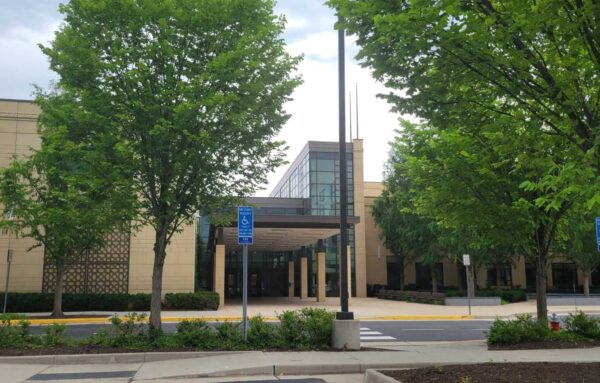
Fairfax County Public Schools has acquired a quantum computer, touted as the world’s first for kindergarten through 12th-grade students, for its new Skyview High School in the Floris area south of Herndon.
Roughly the size of a small refrigerator, the computer is expected to be installed in December and become available next spring to FCPS students, enabling them to explore quantum concepts, understand how the machine differs from a traditional computer, and test problems.
FCPS says Skyview’s quantum computing program — which is being established through a partnership with Connected DMV and the Fairfax County Economic Development Authority — will give students the opportunity to develop skills in coding, math, data analysis, and other areas, while gaining experience in an emerging field.
The $684,000 purchase was approved by the school board with a 10-2 vote on Sept. 24, but it has not been without critics.
At the Sept. 24 meeting, school board representatives Melanie Meren (Hunter Mill District) and Ricardy Anderson (Mason), the lone votes against the purchase, cited financial issues as a concern.
FCPS has not yet solidified an estimate for the full cost of renovations at Skyview, which welcomed its first ninth and 10th-grade students in August but doesn’t yet have a full student body or membership in the Virginia High School League. Additionally, FCPS expects a difficult budgetary year ahead.
At-large school board member Kyle McDaniel, however, is an advocate for the new program, which he argues is a good return on investment for FCPS. FFXnow recently interviewed McDaniel about the acquisition in a conversation that has been edited and condensed for length and clarity.
Where did the idea to get an actual quantum computer come from?
FCPs has offered quantum courses at [Thomas Jefferson High School for Science and Technology] for two decades. Why this [purchase] is so exciting is, it’s like the welding programs that we have, or the culinary arts program that we have.
What we’re teaching now in quantum, what we’ve been teaching for 20 years would be like teaching the students how to weld without giving them hands-on experience with the welding torch, or handing them the cookbook and saying, “This is how you cook,” without ever having to give them the opportunity to go in and actually cook the meal.
This is exciting, because this is the first time in FCPS and in the world where students that are being taught quantum are actually going to have the real-life opportunity, and the curriculum around that opportunity, to go in and get their hands on this piece of hardware.
It seems like this is something you feel strongly about. Why?
In October of 2025, the superintendent outlined several different pathway options. Aviation [and] aerospace was one. I think data analytics was a third one — but then [there was] emerging technology, emerging computer sciences. Quantum is right there in that slideshow … So, I would not want anyone to take away that this was just some random, last-minute ‘Oh, let’s go buy a computer for fun.’ No, the board and the superintendent had for months, almost a year, been looking at this.
The second point: When you open a new school, in particular a high school, you set a budget for the opening. So, you have to have startup costs — hiring your first administrative team, all the staff that goes into it. And another chunk of the startup cost is programming because you have to pay to put programs into place. So, the funding for this was already set aside and allocated. It was well within the program budget for Skyview.
The last high school that opened was South County in the early 2000s. That program budget for the opening of that school in today’s dollars was $15 million. The Skyview programming budget — obviously [in] today’s dollars — is half of that, $7.5 million.
So from a fiscal perspective, not only was the board able to deliver the school at a discount to the taxpayers — $200 million versus $600 million — the program budget to open was half of the last high school’s opening program budget, and this money was pulled from that. Nothing was sacrificed or not funded in order to purchase this particular piece of equipment.
Skyview hopes to become a regional hub for quantum learning. In practice, what does that mean?
We’re kind of approaching this in an incubator model. Skyview made sense because it was a new high school that we had to build out programs for anyway.
The second reason is this computer has to go into specific physical building conditions, and there are two shell buildings at the Skyview site that already had dollars allocated to a build-out plan. So, it made sense to just go ahead and take an empty shell and design part of it around the housing of the computer. If it was put in an already established high school, that would be a significantly higher renovation cost.
The goal, ultimately, is to incubate this capability with Skyview, and then take the program offering … as far as we can across [the] Fairfax County school division. Several years down the road, when this thing is really humming along and clicking, it can be offered to students across the county.
Ms. Anderson [and] Ms. St. John Cunning brought a follow-on motion at the board meeting to say that as soon as the Skyview program is fully established and running, the second high school to receive a program would be Lewis High School, which I think geographically makes a lot of sense. The vision that will take time to fully realize is quantum computing offered to high school students across Fairfax County.
There have been some statements made by school board members and candidates who aren’t thrilled with the purchase, and so, I’d like to go through a couple of the criticisms and get your response.
The first criticism is that right now, FCPS is in a tight spot financially. We’re hearing hypotheticals like maybe cutting needs-based staffing or not honoring the collective bargaining agreement. Given those needs, why is FCPS investing in this technology now?
FCPS — and really any institution, whether it’s a business, public sector, or private sector — you always have to be innovating because if you don’t innovate, you stagnate. So, this was a next logical step in continuing to be an innovative school division.
You know, there have been no budget cuts proposed. The particular talking point that was discussed at a school board meeting is the value of, what does a 1% pay raise cost? What does one class-size adjustment either cost or save? We talk about those numbers every year because it’s important for the board and for the public to understand what those metrics are for the budget.
I think it was potentially misunderstood to be, oh, they’re going to cut class sizes or they’re going to raise class sizes, or they’re going to not fund the collective bargaining agreement. That was certainly not the case.
In fact, at that work session, I explicitly said my number one priority going to the next budget cycle is making sure that the collective bargaining agreements are fully funded, because we have to have teachers that are fairly compensated, [and] treated like the professionals they are. And that starts with fully funding that CBA.
The second criticism that I’ve been hearing is a related one. Some people are saying this will benefit a small, undefined number of students, given that it seems like there’s a pretty advanced academic background that you would need in order to be able to use this quantum computer.
What student numbers are we looking at for this? [What does] the curriculum pathway look like?
Globally, the superintendent — and with the board’s blessing, I might add — has put a priority on a couple of key things: one, reading on grade level by third grade. The number two driver is algebra by eighth grade, and in general … a heavy emphasis on STEM and advanced mathematics, and courses surrounding that.
As we are pushing more advanced math and science down into lower grade levels, you’re inherently going to find more and more and more students that are capable of doing the even more advanced program, perhaps quantum or advanced calculus. As you do that, you inherently have to do more advanced and more innovative coursework.
This is a key part of that concept of being able to offer more advanced programming. Skyview right now is ninth and 10th [grades] only. Next year it’ll be 9, 10, and 11, and the year after that it’ll be full 9, 10, 11, 12. So, in order to not limit the usage of this computer device to just a few kids, it’ll actually be offered as more of an academy-style program. So, kids from certain parts of the county would be able to have access to that.
Is there anything else that you think is important for people to know?
Had we put an auto tech program into Skyview, it would have cost significantly more than this. Had we put a culinary arts program into Skyview, it would have cost significantly more than this. And interestingly enough, had we put a cosmetology program into Skyview, it would have cost more than this.
So, in the context of all of the menu of extracurriculars or electives that we could have put, this was nowhere near one of the pricier options.
