

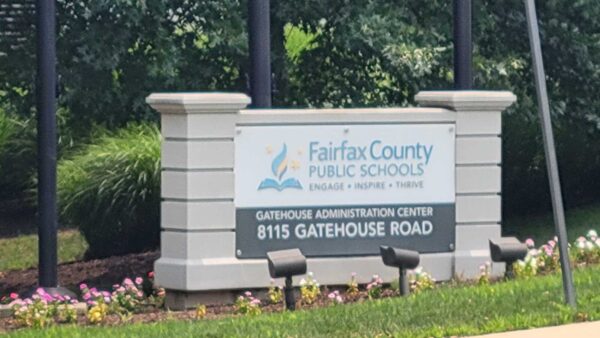
Fairfax County Public Schools will examine its use of instructional apps and software, following two recent unanimous votes from the school board.
At its Oct. 8 meeting, the Fairfax County School Board approved a carve-out in the division’s digital device restrictions to allow kindergarteners in need of additional reading support to use the literacy program Lexia during this academic year — a move that affects about 30% of kindergarteners.
The board then directed Superintendent Michelle Reid to review the cost and instructional efficacy of Lexia specifically, along with all other instructional apps and software, excluding Microsoft Word, Google Suite, and similar apps.
“I’m concerned both with Lexia and other apps and software that [are] in use in our schools that we’re devoting enormous amounts of time, especially in recent years … to having students in front of screens when these tools are not proven to be effective,” said Mateo Dunne, who represents the Mount Vernon District on the school board.
“Because every minute we dedicate students to being in front of a screen, it’s harming their psychological well-being,” he continued. “It’s harming their academic outcomes, and it’s putting them in front of something other than a teacher. And we know human teachers are the best way to ensure that students receive a world-class education.”
Lexia is an approved option from the Virginia Department of Education for meeting 2.5 weekly hours of additional reading support. While FCPS already uses dedicated teacher support for about half that time, it hadn’t made any provisions in the budget for additional staff-led time.
But in July, the board passed a resolution prohibiting issuing devices to pre-K and kindergarten students, with the exception of students who use them for Individualized Education Programs, 504 plans, translation purposes, or multilingual education support. That prohibition, given the lack of funding for additional reading support, led to the division’s current conundrum.
Not everyone agreed with Dunne’s assessment of Lexia. Some board members said the problem isn’t necessarily the program itself, but that the technology or delivery of lessons is only effective for some learners.
Right after approving an exception from FCPS’ kindergarten tech ban for Lexia, the school board directed Reid to develop a policy allowing parents to opt their children out of using that program and a digital math program called ST Math.
That vote was more divided, with eight yeas, two nays, and two abstentions.
“My worry is we have parents who are in the know, who have access to resources, and they’re going to jump on this opt-out if they want to reduce screen time for their students,” said Ricardy Anderson, the board’s Mason District representative, who had voted against allowing the use of Lexia at all.
“We have other parents who may want the same thing,” she continued, “but because of life circumstances, they are not going to engage in this opt-out. So, we are going to create yet another opportunity for [a] divide between those who are in the know and those who are not, and their children having some very different experiences.”
But Springfield District Representative Sandy Anderson called the development of an opt-out policy “a logical extension” of the decision to allow Lexia.
“We have parents that clearly would like a choice as to whether or not their children utilize digital learning tools like Lexia and ST Math, and this is all that follow-on does,” she said. “It gives parents a choice for these two programs.”
Several board members expressed hope that the newly approved plan to use the program won’t be a permanent solution.
“It is my hope that we come up with a better solution,” Franconia District Representative Marcia St. John-Cunning said. “I just don’t think we can come up with it immediately, and kids are in classrooms now. They need the support now. This is what we have in place now. Let’s work with this as we start.”
FCPS students will be evaluated to determine whether they need reading interventions around the end of October, and those who receive a reading plan will have it in place around mid-November, staff told board members.
The school system will then develop a communication plan and strategy to inform families of their ability to opt out of Lexia, though there isn’t yet a strict deadline for that in place.
What alternatives to Lexia will look like will vary from school to school, depending on staffing and the number of students who need a reading plan at each school. Staff noted that there are about a dozen schools where around 50% of students needed reading plans; the cost of the opt-out is unknown.
Hunter Mill District Representative Melanie Meren expressed frustration over the lack of consistency in the technology policy — as well as several other items raised by speakers before the board earlier in the meeting, such as weapons detection duties for teachers. She argued that the public is asking for consistency in FCPS policies.
“I am begging this board to slow down, prioritize the AI and tech policies, and keep our eye on the prize, which is: what do we think is the role of instructional technology in learning?” said Meren. “Everything else comes from there.”
Tom Dannan, the Braddock District representative, supported an opt-out policy for potentially providing flexibility to teachers who use Lexia effectively, while providing students with an alternative pathway if needed.
“It feels sometimes like we are trying to solve a societal problem at the school board level,” he observed, urging parents to prepare their children for a future in which the use of technology in classrooms “is going to be very limited or totally restricted.”
“I remember speaking with one staff member a few weeks ago, who talked about staffing the kiss-and-ride line in the mornings and having kids who are screaming getting out of a car because they couldn’t last a five-minute car ride without a tablet,” Dannan said. “… I’d encourage fellow parents to take a hard look at what we are doing to our kids … to make sure that they’re set up for success.”
