

Level Up is a K-8 math program that finds the skills holding a child back and builds from there. levelupmath.com
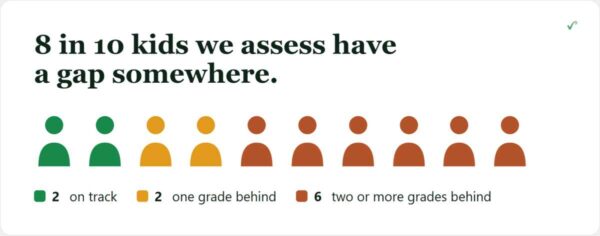
Nearly four in five parents say their child brings home mostly B’s or better. We built a K-8 math program, and when we assess children, about 8 in 10 turn out to be at least a full grade behind in some area of math.
Most children are behind somewhere
In our first study, about 6 in 10 of the children we assessed were two or more grades behind somewhere, usually in one or two areas.
Is our test simply hard? No. Our results are close to those of the federal NAEP test, which finds only about 1 in 4 US eighth graders proficient in math.
How good grades hide gaps
A child who has learned this week’s steps can get the worksheet right without knowing why they work. That is often enough for an A or a B, until a test asks for more.
Homework looks fine too, since it practices the topic just taught. Neither shows the missing earlier skill, so extra practice goes to this week’s topic, not the gap underneath.
Even Virginia’s state test can reassure too easily: a 2026 federal study put its 2022 fourth-grade “proficient” bar in math among the nation’s lowest.
Why gaps get bigger
Math builds on itself, so a missing skill does not stay small. Kindergartners we assess are almost never behind, but from third grade on, more than 9 in 10 have a gap somewhere. Research agrees: children who start behind tend to fall further behind, and fifth graders’ grasp of fractions predicts their high-school algebra results.
What trips children up
Our second study looked at more than 10,000 answers from more than 250 children who recently signed up for Level Up, including questions from earlier grades.
The misses were not math in general: basic multiplication and division facts mostly held up. What tripped them up was a few topics from a grade or two earlier, the ones this year’s math is built on: second-grade subtraction at the end of fourth grade, fourth-grade fraction word problems at the end of fifth, and fifth-grade decimal ordering at the end of sixth.
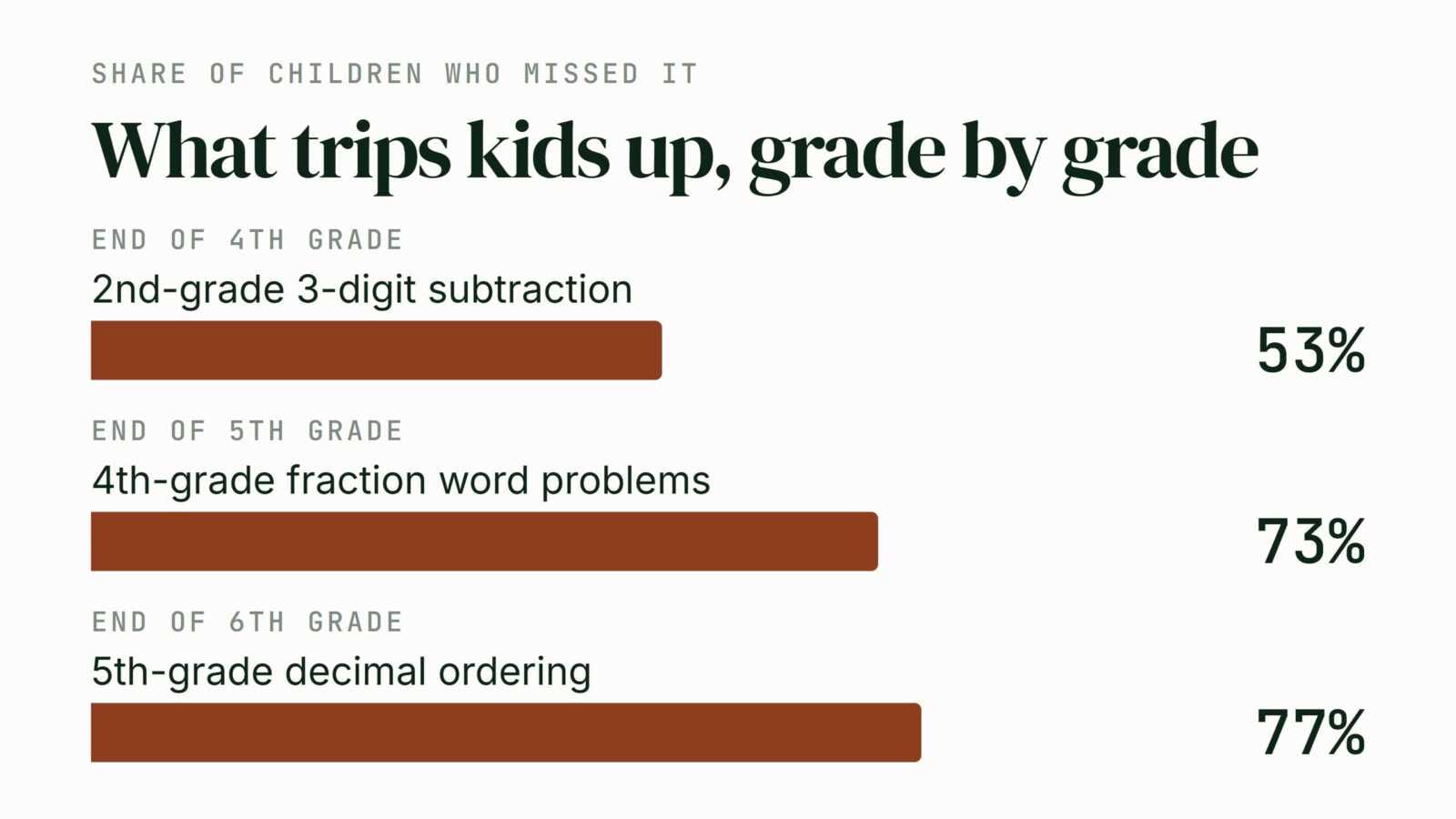
Fractions kept coming back: among children finishing seventh grade, about 8 in 10 of those asked missed fifth-grade fraction word problems.
What closes a gap
One child in our study, just out of fifth grade, missed a fourth-grade fraction question and its fifth-grade version. Practice started with the fourth-grade topic. Within two weeks, the child had mastered all nine of its skills, then four from the fifth-grade version.
That is the approach: find the real gaps, start at the deepest one, and practice each skill from three sides:
-
Identify: recognize the idea, like picking which picture shows three quarters.
-
Construct: build the answer yourself, like marking three quarters on a number line.