

The Fairfax City Council will vote on the future of a much-debated trail planned in the heart of the city later this month.
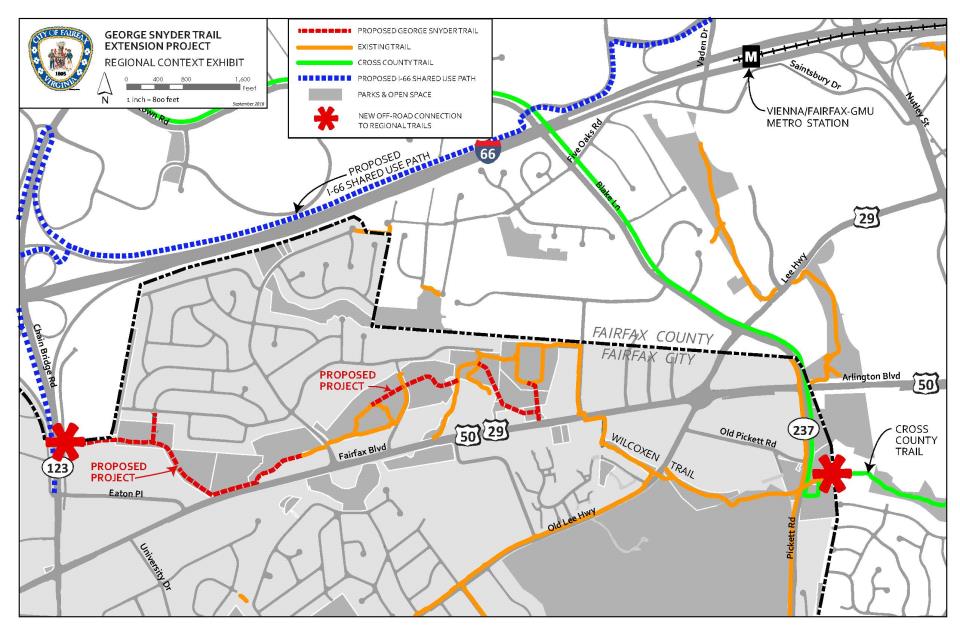
During a meeting on Tuesday (Jan. 9), the city’s transportation director, Wendy Sanford, presented the council with options for proceeding with the George Snyder Trail project, which will complete a 2-mile trail along the southern side of Accotink Creek between Chain Bridge Road (Route 123) and Fairfax Blvd (Route 50).
Plans for the Snyder trail have been underway for more than a decade, but the project has drawn some criticism from environmentalists who say it will eliminate hundreds of trees, negatively impacting the area’s woodlands.
A group of city residents sent an email to the city council and staff on Jan. 2 urging them to consider alternatives that would add a trail or bicycle lanes on existing streets, such as Fairfax Blvd, Cardinal Road or Eaton Place.
The planned route has gotten support from bicycling advocates, who say it’ll fill a missing link in the region’s bicycle network, particularly in the I-66 corridor.
In a presentation, staff recommended the council either continue with the proposed changes or modify it by only constructing the western portion from Chain Bridge Road to Fair Woods Parkway.
“To continue with the project as proposed, that would mean putting the project out to bid,” Sanford explained. “We have the 100% [design] plans to continue with the right-of-way acquisition.”
If the city cancels the project, Sanford said it would be required to repay some or all of the $3 million it has already spent, potentially affecting the city’s ability to be awarded funds for future projects.
Sanford noted that the suggested modification would reduce the overall cost, while still delivering some of the trail. However, Councilmember So Lim pushed for a cancellation, saying she thinks “it’s all or nothing.”
Councilmember D. Thomas Ross disagreed and said cancelling the project could have a negative impact on taxpayers.
“We’ve heard consistently the concerns about cost of operation and development and maintenance of the trail if it’s completed as proposed,” he said. “It’s going to be nothing compared to what we hear when we start talking about paying up to $3 million.”
Mayor Catherine Reed was also against canceling the project, but said she won’t participate in the scheduled vote on Jan. 23 unless there’s a tie.
“What what we understand about environmental impact is significant. No one is saying here that there’s no impact in building this trail, but we have heard it described as destroying a forest,” Reed said.
Anna Safford, the city’s urban forester, acknowledged the environmental concerns surrounding the trail, but said recreation helps to protect land.
“If you don’t use land, you lose land, but at the same time, recreation isn’t conservation,” Safford said. “And there is a very big difference in the land types along this corridor.”
Tom Blackburn, advocacy chair for the Audubon Society of Northern Virginia, said the organization opposes the trail because at least 600 mature trees will be destroyed to construct it.
“The construction of the trail will cause damage to trees and soil for the entire length of the trail that will not be rectified in the lifetime of anyone currently alive,” Blackburn wrote in an analysis conducted back in October.
Fairfax Alliance for Better Bicycling President Bruce Wright told FFXnow that, while a number of trees will be removed, the long-term benefits of the trail outweigh the negatives.
“The 2-mile trail will provide a paved, ADA-compliant shared-use path of 8-10 feet wide, accessible to people of all ages and abilities,” Wright said. “In places like Reston, the paved trails that wind through wooded stream valleys are often cited as the most popular features of the community. The Snyder Trail will also connect to nearby stores and restaurants at Northfax and Fairfax Blvd.”
David Sieracki, a 32-year resident of the city, also supports the trail and highlights the “likely increase in property values” that the trail will bring to some area residents.
“The National Association of Realtors (NAR) has studied this issue and has determined that such trails increase the value of nearby homes by an average of 4% and in some cases as much as 15%. They also debunk the notion that trails bring an increase in crime,” Sieracki said.
The council agreed to vote on a resolution at its next meeting on Jan. 23.
