



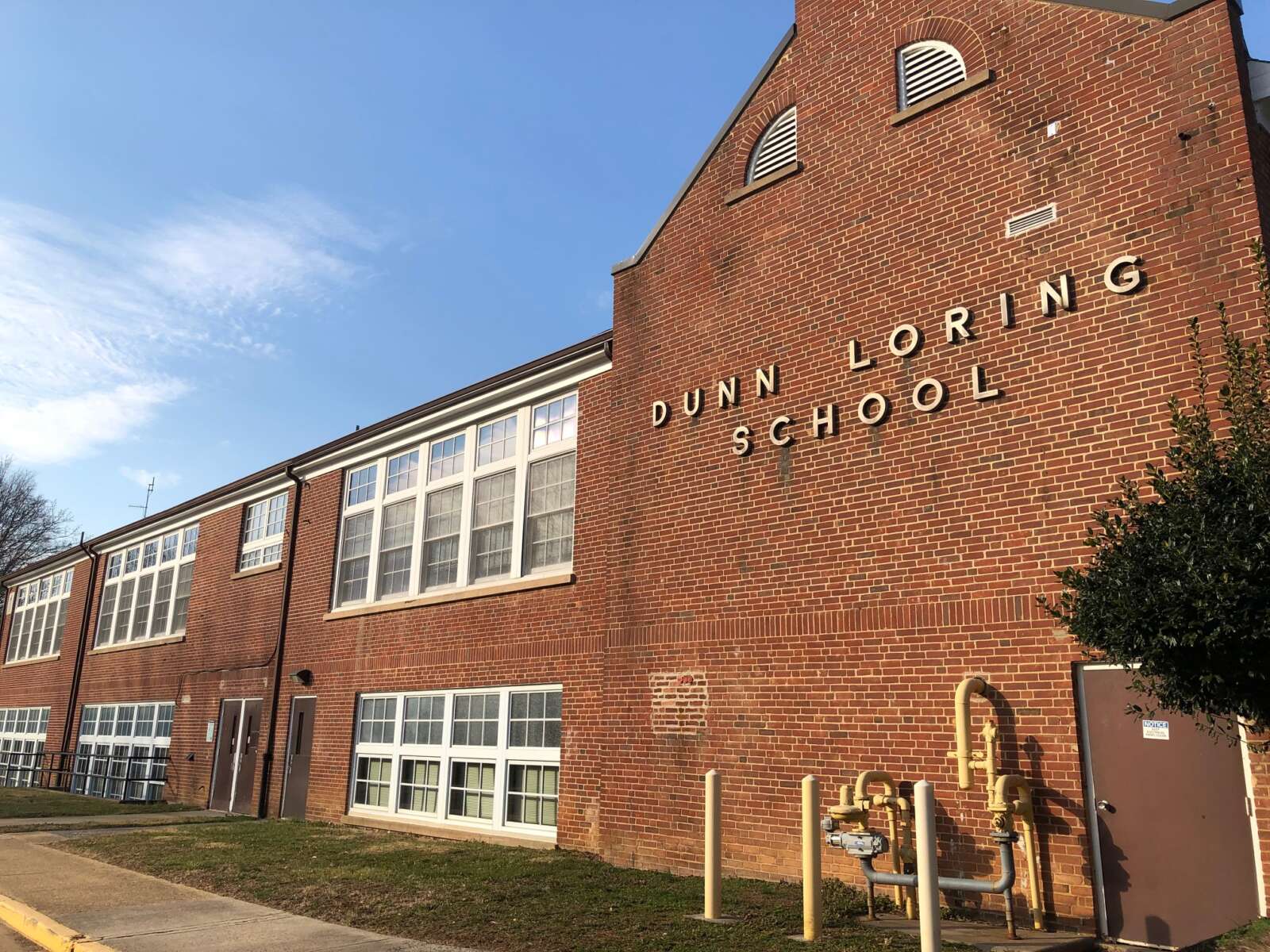
Fairfax County school officials will try again this month to win planning commission support for the proposed new Dunn Loring Elementary School.
“Clearly, we need to do a little more work — [to] get all the pieces right,” Providence District Planning Commissioner Jeremy Hancock said last Wednesday (Oct. 30) after more than two hours of presentations, discussion and public comment.
As a result, commissioners voted unanimously to defer action for two weeks in an effort to tie up loose ends before the body votes on its final recommendation.
“There’s a desire for more information,” Hancock said as the clock approached midnight.
Whether that delay will impact the timeline on a project that has encountered its share of setbacks remains to be seen. A hearing by the Board of Supervisors, which has final say on zoning changes, is on the agenda for Nov. 19.
The proposal to raze the existing Dunn Loring Administrative Center at 2334 Gallows Road and replace it with a new school drew concerns from community members about impacts on traffic congestion, pedestrian safety, water runoff, tree preservation and encroachment on neighboring properties.
Speakers also argued that Fairfax County Public Schools hasn’t seriously explored saving the existing structure, which is listed on the county’s inventory of historic sites, and didn’t conduct adequate outreach with the community.
Concerns of nearby residents “have been completely ignored,” Rebecca Cate, representing the Dunn Loring Community Association, testified at the Oct. 30 hearing.
Braddock District Commissioner Mary Cortina said FCPS leaders were acting as if they don’t need to comply with the county government’s planning process, including robust community engagement.
“They are not the federal government or the state government,” Cortina said. “If this was not a school, if it was a regular applicant, we would be, like, ‘no.'”
The planned new school would have four stories, accommodate about 900 students and 100 staff, and contain about 118,000 square feet of space. It will be used to accommodate growth in the area of the county between Tysons to the north and Merrifield to the south.
FCPS leaders decided to build up rather than out to save the athletic fields and open space that occupy the western part of the parcel. The overall floor-area ratio (FAR) of the project — which represents the building’s total square footage divided by the parcel’s square footage — comes in at 0.3.
The existing, two-story administrative building operated as an elementary school from 1939-78. Designed by a state government architect who also worked on other school buildings around Virginia, the school was built by the Works Progress Administration during the Great Depression on land sold to the school system by a man who had, decades earlier, been enslaved.
According to its webpage for the project, FCPS had a design consultant evaluated the possibility of preserving some or all of the building. The review found that reusing the building would present challenges to meeting “current educational requirements” and “significantly” increase costs.
FCPS intends to preserve artifacts from the original building and display them at the future elementary school.
“Additional ways to honor this important history are also being considered,” FCPS says.
However, the decision not to preserve the existing building, or incorporate parts of it into new construction drew the most vocal criticism at last week’s hearing from both community members and planning commissioners.
“I’d like FCPS to slow down and examine the big picture,” said Tammy Mannarino, a member of the Fairfax County History Commission who was speaking on her own behalf.
An attorney for FCPS explained that school leaders didn’t run their plans through the county’s Architectural Review Board (ARB), because that step isn’t required for new construction.
That may have proved a tactical error. ARB Chair Christopher Daniel testified that a vote should be delayed, or the proposal outright rejected.
Failing to gather the board’s input represented “missed opportunities” to make the project better, he said, making the case that the site has cultural and historic significance and its demolition risks “losing an irreplaceable link to the county’s past.”
Planning Commission members seemed to be on the same page.
“The historical aspect hasn’t been addressed enough,” Sully District Commissioner Evelyn Spain said. “There’s so much richness that needs to be brought forth and kept.”
While concurring that more discussion was warranted before final action, commission chair Phil Niedzielski-Eichner said he’s nonetheless “sympathetic to the challenge the school system has.”
“There’s just a huge backlog of unmet needs,” he said. “Further delay … means higher cost.”
The project will be funded by school bonds approved by voters in 2019 and 2021.
The $36.8 million from the 2019 bond sales were originally destined for a school in the Oakton area, but with the selected site of Blake Lane Park sparking objections, the Fairfax County School Board voted in January 2021 to instead use the funds for a school to serve the Dunn Loring and Pimmit Hills area.
However, some community members, including the McLean Citizens Association, have argued that there are more pressing needs in other parts of the county.
While an initial timeline envisioned construction beginning this fall, Hancock said “we’re years away” from getting the school opened.
