


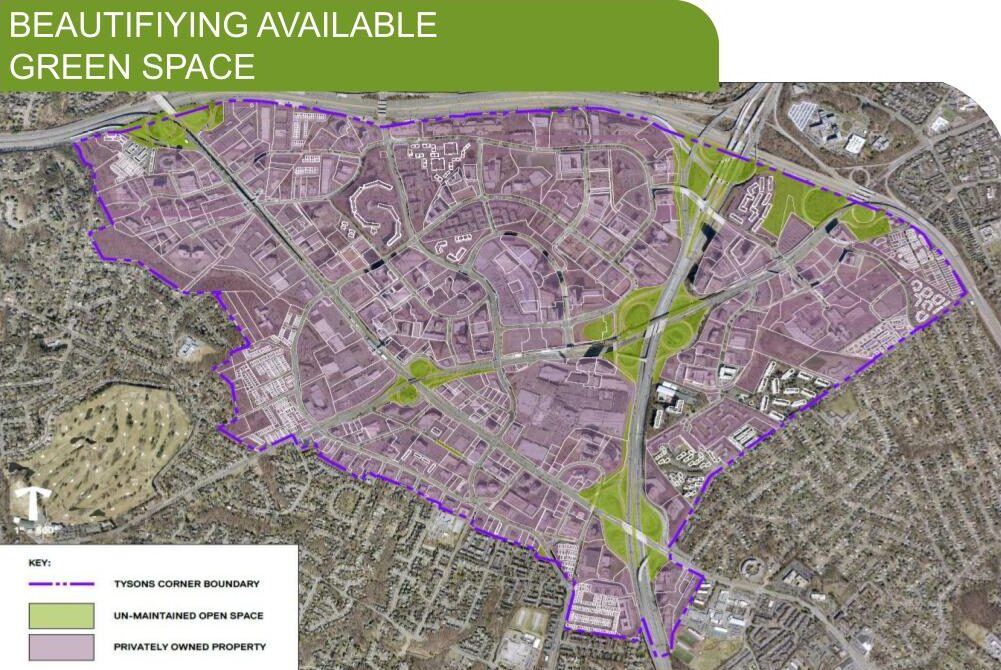
The Tysons Community Alliance (TCA) is turning to the Virginia Department of Transportation for support in its effort to spruce up the area’s highway interchanges.
Building on an ongoing pilot project focused on the Route 7 and Route 123 interchange, the booster organization plans to apply for the state’s Comprehensive Roadside Management Program (CRMP), which lets sponsors landscape and maintain in areas within VDOT’s right-of-way.
If its application is approved, TCA will be the first entity in Northern Virginia to participate in the under-the-radar program, according to VDOT.
Though the exact scope is still being worked out, the beautification initiative aims to eliminate invasive plants and replace them with more intentionally managed landscapes that benefit pollinators, while also making Tysons’ roadways “more pleasant and safer” for pedestrians and bicyclists, TCA project manager Jason Zogg says.
“Having these iconic landscapes that are professionally managed and professionally maintained would improve the perception of Tysons [and] help build the new identity of Tysons into a world-class urban district as Tysons transforms,” Zogg told FFXnow in a recent interview.
Pilot site advances to planting phase
The Tysons beautification project grew out of a proposal from SCG Development President Steve Wilson, who decided “something needed to be done” about the unkempt open spaces he noticed when driving through the area’s major interchanges.
With support from Fairfax County staff, including Providence District Supervisor Dalia Palchik’s office, SCG Development partnered with the TCA to clean up the southwest loop of Route 7 (Leesburg Pike) and Route 123 (Chain Bridge Road) as a “proof of concept” that they hoped could eventually be replicated at other sites.
After the developer, which has its headquarters in Tysons, funded and managed the removal of invasive species this past spring, the TCA anticipates starting to plant trees and shrubs sometime this month, likely around Thanksgiving, according to Zogg. A sign advertising the project was erected on the site on Monday (Nov. 11).
The trees will be planted in a spiral to give passing drivers the illusion that the entire space is filled, while also ensuring there’s enough space for them to grow.
“All of these trees also have some type of either really nice fall color or really nice … spring flowers, one or the other,” Zogg said. “So, as you’re driving around that circle, it’ll be a very pleasant experience, especially in the spring and the fall, when they fill in.”
The project team hopes to take advantage of spring rains by waiting until next year for the pilot’s final phase, which will involve planting seeds for wildflowers and grasses to create a pollinator meadow.
In addition to giving the TCA insight into the landscaping process, including permitting and hiring a contractor, the pilot project has been eye-opening when it comes to just how difficult and expensive it is to tackle invasive species, Zogg says.
“I hope that people out there who have backyards or gardens, they pay more attention to the invasive species in their backyards, because it has significant implications and significant costs when things spread,” he said.
How the Comprehensive Roadside Management Program will work
Based on the lessons learned from the pilot, the TCA has opted to take advantage of VDOT’s existing program to expand its beautification efforts throughout Tysons instead of starting from scratch.
Established by state law in 2004, the Comprehensive Roadside Management Program is open to local governments, businesses, nonprofits, community groups and individuals that agree to take responsibility for landscaping and maintaining land in VDOT’s right-of-way in perpetuity.
The program has a number of participating localities, such as Roanoke County, but it hasn’t received an application since Hanover County submitted one in 2022, according to VDOT.
“Participation in the CRMP has varied over the years,” a VDOT spokesperson said. “Local governments often join the program with businesses or civic organizations to share the costs for beautification activities, and that cost can be a factor that limits participation.”
Before applying for the program, the TCA will evaluate the existing conditions at different interchanges in Tysons and determine which sites could support a project based on VDOT’s requirements, which include a minimum funding commitment. Sites scheduled for construction within the next six years or that have utilities, sidewalks or other elements that could conflict with the landscaping are off limits.
Based on input from a landscape architect, county staff and local landowners and stakeholders, Zogg anticipates narrowing the potential sites down to five or 10 for the CRMP application, which will need an endorsement from the Fairfax County Board of Supervisors.
The TCA also needs to identify property owners who might be interested in sponsoring a particular site. With all those steps to tackle on top of estimating costs and developing designs, it will likely take “many months” to get another beautification project going, Zogg says.
While the TCA’s focus is on Tysons, Zogg hopes its beautification efforts will inspire other communities to follow suit.
“If we do this well, perhaps other jurisdictions in Northern Virginia might be interested in taking advantage of this VDOT program that’s been around for over a decade,” he said. “Hopefully we can be that proof-point of how to use this program for good.”
