

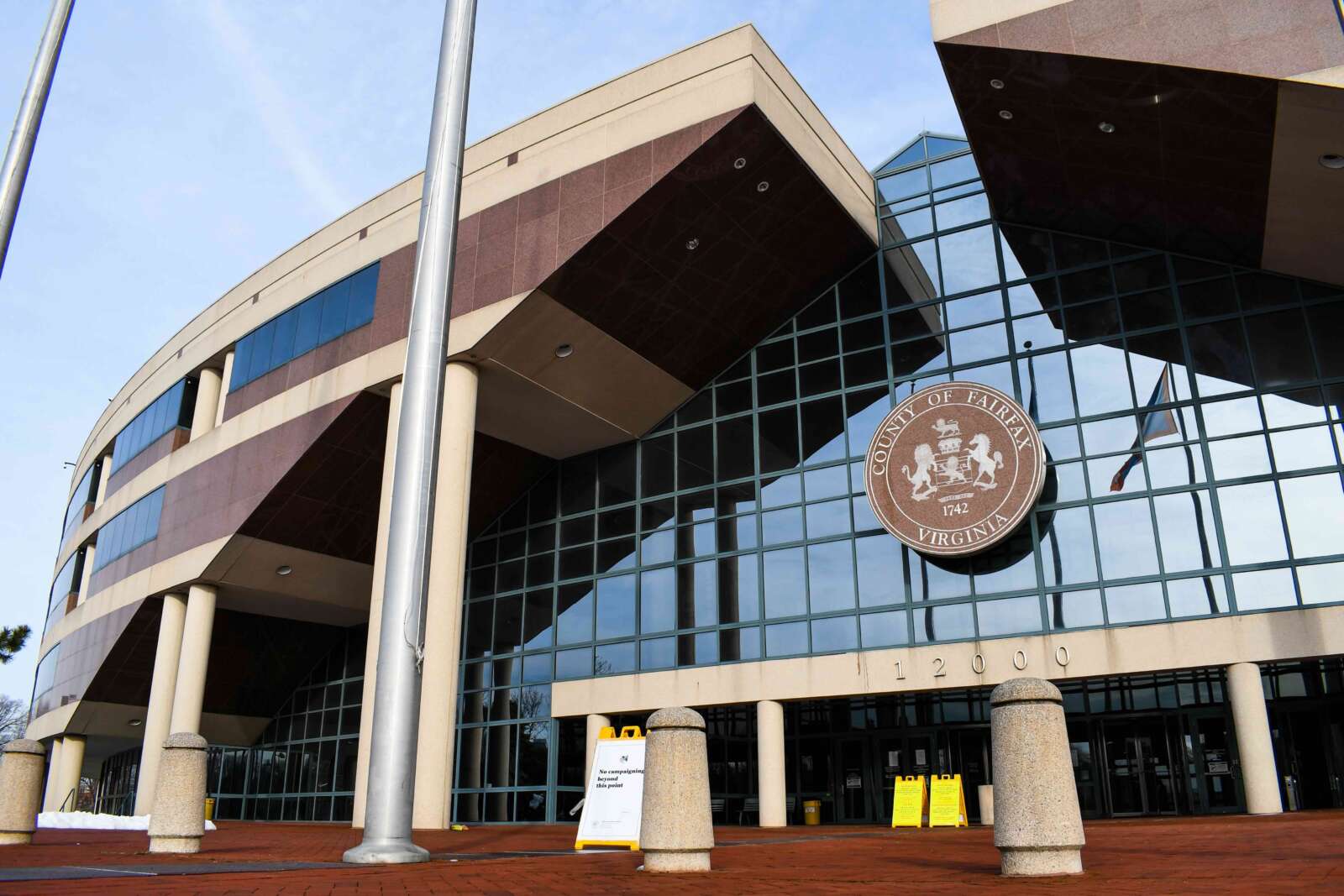
Additional taxes, including the possibility of a meals tax, program and staff cuts and less-than-requested funding for the school system are all incorporated in the Fairfax County government’s draft $5.7 billion fiscal year 2026 budget proposed by County Executive Bryan Hill.
“I don’t think anybody is happy with this budget, but this is where we are,” Hill said when delivering his proposal to the Board of Supervisors this morning (Tuesday). “We have been working diligently to figure out how to make this mildly palatable, to find the right balance.”
Crafted without taking into account the possible impacts of federal funding and workforce cuts, the package proposed by Hill represents an rise of 4.2% in General Fund revenue, including a proposed property tax-rate hike, but rising costs make that increase insufficient to meet expenses, even with the most significant budget cuts in over a decade, he said.
As part of the budget plan, just over 200 county government positions are slated for elimination. More than half of them currently are unfilled, and those who might see their jobs eliminated would be offered other positions within the workforce if possible, Hill said.
Hill said the suggested program and staff reductions total $59.8 million, the largest dollar amount since over $90 million was cut in fiscal year 2010 following the 2008 recession.
On average, the proposal slashes all agency budgets by about 3.4%. The county executive had requested that all departments identify 10% in reductions to address a projected $292.7 million deficit.
“These are not fake” and would have real implications, Hunter Mill Supervisor Walter Alcorn said of the package of cuts.

Impact on homeowners
Hill proposed an increase of 1.5 cents to the real estate tax rate, bringing the rate to $1.14 per $100 of assessed value if it’s adopted by the Board of Supervisors.
The extra 1.5 cents would bring $50.9 million to county tax coffers. A typical homeowner’s tax bill would increase by about $638 — 7.6% — counting both the higher rate and increased home-value assessments that hit more than 90% of Fairfax homeowners this year.
Real-estate taxes are relied on by most Virginia jurisdictions, including Fairfax, for the bulk of revenue. Hill’s budget anticipates $3.8 billion in the coming fiscal year.
A number of supervisors gave early indications they weren’t happy with the impact on residents that a double-whammy of higher assessments and increased tax rate would bring.
A 1.5-cent increase is “far too high,” given current conditions and uncertainty about the future, Chairman Jeff McKay said.
Such an increase is “more than I can personally bear,” Braddock District Supervisor James Walkinshaw added.
“We have to do more with less. We are going to be in that era for the foreseeable future,” Walkinshaw said.
He pointed not just to decisions being made in D.C. and Richmond that will impact the local economy, but also the prospect of elevated inflation levels.
“When costs rise for families and businesses, costs rise for government, too,” he said. “We could find ourselves in that situation again.”
Tax revenue from office buildings continues to tumble, with the county reporting a 22.1 million square feet of vacant space out of the 119.9 million square feet that’s been built, as of the end of 2024. Coupled with the increase in home valuations, the decline in office will reduce commercial properties from 15.6% of the total real estate tax base this fiscal year, which ends June 30, to an estimated 14.8% in the new fiscal year.
Localities like Fairfax rely on a robust commercial office sector, as they bring in healthy revenue while requiring relatively little in services. Hotels and data centers are among the commercial properties that have increased their revenue contributions, according to Hill.
School funding
Hill’s budget proposal calls for a $118.6 million increase in funding for Fairfax County Public Schools, bringing the county’s total transfer amount to about $2.7 billion. That falls short of a request for an additional $268 million from Superintendent Michelle Reid.
Fully funding Reid’s request would add an additional 4.5 cents on the real estate tax rate, the county executive said, who said he wasn’t happy about being unable to fulfill the FCPS request.
“A tight budget brings difficult choices,” he said.
Perhaps even more so than the county government, the school system is facing fiscal uncertainty owing to issues at the state and federal levels.
In Hill’s proposal, the school system would receive 51.5% of General Fund revenues. But stark choices by school leaders may await if his recommendation is ratified by supervisors, including whether the School Board will be able to fulfill promises made to its staff through the new collective-bargaining process.
“There may be some very difficult decisions our colleagues on the School Board may have,” McKay said.
Meals tax on the table
Hill didn’t formally propose imposing a countywide meals tax, but if implemented, it could be used to avoid a real estate tax increase.
A 3% meals tax starting in January 2026 would bring in $48 million for the final six months of the budget year, which could be used to eliminate the need for a real-estate tax rate increase, according to county staff.
A 4% tax would permit a net reduction in the current tax rate, or a combination of lowering rates and restoring proposed cuts, according to the county executive.
McKay said his “strong preference” was to use meals tax revenues to offset the tax rate on real estate, and seemed to be leaning toward 3%. State law allows localities to impose rates up to 6%.
Providence District Supervisor Dalia Palchick indicated a preference to use meals tax revenue to ease human services cuts, while Hunter Mill District’s Walter Alcorn said some of the funding could be used to further support affordable housing goals.
The board’s lone Republican, Springfield District’s Pat Herrity, expressed skepticism of tying imposition of the meals tax to a reduction in real estate taxes.
“It’s obviously a set-up,” Herrity said, noting that county voters twice had rejected a meals-tax referendum. The General Assembly later changed state law to eliminate the referendum requirement.
The towns of Herndon and Vienna already impose meals taxes within their boundaries. Any Fairfax tax would not be applicable there.
County staff pay
For general county employees and non-union public safety workers, Hill proposed a 2% cost-of-living increase, plus performance, merit and longevity increases for those eligible.
As determined by a collective bargaining agreement approved in 2023, unionized firefighters would receive a pay-scale adjustment of 3.1% plus merit increases. Police would receive a 2% scale adjustment, a 2% cost-of-living increase, plus merit and longevity increases for those eligible.
Affordable housing
Hill’s budget dedicates 1.25 cents of the overall real estate tax rate to furthering the county’s goal of creating 10,000 net new affordable housing units by 2034. That’s up from the current penny, with the higher rating increasing to $42.44 million in fiscal 2026.
Herrity said he was “struggling” with authorizing higher funding levels for affordable housing, given the increasing tax burden on all those across the county.
“It’s clear taxes are having an impact on our residents. There are more leaving than coming,” he said.
Hill said he was following board policy on allocating the funds to affordable housing, which Herrity acknowledged.
Upcoming bond referendums
Hill proposed a series of annual bond referendums for capital projects sent to county voters over the next four Novembers.
It would begin with a $346 million bond package for fiscal year 2026 that incorporates $180 million for the Fairfax County Park Authority; $125 million for human services programs, including $25 million for early childhood education facilities; and $41 million for libraries, including upgrades to the Herndon Fortnightly and Kings Park branches.
Future-year referendum packages totaling an estimated $1.1 billion are on the horizon for fiscal years 2027, 2028 and 2029. They will be aimed primarily at transportation and education projects.
Efforts are being made to find efficiencies in capital projects in the future pipeline, Hill said. “We must apply the same level of scrutiny” as with the general-fund budget, he said.
Uncertainty persists at federal, state levels
Hill said the budget proposal was developed before the arrival of the Trump administration on Jan. 20, and that budget uncertainty at the federal and state levels will have “enormous potential impact” both short-term and long-term.
The current situation in D.C. represents “a much higher risk to Fairfax County than Covid ever did,” McKay said, because the impacts are being directly felt by the 80,000 federal workers and thousands more government contractors calling the county home.
“Every day, we’re seeing a worse impact … than we’re seeing the day before,” he said. “Thousands of people have lost their jobs. Northern Virginia’s economy is under attack.”
Walkinshaw turned his rhetorical fire toward the state government, focusing on “severe and shameful under-funding,” particularly on education, while Gov. Glenn Youngkin and legislators are embracing “pretty significant” tax cuts.
Next steps
Hill’s Feb. 18 presentation kicks off a three-month process.
The Board of Supervisors’ Budget Committee will hold meetings on Feb. 25 (jointly with the school board), March 11 and March 25. The board is expected to authorize legal advertisements on the real estate tax rate, proposed food tax and a potential increase in the local transient-occupancy tax rate from 2% to 6% on March 18.
Public hearings are slated for April 22-24, with final budget adoption slated for May 13. The 2026 fiscal year goes into effect July 1.
Advocacy groups were quick to begin weighing in on the proposal.
“We need long-term solutions,” the Fairfax Workers Coalition, which provides support to employees unrelated to recognized collective-bargaining units, said. “We need to restructure the county government, bring everyone in to examine costs, needs, and plan for our future.”
As they do every year, county officials said the county executive’s presentation ended one phase of budgeting and kicked off the public-review phase
“There will be a lot of time for deliberation in the months ahead — [I] look forward to that conversation with our community,” McKay said.
