


In the wake of the country’s longest-ever federal government shutdown, a key safety-net organization is calling for a renewed emphasis on helping lower-income, working residents achieve economic independence across Fairfax County and the broader D.C. region.
While welcoming the shutdown’s end on Thursday (Nov. 13), United Way of the National Capital Area President and CEO Rosie Allen-Herring said at a briefing that morning that her organization believes “the impact will be felt, for thousands, for months ahead.”
The looming end of subsidies for American Care Act health insurance policies coupled with the potential of an economic downturn could compound existing challenges for people already struggling to make ends meet, she said.
“The shutdown magnified how fragile financial stability is for many households in our region,” Allen-Herring said in a statement. “For both federal workers who missed paychecks and families who rely on SNAP, the past six weeks have been a crisis of uncertainty, not just inconvenience.”
Based in D.C., United Way provides food, health, education and economic support services to residents throughout the region.
At yesterday’s briefing, United Way officials highlighted the findings of the nonprofit’s recently released report on ALICE households, an acronym that stands for Asset Limited, Income Constrained and Employed.
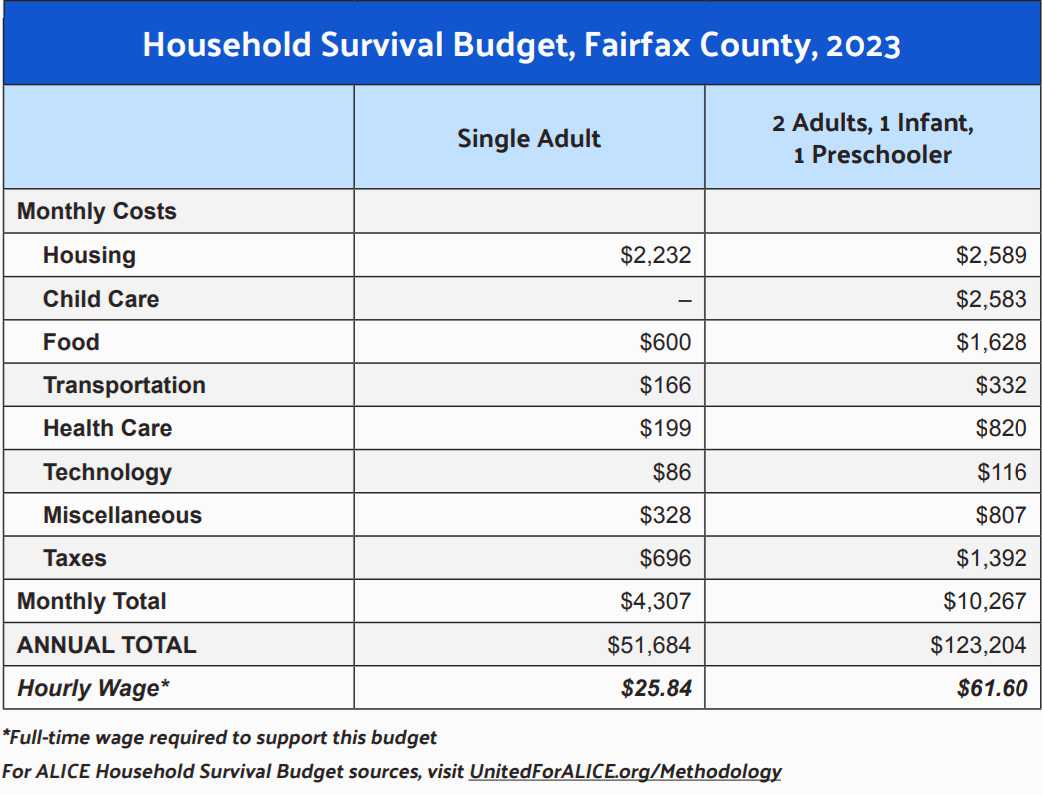
The term refers to people who have a job and live above the federal poverty level but don’t earn enough to achieve an economic “survival budget” for the region, defined as about $49,000 for a single-person household and more than $118,000 for a two-adult household with two young children.
According to the report, the survival-budget figures for Fairfax County are even higher: $51,684 for a single-person household and $123,204 for a family of four, based on the most recent (2023) data that doesn’t fully capture the post-pandemic spike in inflation.
Approximately 100,000 households — one in four — in Fairfax County and the cities of Fairfax and Falls Church fit the ALICE category. That total represents about one in six ALICE households across the region, officials said at the briefing.
Rising costs of food, housing, health care, transportation and child care have led many of those households to live in “a state of perpetual stress and uncertainty” where they face “a constant battle to make ends meet,” said Racquel Farah, a data and research manager at United Way.
Many are “one unexpected event away from slipping into poverty or crisis,” Farah said.
Among those living in the ALICE category is Charlene, a divorced mother of two boys aged 7 and 10 who works full time but still finds it difficult to meet the family’s living expenses.
“It’s still a struggle,” she said. “It’s hard to make ends meet.”
Charlene — whose last name was redacted out of consideration for her privacy — said tackling the issue of ALICE families needs to come to the forefront.
“If we don’t raise the awareness, it’s never going to change,” she said of the challenges facing that economic group.
In response to a question from FFXnow, Allen-Herring said a key focus needs to be “getting public-private partnerships to work” on the issue, and promoting changes in public policy.
“It’s not monolithic. It’s not homogeneous,” she said of ways to address the issues.
The ALICE cohort is “the engine that makes our economy and our local lives run,” Allen-Herring said. “Yet they are often overlooked.”
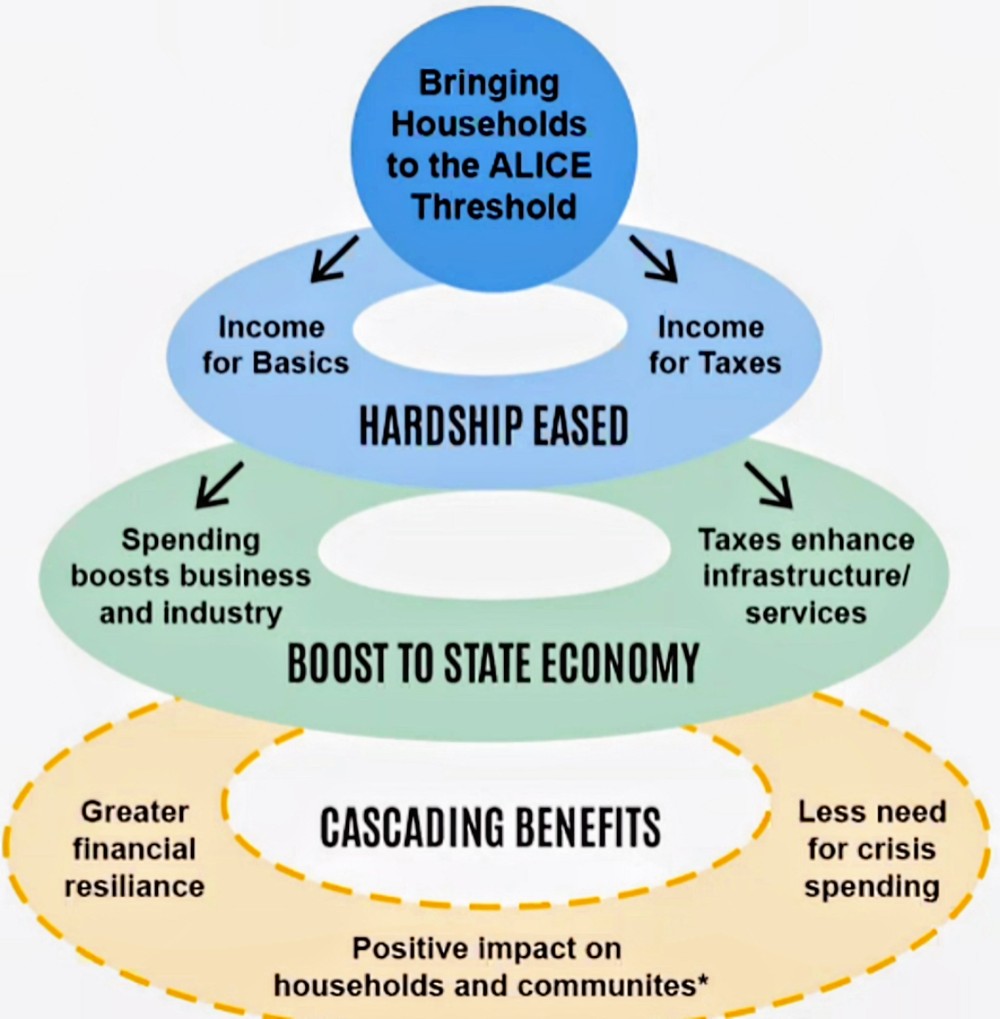
Addressing the needs of those who earn too much to qualify for government assistance, but too little to meet the region’s high cost of living, will benefit more than the individuals themselves, she said.
“Every investment in ALICE … has a ripple effect in the community and our economy,” Allen-Herring said. “Now is the time to meet the moment.”
She and others praised Fairfax County’s One Fairfax policy, which puts equity at the forefront of decision-making. United Way officials said the policy serves as a guide for other localities to follow.
Among the county’s efforts has been an economic mobility pilot, in which households in the ALICE category received monthly cash payments for 18 months to determine the effect on their economic stability.
The effort, which ended earlier this year, won praise from county leaders but likely will not be repeated any time soon due to the county government’s constrained budget situation.
