

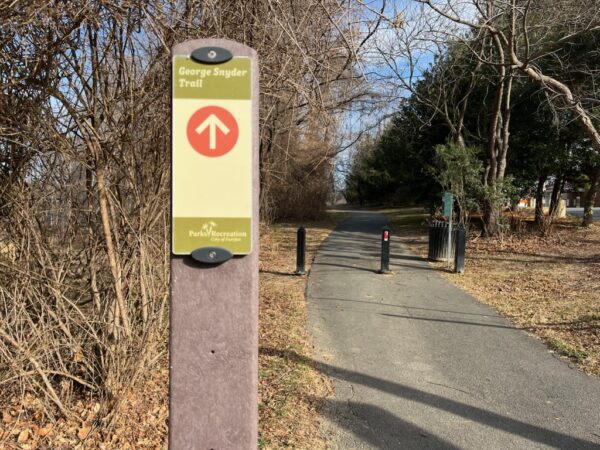
The contentious George Snyder Trail extension will officially remain unbuilt, as the Fairfax City Council opted to nix the project Tuesday (Jan. 13) following more than two hours of public comments.
The council voted 4-2 to cancel the project, with Councilmembers Tom Peterson, Rachel McQuillen, Stacy Hall and Billy Bates in favor and Councilmembers Stacy Hardy-Chandler and Anthony Amos opposed.
Earlier in the meeting, the council voted 3-3 against allocating an additional $4.6 million for the project with funds from the I-66 Outside the Beltway builder’s $500 million concession fee.
The new funds would’ve accounted for higher-than-anticipated construction bids, bringing the total project cost over the $20 million previously allocated to it. The concessionaire funding was approved by the Commonwealth Transportation Board after a recommendation by the Northern Virginia Transportation Authority.
Amos, Hardy-Chandler and Bates were in favor of the funding, while Peterson, McQuillen and Hall opposed it. Mayor Catherine Read — who announced at the end of the meeting that she won’t seek reelection — noted she did not have a vote on the appropriations-related matter under the city charter.
City Council failed to find a consensus in past years on the long-planned trail extension, which would’ve run along the south side of Accotink Creek for about 1.8 miles from Chain Bridge Road (Route 123) to Fairfax Blvd (Route 50), connecting the current George Snyder Trail to the I-66 shared-use path.
Environmentalists have raised concerns about tree loss and hurt the woodland ecosystem, while others pressed for a trail extension to improve connections for pedestrians and bicyclists.
City Council split dooms project

Council members favoring the project cancellation shared support for trails but not the George Snyder extension as it stood.
“This course of action that we’ve been now looking at for a great many years, does not appear to be that course,” said Peterson. “There are other courses out there, and we can recommit ourselves to looking at new opportunities by moving on.”
McQuillen said she visited the trail extension alignment during rainfall to observe the stormwater conditions, which she said “reinforced the environmental, maintenance and safety complexities of this project.”
“I’ve spent significant time reviewing the record, the data, the long-term implications of this decision,” she said. “I support trails. I support connectivity and accessible infrastructure. But I also have a responsibility to evaluate whether a project as currently designed and priced remains the most responsible choice for our community.”
Hall said she would like to return to a simple, less costly “stone dust” trail.
“When you think of a trail, you think of [the] Daniels Run woods,” said Hall. “You think of a trail that runs through the woods, that looks like it belongs there, that doesn’t have these huge walls to protect you from the side of a hill or a mountain or to keep you from off the side of something into the stream restoration area. That, to me, isn’t a trail.”
For more than two years, the council went back and forth as it weighed three options: continue the full project, cancel the project or revise the previously approved plans to include only the western half of the trail. Amos said he supported the third option until he heard both sides of the community opposed it.
“It’s a rare topic where everyone is to some degree correct,” said Amos. “You can like trails, you can even like this trail but acknowledge that there are environmental concerns with it, and I think that’s completely fair and valid.”
Hardy-Chandler was in favor of continuing the project, noting testimony from residents who have supported it from the beginning.
“The trail is an example of things like promises, things like reliability, things like credibility, things like partnership, thinking larger,” said Hardy-Chandler. “It’s about recognizing the history and the origins of what brought this before us, and I do believe it is about investing in the infrastructure for the things that will be part of the future.”
City Attorney Brian Lubkeman noted the Virginia Department of Transportation would treat any changes to the planned trail as a new project requiring a new funding process.
