

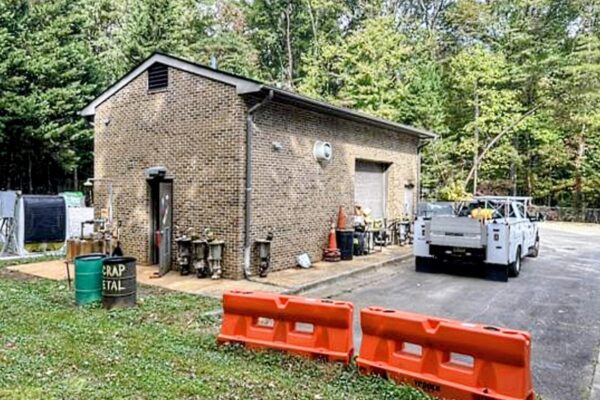
The Fairfax County Planning Commission has approved plans to modernize a facility used to reduce the amount of smelly — in some cases potentially lethal — hydrogen sulfide in neighborhoods near Braddock Road in the southwestern part of the county.
The unanimous vote on Wednesday (Jan. 28) paves the way for the 35-year-old Lincoln Lewis Vannoy Odor Control Facility to be replaced with more updated technology to limit unwanted smells emanating from pressure sewers in the vicinity.
A residential neighborhood to the west of the facility at 5426 Willow Springs School Road off of Braddock Road, users of nearby Patriot Park North and Willow Springs Elementary School students will be the main beneficiaries of the upgrade.
“It’s a pretty straightforward project. The modifications are necessary and need to happen,” Planning Commissioner James Thomas, whose Springfield District includes the project, said at the Jan. 28 meeting.
The 5.2-acre site on which the facility sits is owned by the Fairfax County Board of Supervisors. With the exception of the odor-control plant, most of the parcel is wooded.
Because the project is under the authority of the county government, the planning commission had final say on whether to approve a so-called “2322” review required for changes to public facilities.
With a smell often likened to rotten eggs, hydrogen sulfide is a byproduct of decomposing organic matter, including human and animal waste. Exposure to the compound can cause respiratory and eye irritation as well as headaches and fatigue. In extreme cases, it can be deadly.

County staff told commissioners there have been concerns about smells raised for years in the community.
The existing odor-control facility, located in an enclosed structure, can’t be easily updated with new technology and has to remain operational until its replacement comes online, staff said.
Located adjacent to the existing one, the new facility will feature double-lined containment tanks on a concrete slab over a trench. It will be topped by a pavilion.
The existing building will be converted into storage use after the new one is operational. As is the case currently, county staff will check on the facility once per month.
Members of the planning body had no objections to the new facility, but several raised concerns about what they felt had been a lack of robust community engagement up to that point.
“We typically would like to hear from the community,” Mount Vernon District Planning Commissioner Walter Clarke said.
County staff replied they would be doing more to engage neighbors once the project reaches the 70% design mark in coming months.
Commission members briefly considered deferring action until more engagement took place, but ultimately dropped the idea.
“I do not think it is entirely necessary,” Thomas said of the proposal to defer. “I doubt we’ll get any negative feedback.”
Commission members did secure an informal agreement from county staff to engage in public outreach once the project’s design is more advanced. Anyone with concerns should contact Springfield District Supervisor Pat Herrity’s office, Thomas said.
Until the 1980s, many homes in the nearby communities “still depended on wells and outdoor privies,” according to a local history of what had been an African-American residential enclave in the county.
After the community organized protests about the situation, more than 600 homes in the Lincoln Park, Lewis Park, Vannoy Park, Vannoy Acres and Blevinston neighborhoods were fitted with indoor bathrooms for the first time.
