

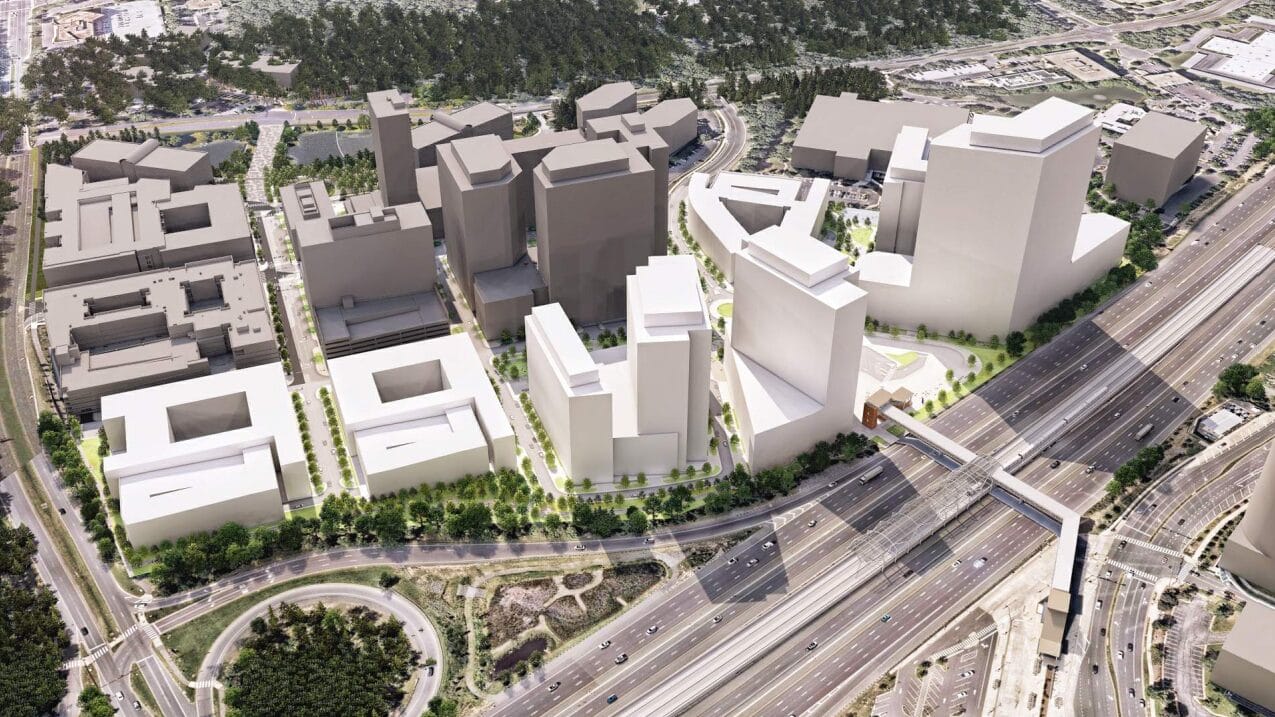
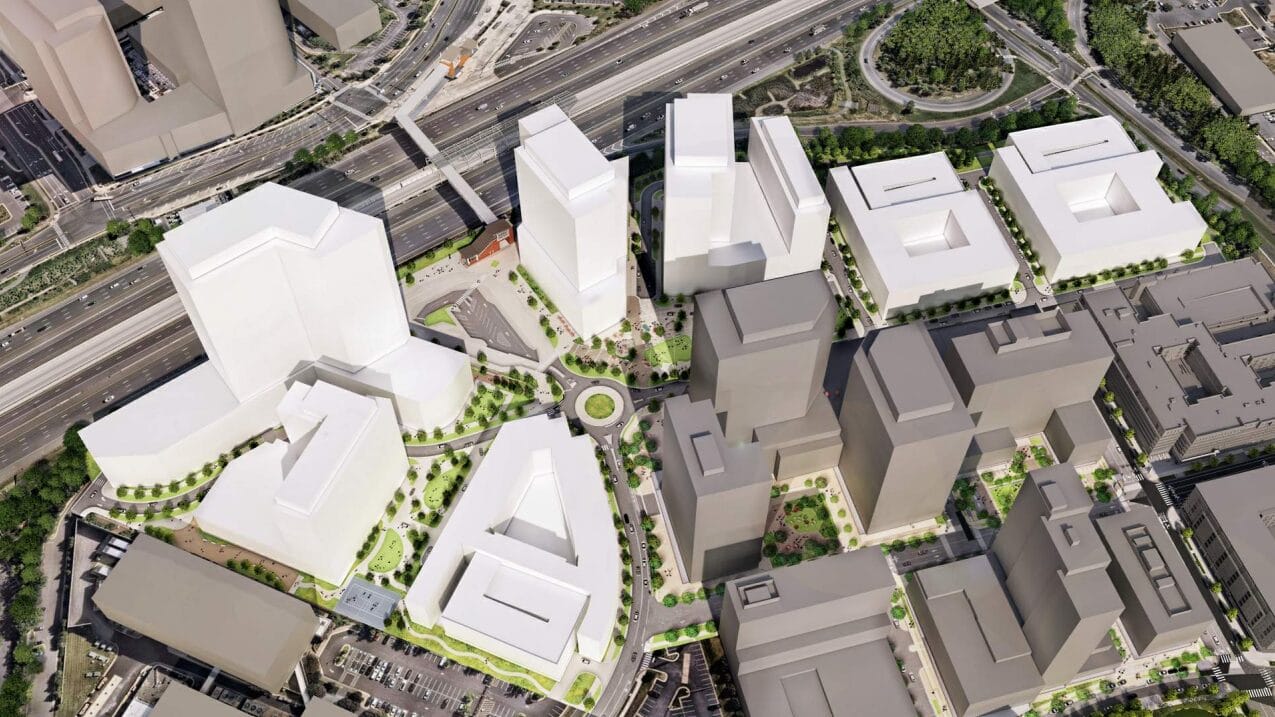
A new developer hopes to try its hand at transforming an office park on the south side of the Reston Town Center Metro station into a fully inhabited community.
Bethesda-based Bernstein Management Corporation is seeking to revive and expand on a mixed-use redevelopment of the Reston Crossing offices that still exists only on paper, nearly seven years after the Fairfax County Board of Supervisors approved the project.
Now the owner of the paired office buildings flanking the Metro station’s kiss-and-ride parking lot at the end of Edmund Halley Drive, Bernstein has proposed replacing them with more than 3.1 million square feet of new development, including 1.48 million square feet of Class A office space, 1.6 million square feet of multifamily housing and 31,000 square feet of ground-floor retail.
“In conjunction with the adjacent Halley Rise development to the south, the Property will form a unified, transit-oriented district centered around the Town Center Station,” Walsh Colucci Lubeley and Walsh land use attorney Andrew Painter wrote in a March 5 statement of justification for the rezoning application.
According to county property records, Bernstein acquired the Reston Crossing office buildings (2001 and 2003 Edmund Halley Drive) from the previous aspiring developer, Tishman Speyer, for $37.25 million on Dec. 11, 2024. The firm then purchased the two Summit offices (2000 and 2002 Edmund Halley Drive) from Brookfield Property Partners for $53 million on April 1, 2025 in an apparent distress sale.
Constructed in 1998 and 1986, respectively, the six-story buildings currently host the headquarters of the software company Ellucian and federal contractor Noblis as well as an office for Jeff Bezos’s Blue Origin, among other tenants.
Tishman Speyer had planned to redevelop the Reston Crossing property with 2 million square feet of office, residential and retail space, a project that would’ve also delivered an elevated pedestrian bridge to the not-yet-open Reston Town Center Metro station and a variety of urban parks.
Though the plan was approved by Fairfax County leaders in June 2019, no portion of the development was ever built “due to evolving market conditions, significant infrastructure requirements, and phasing complexities,” according to Bernstein’s rezoning application.
After acquiring the properties, Bernstein worked with a design team to develop a new vision for the Reston Crossing offices — now designated as “Reston Crossing East” — that incorporated the neighboring Summit offices, now “Reston Crossing West.”
“The Applicant’s proposal will transform the Property from a conventional suburban office use with substantial surface parking into a walkable, connected mixed-use neighborhood,” Painter wrote. “The development will generate sustained daytime activity in support of locally-serving retail and office uses, increase Metrorail ridership, and deliver much-needed, diverse housing options within Fairfax County.”

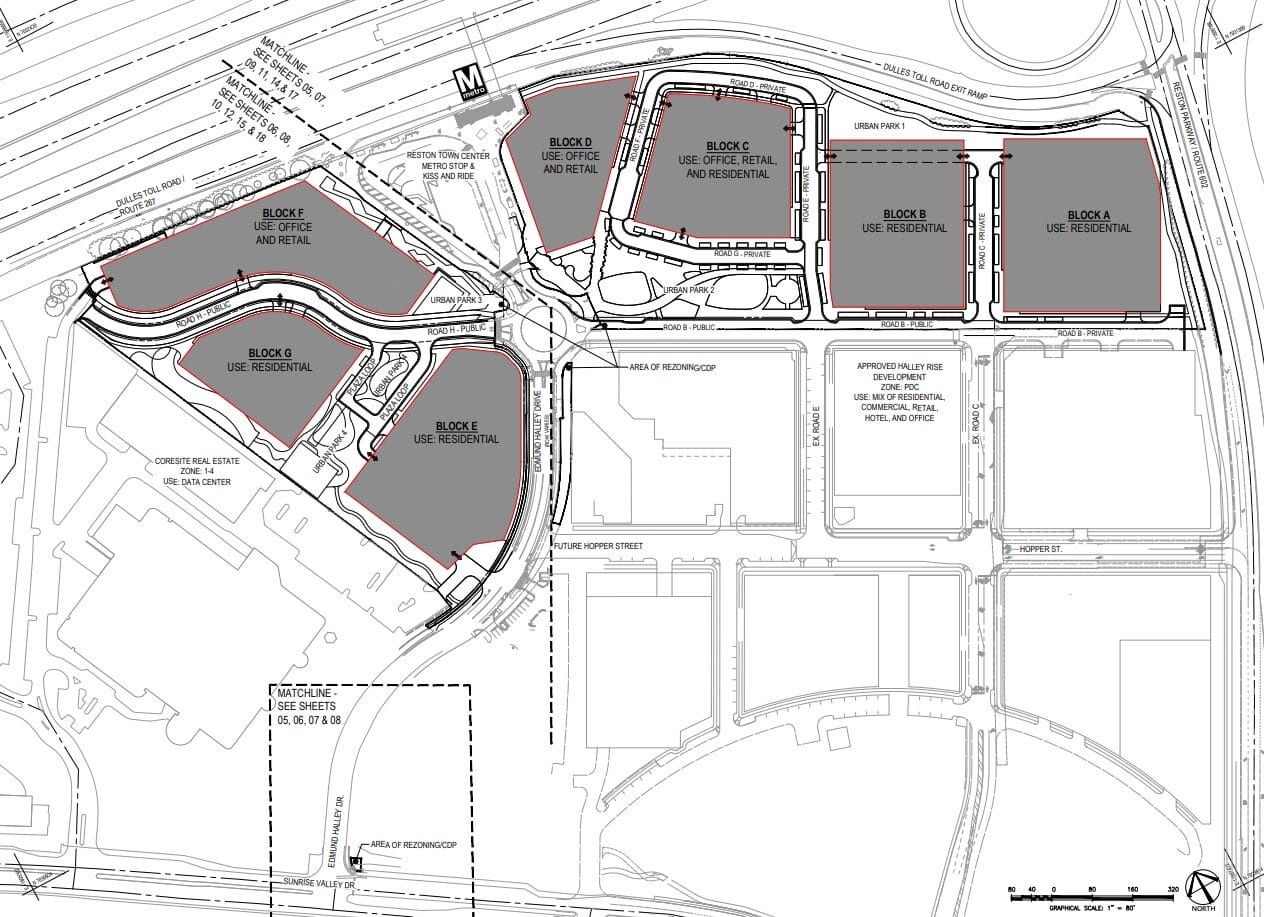
The development would consist of seven blocks across approximately 23.8 acres of land:
- Block A: 380-unit residential building with a maximum height of 110 feet
- Block B: 320-unit residential building with a maximum height of 110 feet
- Block C: mixed-use building with 235 residential units, up to 406,000 square feet of office space and 16,000 square feet of retail. A height limit of 425 feet is proposed.
- Block D: office building with 460,000 square feet of space, including 10,000 square feet of ground-floor retail, and a maximum height of 425 feet. A direct pedestrian connection to the Metro station would likely be located here.
- Block E: 355-unit residential building with a maximum height of 110 feet
- Block F: office building with 625,000 square feet of space, including 5,000 square feet of retail, up to 425 feet tall
- Block G: 330-unit residential building with a maximum height of 340 feet
While no final development plans with more details of the proposed blocks have been submitted yet, the application says the housing will include “a range” of sizes and price points, with 16% of the units set aside as workforce or affordable dwelling units.
When combined with the emerging Halley Rise neighborhood, the project would fulfill the Reston Comprehensive Plan’s recommendation of a 50/50 split between residential and non-residential development in the subdistrict south of the Reston Town Center Metro station, according to Painter’s statement.
“While office demand has softened in some markets, transit-oriented and transit-adjacent mixed-use environments — such as the Property — remain well positioned for long-term success,” Painter said.
The retail would be aimed at serving the immediate neighborhood to limit competition with “the more extensive retail” in Halley Rise, the application says.
Like the previous Reston Crossing plan, Bernstein’s new proposal envisions a number of publicly accessible park spaces, totaling around 4.75 acres:
- The Canopy Trail: a 64,300-square-foot linear park along the site’s northern and southern edge with a 10-foot-wide shared-use path, seating areas and fitness stations. The trail would connect Reston Parkway to the Metro station.
- Central Commons: a 64,400-square-foot urban park at the “heart” of the new neighborhood. Potential amenities include a multi-purpose lawn, movable seating, a shade structure and a plaza, while a pedestrian-focused woonerf for one of the development’s internal streets could allow the park to extend to Block C.
- Boardwalk Green: a 27,400-square-foot park between the east and west sides of the project with a multi-purpose lawn, seating areas, landscaping and “a passive nature walk along the edge” of the Metro station’s bus loop
- Crossfields Park: an approximately 51,000-square-foot park with a dog park, sports court, multi-purpose lawn, seating areas, landscaping and “multi-generational play elements.” The park would also serve as a buffer between the development and an adjacent CoreSite data center.

Private amenities for residents and workers would also be included.
In addition to adding internal streets and sidewalks, Bernstein says it will retain Tishman Speyer’s approved 10-foot-wide shared-use path along the Dulles Toll Road and extend it to the Summit property’s western boundary. The existing Reston Parkway trail would also be widened and “enhanced” with a double row of trees to match the segment along Halley Rise.
Up to 7,892 vehicular parking spaces and 630 bicycle spaces are proposed in garages for each of the buildings.
“Collectively, these elements support a multimodal transportation network that prioritizes accessibility, connectivity, and a high-quality pedestrian experience,” Painter wrote.
Submitted last Thursday (March 5), the application hasn’t been formally accepted for review yet by the county’s planning and development staff.
