

The Fairfax County government will not be imperiling its coveted AAA bond rating despite taking on an estimated $2.26 billion in new debt in coming years, county staff told supervisors this week.
Despite the reassurance, staff raised concerns at the Fairfax County Board of Supervisors’ Budget Policy Committee meeting on Tuesday (March 10) that the increasing debt load will put the squeeze on a county budget already facing economic headwinds.
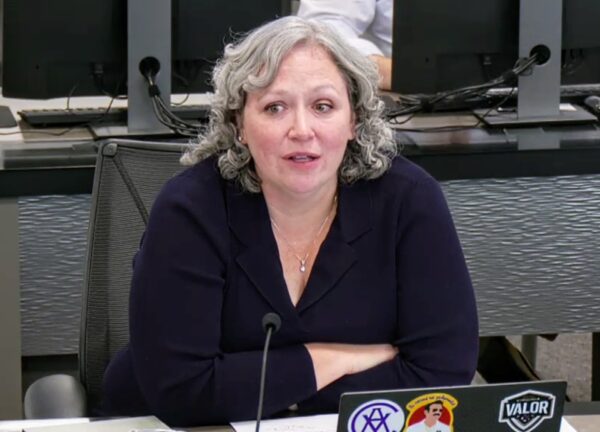
“We have a number of larger projects that are on the horizon that are going to create some significant debt-service requirements,” said Christina Jackson, the county’s chief financial officer.
At the meeting, staff outlined the nearly $16 billion capital improvement program for fiscal years 2027-2031 and how decisions about projects and timing will impact the county’s budget.
The good news? County officials have some wiggle room.
Currently, the county’s overall annual cost of servicing its debt represents 6.43% of total government expenditures. County officials say financial markets would only start to question the county’s AAA bond ratings if that figure approaches 10%.
“We don’t have a lot of concern there, but that’s one to keep an eye on, particularly if we are in an environment where we think revenues might dip,” Jackson said.
Historically, the ratio of debt-service cost to the total budget has been slightly higher than it currently is, according to Joe LaHait, deputy director of the Department of Management and Budget.
“Briefly, we got close to 9%, but we’ve been pretty comfortably under it,” he said.
The percentage includes debt authorized by voters through referendums and debt issued by the county’s Economic Development Authority (EDA) without voter approval.
The county’s bond ratings for general obligation debt approved in referendums have been at AAA for a half-century, and were reaffirmed by the three main bond-rating houses in advance of January’s debt sale. EDA bonds are rated slightly lower (AA+) and, as a result, carry a slightly higher cost.
When considering how to fund capital projects, LaHait said staff there is a pecking order depending on a variety of factors.
“Option 1 would always be a voter approved [general obligation] bond,” he said. “In some cases, we’ve always wanted some flexibility, a backup option.”
According to LaHait, while EDA bonds don’t carry the full faith and credit of the county government that voter-approved issuances do, they are “fundamentally sound and legal” — and there is no question in the bond market that the county will repay them.
“You’ve got to make your pension obligations and you’ve got to make your debt obligations” before spending other money, he said.
McKay said any proposals that could imperil the county’s existing bond ratings would be nonstarters.
“There is an enormous, unquantifiable impact of having our AAA bond rating on everything we do in this county, and reputationally,” he said. “You do not want to live in a county that does not have an AAA bond rating.”

In his draft fiscal year 2027 budget, County Executive Bryan Hill proposed moving around some bond items on upcoming referendum packages.
For the November 2026 referendum package, he recently proposed eliminating planned funding for early childhood projects; deferring funding for a planned Springfield Community Center to 2032; and pushing back renovations to Kings Park and Herndon Fortnightly libraries, also to 2032.
Those changes would leave a two-item, $255 million bond package headed to voters: $180 million for the Fairfax County Park Authority and $75 million for human services.
The plan for a $460 million school bond in November 2027 remains unchanged. A $200 million Metro bond would follow in 2028, with another $460 million school bond in 2029 and a $116 million public safety bond in 2030.
Instead of new facilities, the focus going forward, in large part, will be on catching up with needed renovations to existing facilities.
Though the Board of Supervisors will need to approve the changes, McKay at least seemed to like the focus on maintenance. He pointed to “the stark contrast between new facilities in the county and the condition of some of our older facilities.”
Supervisors criticize some School Board members
At the committee meeting, both McKay and Springfield District Supervisor Pat Herrity criticized some on the Fairfax County School Board for embarking on new construction and the $150 million purchase of a new building while the public school system’s student enrollment is declining.
“They need to get the same message we’ve got: focus a little more on renewals and less on new,” Herrity said.
McKay — who on certain issues can be a sparring partner against Herrity, the board’s only Republican — was on the same page this time. He was critical of a few Fairfax County Public Schools leaders who do not, he believes, prioritize maintaining AAA bond ratings above all else.
“There are some members of our School Board that don’t share our opinion of that, and that is very concerning,” McKay said.
The presentation delivered March 10 to supervisors “needs to be shared with the School Board as well, so they can see what we’re dealing with,” he said.
Metro funding remains ‘800-pound gorilla’
The decision on capital spending came despite uncertainty over the state budget, including how much state revenue and/or local taxing authority would be focused on Metro funding.
“That’s really the 800-pound gorilla in the room,” Mount Vernon District Supervisor Dan Storck said.
Hopes by Northern Virginia leaders for dedicated transit funding may not materialize out of the 2026 General Assembly session. County Executive Bryan Hill acknowledged “very difficult conversations” were ongoing with members of Gov. Abigail Spanberger’s team on transportation issues.
“We’ll have to recalibrate,” McKay said, depending on what transpires out of the state’s budget process.
“We’re going to know in a couple of weeks what our next steps are,” he said. “There’s going to be a lot of lobbying work that has to be done, likely beyond this year.”
