


Should Fairfax County switch to ranked-choice elections for Board of Supervisors’ races? Views were mixed during a community forum held last night (Monday) in Reston.
Even Hunter Mill District Supervisor Walter Alcorn, who could be directly impacted by a voting-format change, said he needs to learn more about any potential impacts.
“I really don’t know much about it,” Alcorn acknowledged at the forum. “I would be happy to learn more, and I think Hunter Mill District residents would want to learn more.”
Alcorn convened a town hall discussion on the topic on May 11 at the North County Governmental Center. About 50 residents turned up.
Many already support switching from Fairfax’s current winner-take-all election format to the more nuanced ranked-choice format, also known as “instant-runoff” voting.
Since 2020, the General Assembly has given local governing bodies the option of switching to that format in races for supervisor, city council and now town council. All other races, from School Board to Congress, are not eligible.
The format switch is beginning to gain traction in several Virginia localities, albeit with bumps along the way.
Arlington has run its County Board general elections under ranked choice for the past two years, and has used the format for Democratic County Board primaries for three years. Charlottesville last year held its City Council elections using ranked choice.
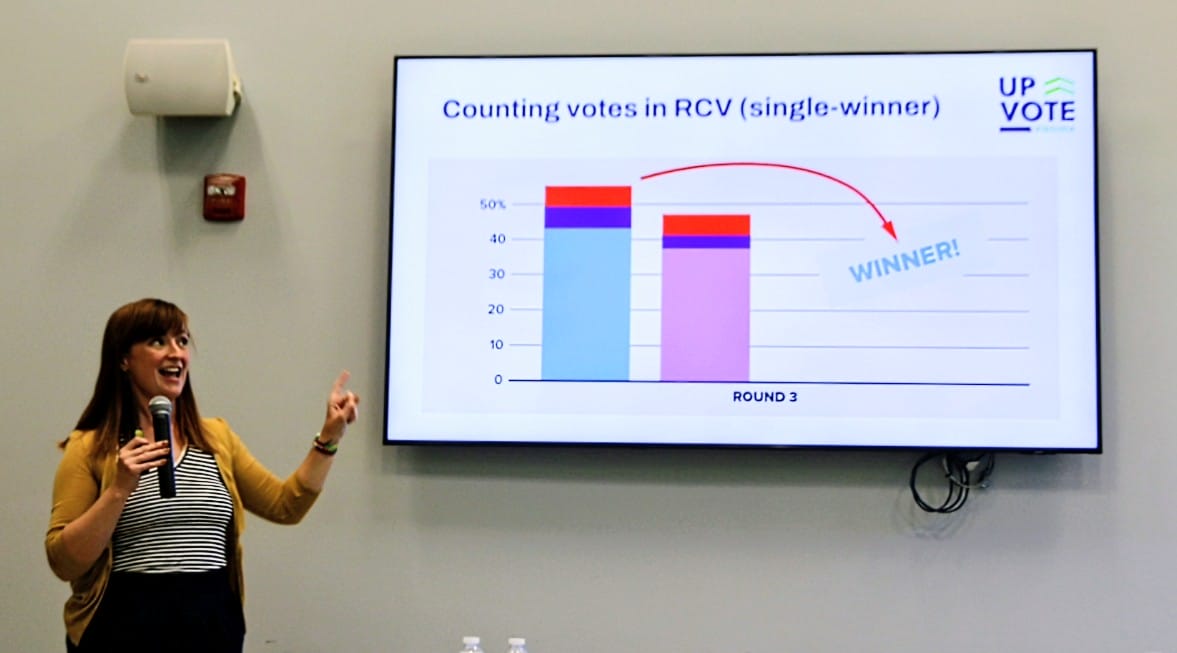
The goal of the ranked-choice option is to “identify the candidate that has the support from the majority of voters,” said Liz White, executive director of the voting advocacy and education group UpVote Virginia.
White joined Arlington elections director Gretchen Reinemeyer in providing a tutorial at the 90-minute town hall.
In ranked choice, voters are able, but not required, to rank candidates in order of preference. If a candidate receives more than 50% of the vote in the first round, that candidate is declared the winner.
If no candidate receives 50%, the candidate with the fewest votes is eliminated, and votes for that candidate are redistributed to others on the ballot as directed by the eliminated candidate’s voters. The process repeats until a candidate emerges with a majority of the votes cast.
Reinemeyer said that when the switch was first implemented in Arlington, “the voters let us know a full range of emotions.”
“It has been a learning curve,” she said of public awareness.

A survey of Arlington voters immediately after the November 2025 election showed 66% of respondents supported the ranked-choice format, 26% opposed it and the rest were undecided. Earlier surveys of county voters reported more mixed results.
Arlington County Board members have had mixed feelings as well. Though they have made the format switch permanent for Democratic primaries, its use for general elections remains a pilot program.
At least half the attendees at the May 12 event were backers of UpVote Virginia, so a majority of speakers were in favor of considering a change. However, there were some dissenting voices, resulting in an animated discussion of the pros and cons of a format switch.
“You’re not presenting us with any evidence” to back up claims that a change would be beneficial, one attendee told White.
Others supported a format change, but predicted it was unlikely to happen because the county’s elected leaders might feel their power being threatened.
White said the benefits of moving to the format can include a more diverse field of candidates and more civil campaigning. It also prevents a candidate from sneaking into office with far less than a majority of votes cast.
She pointed to some elections, particularly primaries, where a candidate needed just 25% of the vote to win.
“If you’re one of the 75% who didn’t like that candidate, you aren’t represented at all,” White said.
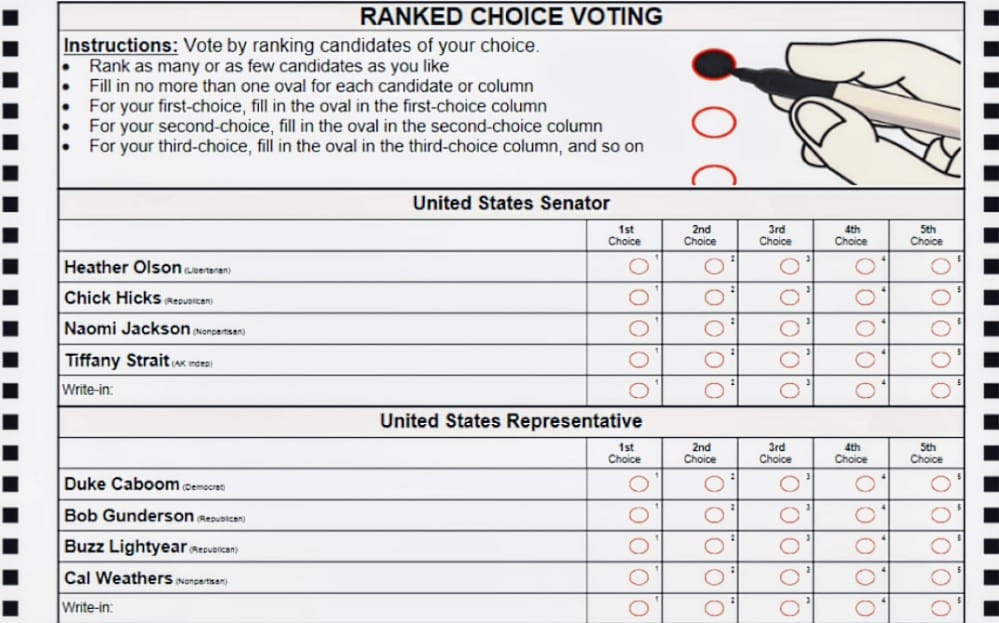
Under state authorizing legislation, county supervisors would have exclusive power to change the election format for their general elections, primary elections, or both. No public referendum is required.
It would be an all-or-nothing decision, with all 10 supervisor seats using one format or the other.
The next election for all county supervisors is November 2027. Whether a format change is made for that election, or for subsequent ones, a massive effort to explain the change to the public would be needed.
“Voter education is really important. We would certainly go to great lengths to educate,” said Eric Spicer, Fairfax’s director of elections.
Spicer, who attended Alcorn’s May 11 town hall, said he could envision some logistical problems in making a format switch, but it’s up to the Board of Supervisors to determine whether to move forward.
“We never take a position on anything,” Spicer said of his office’s role. “That’s not our place.”
If the supervisors decide to make the change, “we’ll do whatever it takes to make it work,” he said.
In Arlington, where at least one of the five County Board seats is on the ballot every year, the format switch has not yet had a substantial impact in the two general elections in which it was used.
The Democratic candidates for County Board won 58% of the vote in the four-way 2024 race and 65% in the 2025 five-way race.
It has had more significant implications in the Democratic primaries in which it has been used for the past three years. In Arlington, as in most of Fairfax County, Democrats hold strong political advantages, making winning the party primary the key hurdle for candidates seeking office.
The Fairfax County Democratic Committee opted for a ranked-choice approach in a primary for last year’s race to fill the Braddock District supervisor seat vacated by Rep. James Walkinshaw. Rachna Sizemore Heizer — who represented the district on the Fairfax County School Board — ultimately won 60% of the vote in the first round, rendering the candidate rankings moot and setting the stage for an easy victory in the Dec. 9 special election.
This year, the General Assembly passed and Virginia Gov. Abigail Spanberger signed legislation expanding the ranked-choice option to town councils, giving leaders in Herndon, Vienna and Clifton the option of using that format in future elections, starting this July 1.
