


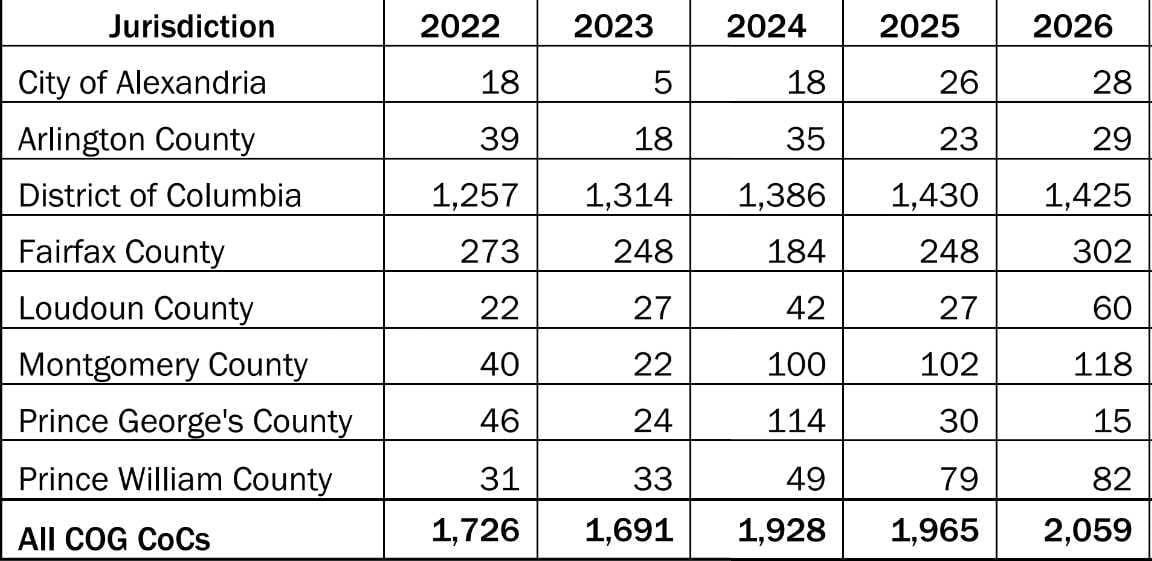
Despite a relatively stable year-over-year homelessness count in new data, Fairfax County’s level of those experiencing chronic homelessness ticked up more substantially between 2025 and 2026.
A total of 302 people were counted as chronically homeless in Fairfax County and the cities of Fairfax and Falls Church in this year’s Point-in-Time Survey, coordinated by the Metropolitan Washington Council of Governments (COG).
That’s up 22% from last year’s total of 248, according to figures reported yesterday (May 13). It also represents nearly half the 634 individuals counted as chronically homeless in the D.C. suburbs.
Chronic homelessness is defined by COG as continuous homelessness that has lasted one year or longer, or homelessness that has occurred at least four times over three years, totaling 12 months or more overall.
Regionally, the ranks of those determined to be chronically homeless regionally grew 5% year-over-year to 2,059, with the bulk — 1,425 people — reported by the District.
Most individuals identified as chronically homeless across the region were staying in shelters, but more than a quarter were on the streets or in other unsafe conditions, analysts noted.
Total levels of homelessness rise slightly
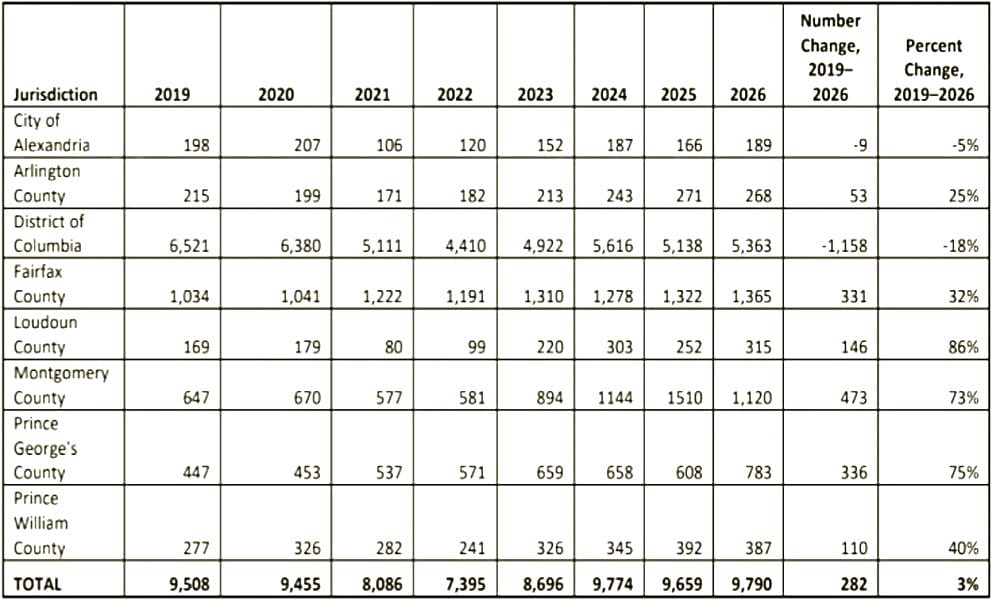
Overall, the total number of those counted as homeless for any length of time across Fairfax was 1,365 in 2026, up slightly from the 2025 count of 1,322. Across the Washington region, the 2026 Point-in-Time count totaled 9,790, up 131 individuals or 1% from 2025.
In Fairfax County specifically, the number of people experiencing homelessness increased by 3% or 43 individuals from 2025, continuing an upward trend that started in 2017, according to the county’s Department of Housing and Community Development:
The increase in 2026 is primarily driven by the higher number of adults accessing emergency shelters. The most significant increases occurred during the COVID-19 pandemic, when the total count increased from 1,041 people in 2020 to 1,310 people in 2023 – an approximately 26 percent increase in three years. Since then, the total count has increased by four percent, with 55 additional people counted.
The 2026 count was conducted on Feb. 4. It was postponed from late January, when counts typically occur, due to extreme winter weather.
Volunteers and local government personnel fanned out across the region to count those living in unsheltered conditions. The number of individuals in shelters was reported by the shelter operators.
Those in shelter facilities represented 87% of those counted during the 2026 event. That is a higher number than usual, likely owing to the extraordinarily cold, icy conditions of late January and early February.
Christine Hong, who chairs COG’s Homeless Services Planning and Coordinating Committee, told the board of directors yesterday that the report has built-in limitations but still provides valuable insights.
“Although it’s an imperfect measure, it provides an important regional snapshot,” said Hong, a human services official with the Montgomery County government in Maryland.
The data “tells us who was counted on one night,” she said, “[but] does not tell us causation, does not by itself tell us exactly why someone became homeless, why one jurisdiction increased while another decreased.”
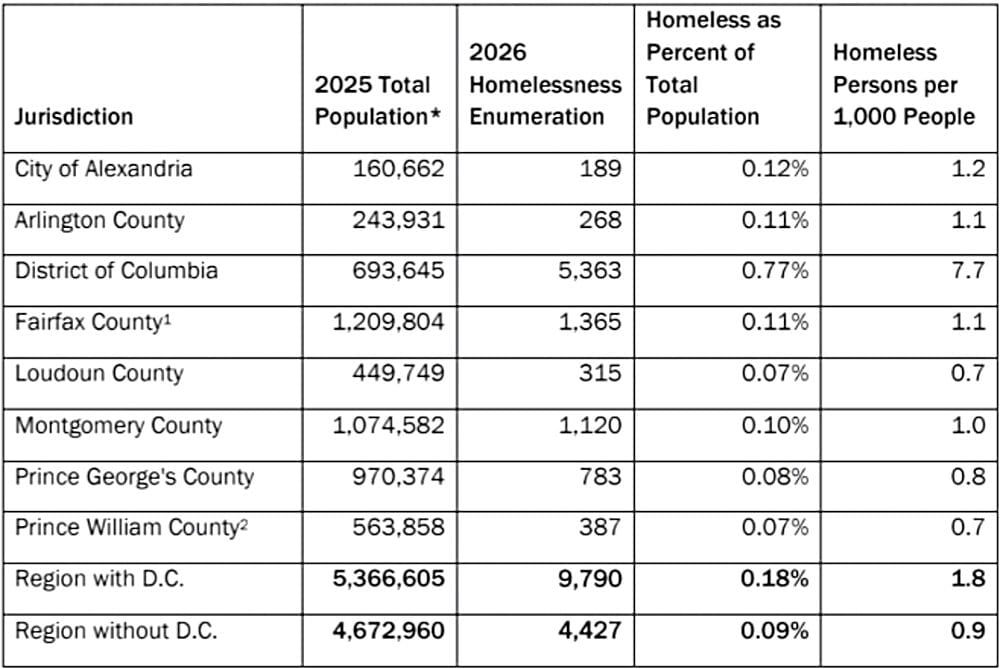
Fairfax’s 2026 rate of homelessness stood at 1.1 per 1,000 residents, above the D.C. region’s suburban total of 0.9%. When the District is included, the overall regional rate grows to 1.8 per 1,000 residents.
‘Spectrum’ of services provided by county
The Fairfax-Falls Church Community Partnership to Prevent and End Homelessness collaborates with government staff in leading homelessness prevention efforts in the county.
In Fairfax, “the homeless services system is comprised of a spectrum of homeless service interventions, all of which are designed to achieve the goal of ensuring homelessness is prevented whenever possible and, when it occurs, it is rare, brief and only once,” according to the Point-in-Time report.
Fairfax’s efforts include a six-pronged approach:
- Street Outreach
- Prevention
- Emergency Shelter
- Transitional Housing
- Rapid Rehousing
- Permanent Supportive Housing
In April 2025, the county’s 85-unit Fair Ridge Shelter opened to serve families with children, providing another tool in the county’s efforts.
In addition, the county’s Office to Prevent and End Homelessness last fall awarded contracts to new providers delivering county-funded homeless services.
Earlier this year, county supervisors approved construction of a shelter facility to be located adjacent to a new fire station in the Penn Daw neighborhood just east of Richmond Highway. When open, the three-story building will offer 50 shelter beds, 20 supportive-housing units for individuals and 10 supportive housing units for families.
Seniors a growing area of concern
Addressing the COG board, Hong acknowledged that there have been “significant cuts” to supportive housing programs implemented by the Trump administration. More may be on the horizon.
“We are still anticipating threats and continuing uncertainty,” she said.
One of the concerns raised at the meeting was an increasing level of homelessness experienced by the region’s seniors.
“Older adults experiencing homelessness face unique vulnerabilities due to health or mobility limitations,” the Point-in-Time survey reported.
“They may also have more significant health concerns not typically seen in homeless services systems, such as Alzheimer’s disease or cancer,” the report said.
The report noted that “the average life expectancy of a person experiencing homelessness is estimated between 42 and 52 years, compared to 78 years in the general U.S. population.”
