

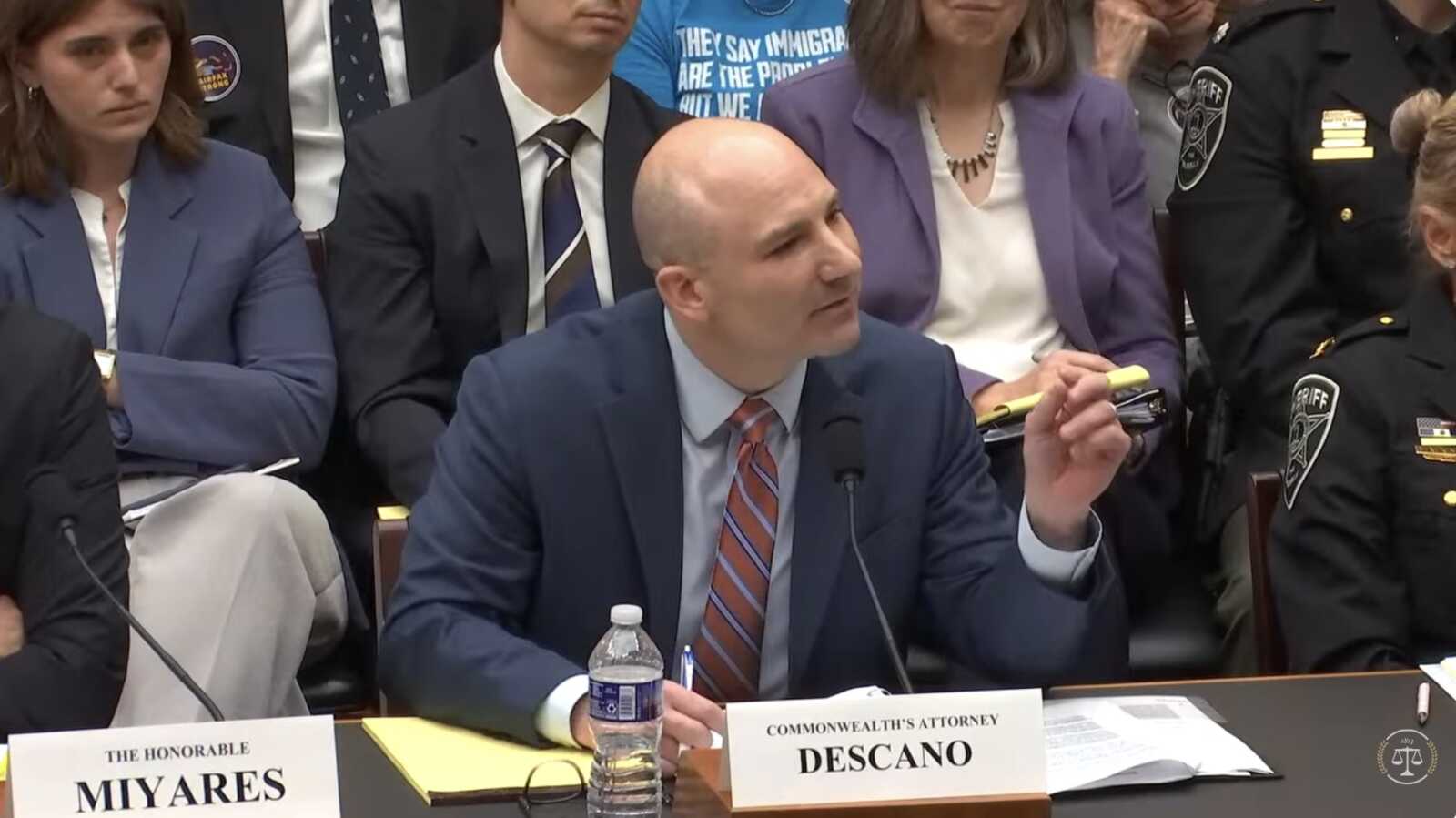
Republican lawmakers accused Fairfax County’s top prosecutor and sheriff of being soft on crime and endangering lives due to policies limiting cooperation with Immigration and Customs Enforcement — a charge both denied during a tense congressional hearing yesterday (Thursday).
Fairfax County Commonwealth’s Attorney Steve Descano and Sheriff Stacey Kincaid testified that they do not provide preferential treatment to immigrants, as congressional Republicans repeatedly alleged throughout the House Judiciary Subcommittee on Immigration Integrity, Security, and Enforcement hearing.
“We’re not protecting undocumented individuals. As a matter of fact, we prosecute people who commit crimes in Fairfax County, regardless of their status … so the idea that we don’t do that is simply wrong,” Descano said. “Our policies simply maintain that our role is to prosecute Virginia crime. That’s what we do. ICE’s role is to do federal civil immigration enforcement.”
At the center of the hearing was the case of Stephanie Minter, a Fredericksburg resident who was stabbed to death at Hybla Valley bus station earlier this year. Abdul Jalloh, an undocumented immigrant from Sierra Leone with a history of arrests, was charged with second-degree murder in her killing.
Her mother, Cheryl Minter, who recently began working with groups on a recall campaign against Descano, testified against Fairfax County policies.
“I stand here because her life was taken in a way that should have never happened,” said Cheryl Minter. “The man who took my daughter’s life should not have been free to walk the streets. He had been picked up many times. He was known, there were warnings, there were emails sent saying he was a danger, and still, he was released. I am not here for politics. I am here for accountability. I am here because a system failed my daughter.”
Virtually everyone at the hearing expressed agreement that the system failed Minter — but they differed on exactly which system was at fault.
Republicans blamed Descano’s policies, while Descano blamed the Department of Homeland Security for releasing Jalloh from custody during the first Trump administration.
While most of the anger at Thursday’s hearing was directed toward Descano, Kincaid also faced some questions about her office’s policy not to hold inmates past their release date “unless an ICE administrative request to detain the inmate is accompanied by a criminal detainer issued by a court.”
“My agency is not staffed for, budgeted for or mandated to reform the duties of the federal government,” Kincaid said in her opening remarks. “My operating budget is approved by state and local government … maintaining a safe and secure detention center, serving civil process and ensuring the safety of the courthouse. It is simply not the job of the Fairfax County Sheriff’s Office to engage in federal immigration enforcement.”
Kincaid said the Sheriff’s Office still works with ICE and “treats them like every other law enforcement agency we interact with.”
“They are allowed into our facility at any time. They are notified of every undocumented immigrant booked into our jail, and they know their location. If there is an individual they want to take custody of, they can do so by obtaining a judicial warrant calling to ask when the individual will be released, tracking the individual’s court date or taking custody of the individual up to five days prior to their release. When ICE does call, we even coordinate high-risk transfers with ICE to ensure their safety. We have no problem with ICE conducting its lawful business, but it is their business to conduct, not ours.”
Also testifying against Fairfax County at the hearing, titled “Fairfax County, Virginia: The Dangerous Consequences of Sanctuary Policies,” was former Virginia Attorney General Jason Miyares and Sean Kennedy, a member of the Fairfax County Criminal Justice Advisory Board and president of the group Virginians for Safe Communities.
“The ‘immigration consequences’ policies of Fairfax Commonwealth’s Attorney Steve Descano have enabled repeat violent and sexual offenders to victimize Fairfax County,” said Kennedy, referring to the policy instructing assistant commonwealth’s attorneys to “consider immigration consequences where possible and where doing so accords with justice.”
David Bier, chair of the Selz Foundation in Immigration Policy, and Jane Stoever, a professor at the University of California, Irvine School of Law, testified that local governments have good reasons to limit the amount they work with ICE.
“Several courts have found that it is unconstitutional for states to detain individuals solely at the request of ICE,” Bier said. “More than a dozen settlements have involved subjects of immigration detainers who were detained by localities. This includes a man unlawfully detained in Virginia. This means that states and localities cannot lawfully arrest and detain someone merely on the basis of an immigration detainer request from the federal government without a court order supported by probable cause unless they are deputized by ICE. Many states and cities are labeled ‘sanctuaries’ simply for following these court decisions.”
The hearing comes at a time when Descano’s policies are under investigation by the Trump administration. In early May, the Justice Department’s Civil Rights Division opened an investigation into the CA office’s policy of considering immigration status when making charging, plea agreement and sentencing decisions.
The Fairfax County prosecutor is also a member of a coalition of prosecutors who have vowed to “rein in unlawful conduct” by the administration.
