

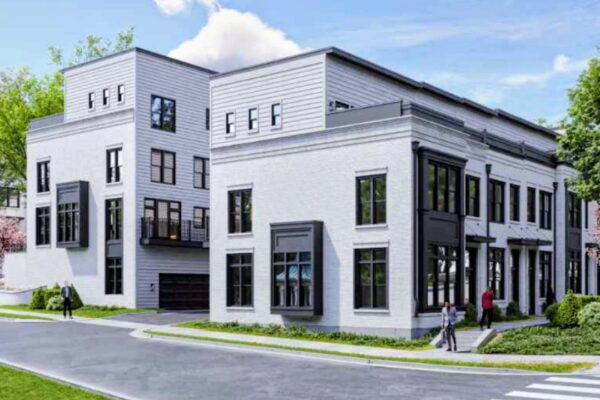
The Fairfax County Planning Commission on June 3 recommended approval of redevelopment plans for a 5.2-acre Reston site that will retain the historic A. Smith Bowman House as its centerpiece.
The unanimous vote sends the project to the Board of Supervisors. A public hearing has been set for July 14.
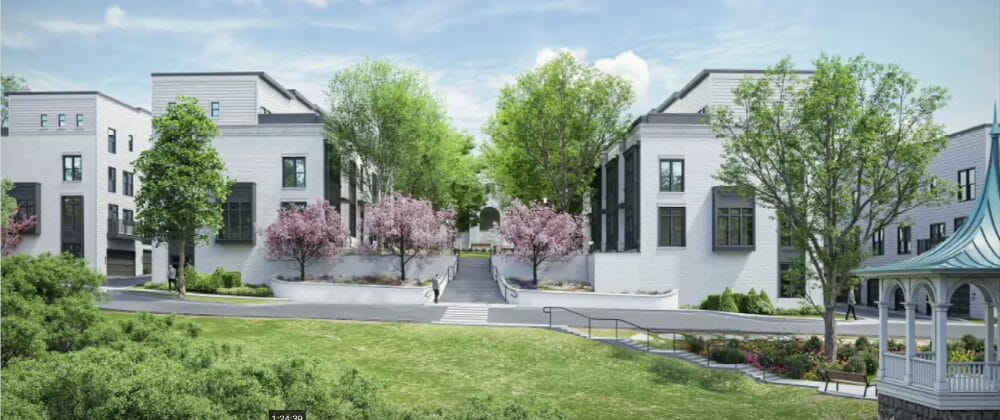
Plans from developer EYA and the American Armed Forces Mutual Aid Association (AAFMAA), the property owner, call for razing the association’s existing three-story office building and replacing it with 57 townhouses and two public parks.
As part of the development plan, the 19th-century Bowman manor house could remain in its current use as an office, be converted to a community clubhouse, or return to its original use as a single-family home.
Seven of the townhouses will be reserved as affordable housing.
The site is bounded by Old Reston Avenue, Sunset Hills Road, Stratford House Place and the W&OD Regional Trail. “Sunset Hills” was the original name of the Queen Anne-style manor house, occupied by A. Smith Bowman, whose family owned much of the surrounding acreage into the 20th century.
Long before there was Reston, which was founded in the 1960s, there was the late-1800s community of Wiehle.
“This was the center of town,” said Hunter Mill Planning Commissioner John Carter, who lauded the proposed development plan for respecting “the character of the existing historic structures.”
“We don’t do that very often,” he said.
Planning Commission Chair Phil Niedzielski-Eichner joined Carter in praising the architectural design for paying attention to the past while looking forward.
“Rarely have I seen [a development plan] where there is such sensitivity to not just how it meets our requirements, but the way it comes together,” he said.
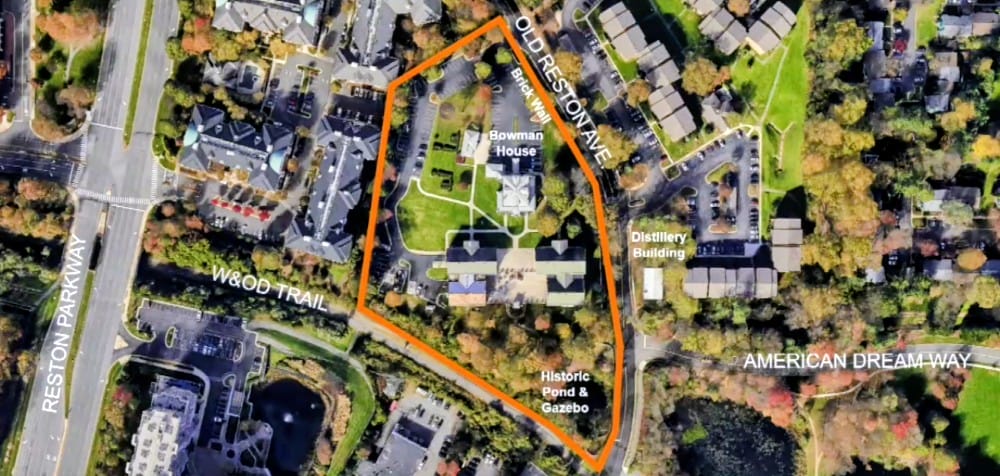
Constructed in 1899, the Bowman manor is listed on the Fairfax County Inventory of Historic Sites, but inclusion does not provide any specific protections against redevelopment.
In 2019, the American Armed Forces Mutual Aid Association won county approval to construct a pair of new office buildings on the site, but the project never got past the design stage.
Andrew Painter, the current project’s land-use attorney who handled that earlier application as well, said the switch to a housing project was not easy.
“This site is unique,” he said. “We have spent countless hours working through [issues]. Every detail has been examined, debated, refined. That’s as it should be.”
Carter agreed that there had been challenges along the way.
“We’ve been up and down and back and forth and around the corner and back — several times,” he said.

Not everyone was happy with the proposal.
Rosalind Gold, who lives nearby and spoke at the public hearing, said an area already problematic for both vehicles and pedestrians would only get worse.
“Old Reston Avenue near Sunset Hills Road is already a busy street,” she said. “I worry greatly about the traffic impact.”
Given other recent development nearby, “it is simply too many cars added to an already busy two-lane street,” Gold said.
Painter pushed back on the idea that the project could worsen traffic. He noted that the plan for residential development is expected to result in 60% to 70% fewer daily trips to and from the site than if more office space was added as initially envisioned.
The planning commission voted to approve the final development plan for the site, a decision that is within its purview. Rezoning power belongs to the Board of Supervisors.
Currently zoned PDC (planned development commercial), the development partners are requesting that the parcel be rezoned to the PDH-12 district, allowing for up to 12 units of housing per acre.
At the planning commission meeting, questions remained about pedestrian improvements along Old Reston Avenue and the site’s connection to the Washington & Old Dominion Trail. The developer is seeking input from the Virginia Department of Transportation and NOVA Parks for some of those plans.
