




Inova Health System’s CEO used a recent roundtable discussion with the Fairfax County Board of Supervisors and business leaders to connect his organization’s growth to broader quality of life across the region.
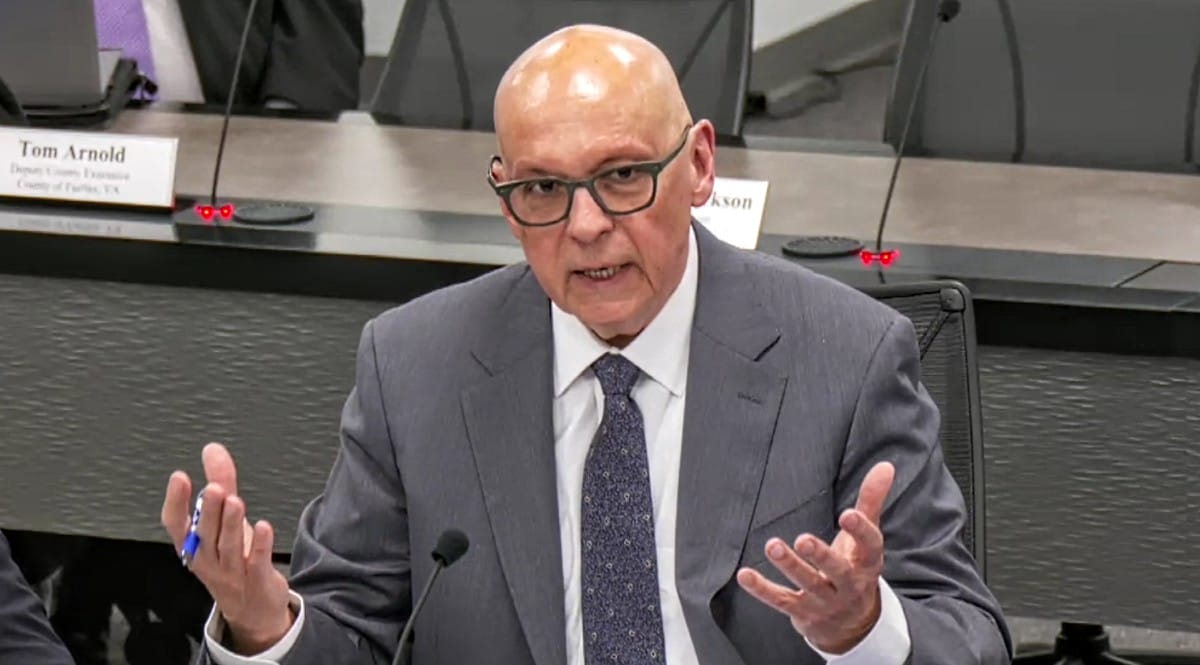
Health care is “the job engine and in many ways economic engine” of Northern Virginia, Dr. J. Stephen Jones said at yesterday’s meeting of the county’s Council for Economic Opportunity.
With its workforce of 26,000 employees growing an average of 1,000 a year and a budget approaching $7 billion annually, the nonprofit health system is the largest private employer in the Washington region.
While generally upbeat about Inova’s working relationship with the county government, Jones expressed concerns similar to those of most developers, describing the planning and permitting process as involving too much bureaucracy and too lengthy a period to get projects approved.
“Make it easy. You’ll get more things fast,” he said. “If it’s not doable to build, building doesn’t happen.”
Inova currently is in the midst of two major hospital projects, both designed to replace the aging Alexandria Hospital.
A 192-bed facility is rising at West End Town Center on the former Landmark Mall site in the City of Alexandria, while the new 110-bed Inova Franconia-Springfield Hospital is linked to the existing HealthPlex outpatient facility.
Jones said both facilities remain on track to open — perhaps on the same day — in late 2028.
“It will be an employment magnet,” Jones said of the $2.5 billion being invested in the facilities. “We have confidence in our ability to arrive and thrive.”
When complete, the existing Inova Alexandria Hospital on Seminary Road will close. Inova has been exploring a possible redevelopment of the site centered on housing.
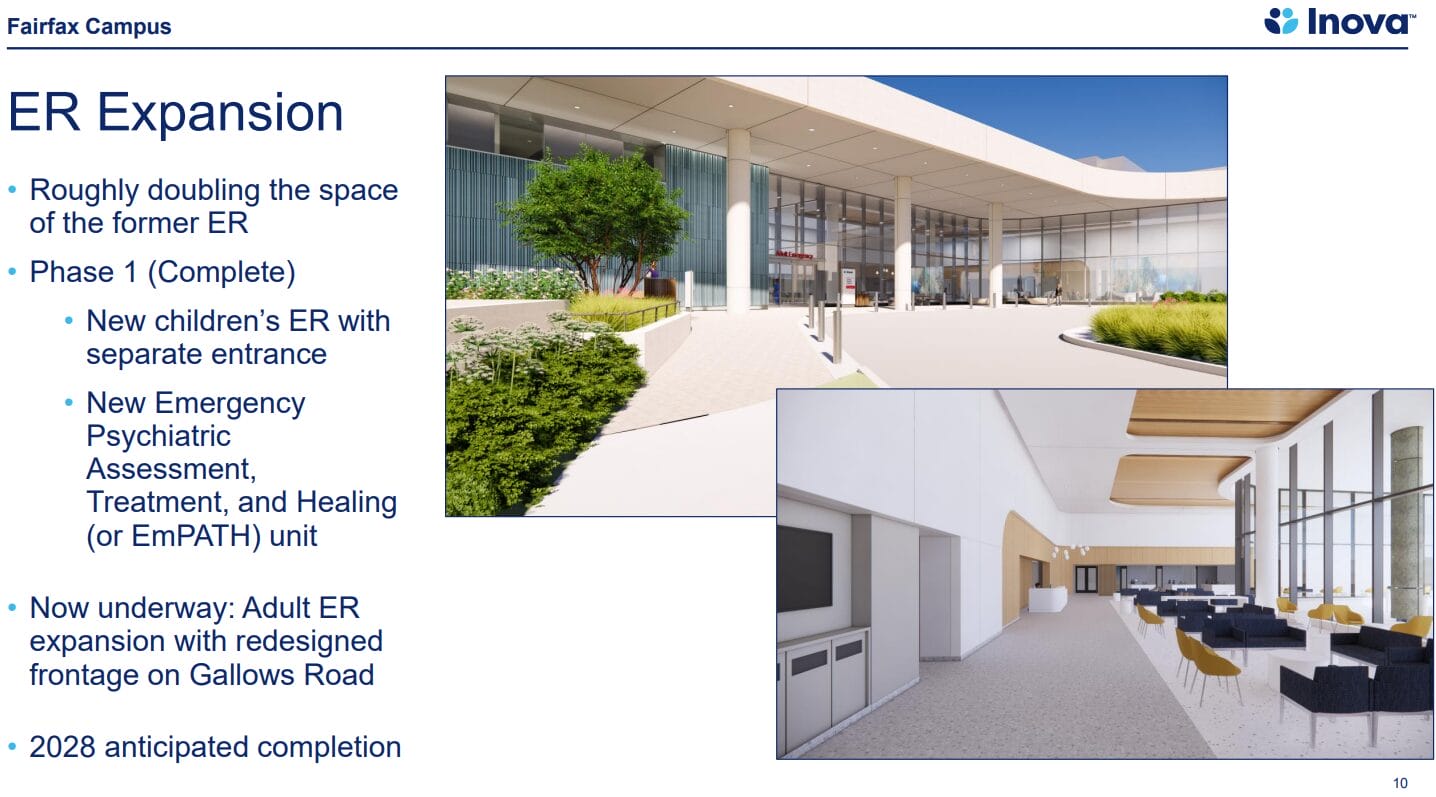
A major expansion of emergency department facilities at Inova Fairfax Hospital in Woodburn is also underway. Roughly doubling the size of the existing emergency room, which is the fourth busiest in the country, the project has so far included the addition of a new children’s ER with its own entrance and a mental health unit.
Inova is now working to expand the hospital’s adult ER with a new entrance facing Gallows Road. The second phase of construction is expected to finish in 2028.
In the meantime, the organization is attempting to give patients more urgent care options, which generally provide services at a lower cost than what’s available at emergency departments, Jones said.
Among other topics discussed by Jones at the roundtable:
Community-based facilities: Inova is placing increased emphasis on community-based facilities, particularly in areas with larger percentages of low-income residents. “We’ve been very much intentional in meeting the need where the need is,” he said.
Inova Mount Vernon Hospital: According to Jones, there are no plans to reduce acute care offerings at Inova Mount Vernon Hospital, which recently celebrated 50 years, as some have feared. “As long as I am CEO, it will be a thriving hospital we are investing in,” he said.
Charity care: The dollar amount of care that Inova is providing to those without the ability to pay has increased 27% over the past year, but Jones says “we do not ever run” from providing that kind of care.
Artificial intelligence: Jones sees both opportunities and challenges in how artificial intelligence technology could affect the health care industry. “We’re going to do our very best to stay with it,” he said of the evolving AI landscape.

The Fairfax County government has partnered with what evolved into Inova Health System since planning for Fairfax Hospital began in the 1950s. That facility opened in 1961, and Inova has continued expanding both on its Fairfax campus and across the region ever since.
Board of Supervisors Chairman Jeff McKay said that from his vantage point, the organization is taking the right steps to meet community needs.
“I don’t know that I’ve ever felt more confidence in the leadership and the future,” McKay said.
Having a solid regional health-care infrastructure — via Inova and others — aids in economic development efforts, McKay said.
Companies “absolutely look at health care” when making relocation and expansion decisions, he said.
Dan Storck, who chairs the Council of Economic Opportunity, noted that health care as a percentage of the nation’s economy has more than doubled to 18% over the past half-century.
Moving forward with new facilities and services is not optional, but necessary, Storck said.
“If we’re not winning, we’re losing,” he said.
