

Fairfax County is bracing for cutbacks in federal funding for Medicaid and Supplemental Nutrition Assistance Program (SNAP) as a result of the so-called One Big Beautiful Bill Act passed by Congress and signed into law by President Donald Trump last July 4.
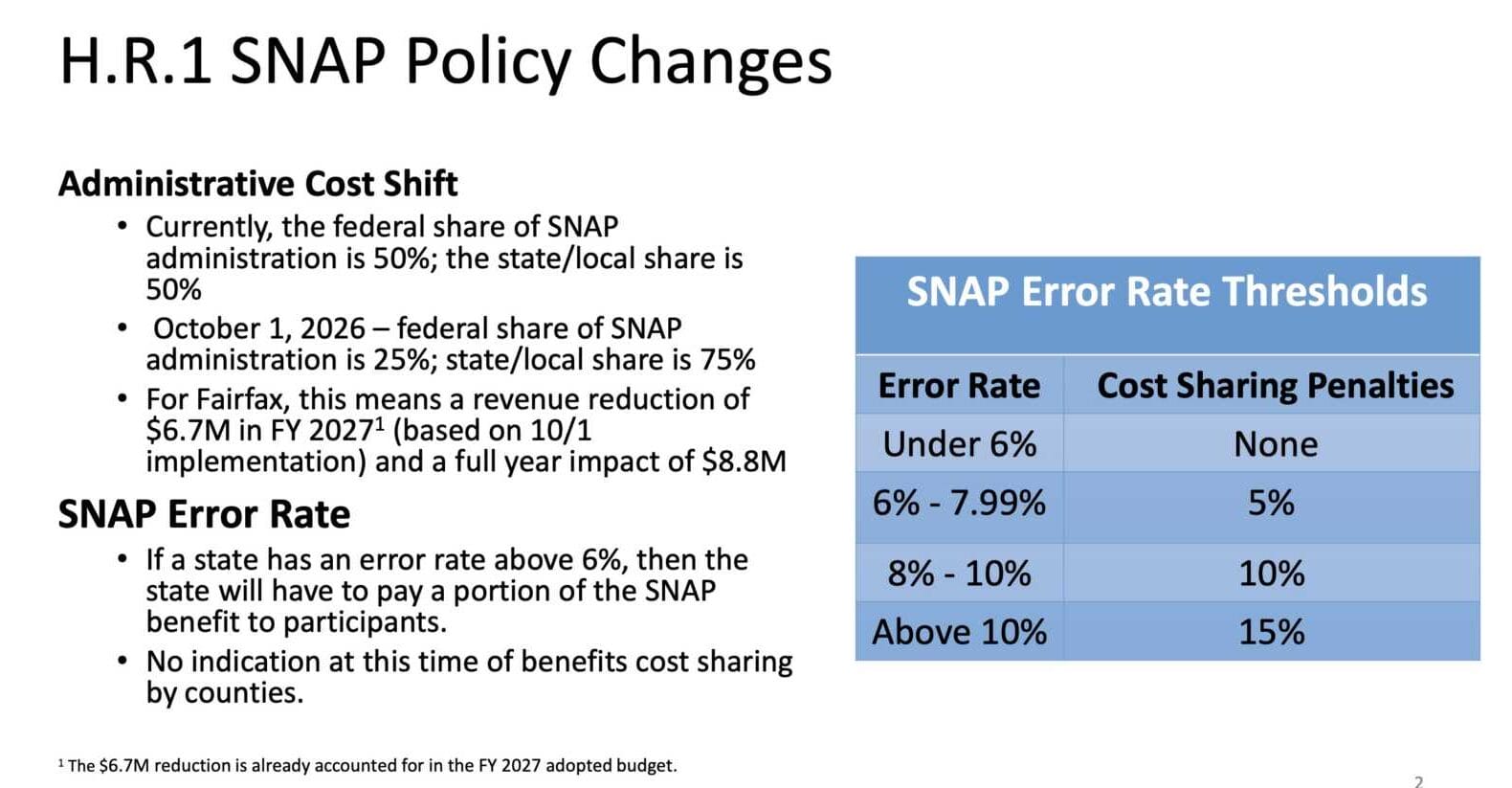
An approximately $6.7 million reduction in revenue — already reflected in the fiscal year 2027 budget adopted on May 5 — is the result of the federal government shifting more administrative costs for SNAP to the states, county staff told the Board of Supervisors during their Health and Human Services Committee meeting on June 16.
“The federal government has sort of single-handedly shifted…costs away from itself to states,” said Michael Becketts, director of the county’s family services.
Under the new rules, states will pay 75% of the administrative costs for the food benefit program, up from the 50% they currently cover.
Because the changes take effect on Oct. 1, the $6.7 million figure is adjusted down slightly from the $8.8 million that could be lost in a full fiscal year. The amount is only an estimate, because it is contingent upon Fairfax County’s actual expenditures as well as the state’s adopted budget.
In addition to the administrative costs, states must now pay a portion of the SNAP benefits if they have an error rate — meaning the rate of recipients either overpaid or underpaid benefits — above 6%.
That’s potentially a $270 million problem for Virginia, which had an error rate of 11.5% in 2024.
“We are hopeful that these numbers have gone down,” Beckett said. “Virginia is projecting that the error rate is somewhere between 8 and 10%, but we’re not necessarily sure.”
New numbers should come out around June 30, he said. The county government can do its part by focusing on making sure that people get “the right amount of benefits at the right time.” The state has not told the county what its error rate is, adding an additional layer of uncertainty.
The new law changed eligibility criteria for SNAP and the processes for applying, leading to a drop in enrollment of 3.5 million nationwide, according to reporting by PBS.
Virginia is no exception to that trend. In March 2025, about 867,000 people statewide received SNAP benefits; that number fell to 754,000 in 2026, the Virginia Mercury reported. Federal spending for the program is expected to fall by $187 billion over a 10-year period.
Changes to Medicaid
At the same time, more people will become ineligible for Medicaid in the coming months as a result of the federal budget reconciliation bill, which instituted new restrictions on which immigrants can qualify that will take effect on Oct. 1 and work requirements starting Jan. 1, 2027.
“We recognize that this will reduce the impacted populations’ access to preventative care and has the potential as well to increase the need for safety-net health services,” Fairfax County Department of Family Services Deputy Director Alycia Blackwell told supervisors.
The county’s role in this transition is to assist with state communications around the program and provide resource information to anyone impacted, she said. Additionally, the program’s “north star” is to ensure that “no one who is eligible loses coverage.”
The county will focus its communications in some of the most-impacted areas: Fair Oaks, Annandale, Bailey’s Crossroads, and the Route One corridor.
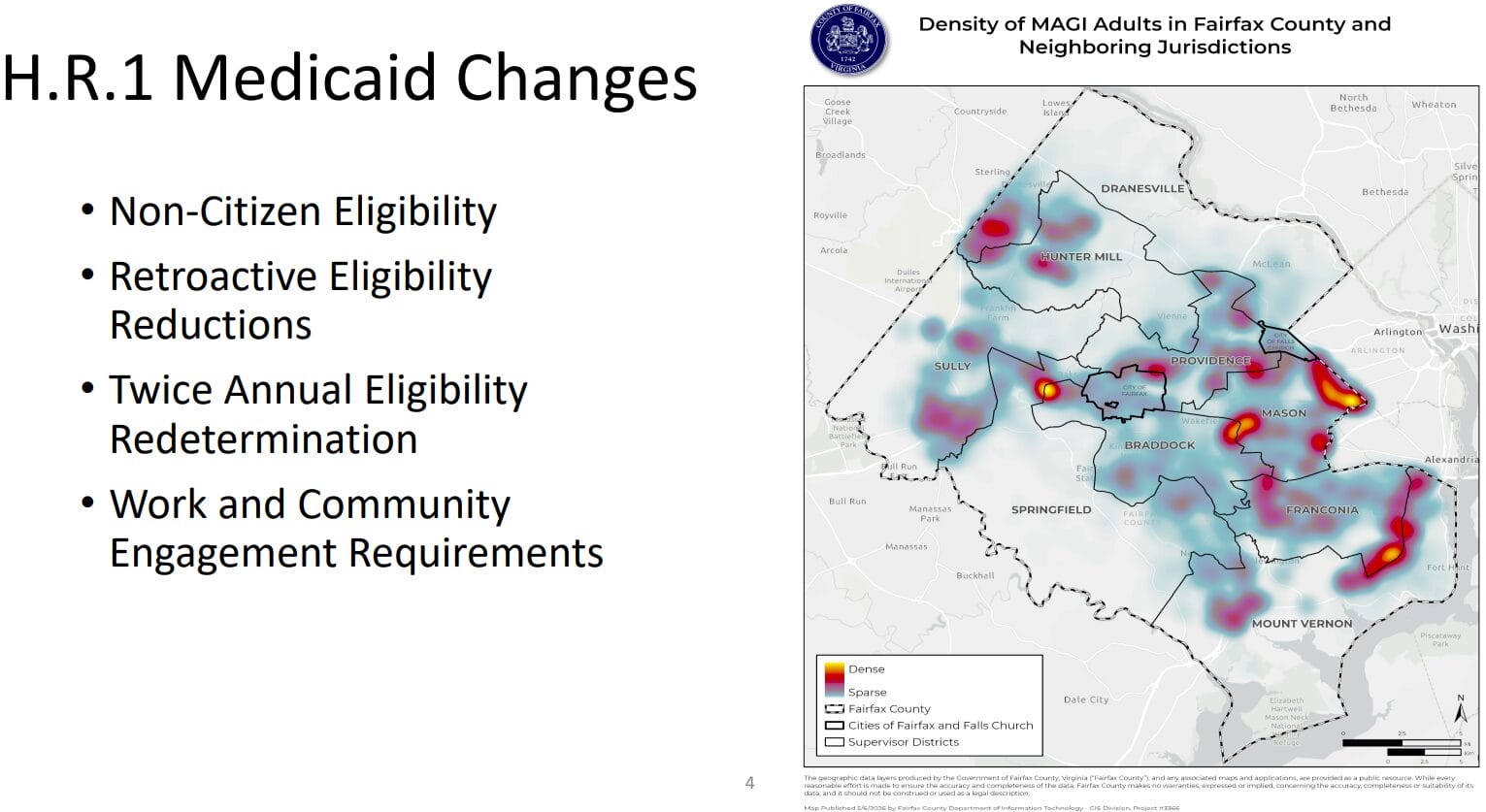
The federal government’s timeline for retroactive funding of medical expenses will also change on Jan. 1, creating “significant implications” for Inova and other health care systems that rely on retroactive coverage from Medicaid to offset the cost of care.
The county is conducting an internal planning process with Inova, and working out logistics around getting applications from the health system faster.
Additionally, beginning on Jan. 1, 2027, the approximately 50,000 people in Fairfax County enrolled in Medicaid under the expansion allowed by the Affordable Care Act will have their eligibility reviewed every six months. Currently, reviews occur only once a year.
“Doubling the frequency of redeterminations for this population represents a substantial increase in workload,” Blackwell said, “and also an administrative burden for citizens to have to do this twice per year versus once per year.”
The Board of Supervisors already approved 13 new positions to help support the increased workload around Medicaid, Blackwell noted.
Given that every six months, about 50,000 people will need to be able to prove they are working, volunteering, or participating in an educational or training program for 80 hours every month, the county is still trying to determine the full impact of the changes. Some may also be exempt from the requirements.
“We have requested that data and are waiting for it from the state to be able to tell us exactly how many residents that we’re going to need to prepare for,” said Lisa Tatum, a Department of Family Services division director.
The county is in a good position to help the population that needs to find work stay eligible, Tatum said, because it already operates Virginia Career Works.
“We operate the SNAP employment and training program, which is similar…so we know how to do this,” Tatum said. “We just need to be able to adapt it to our Medicaid enrollees.”
