


Fairfax officials acknowledge they have no easy solutions to offset rising costs of operating the local government’s trash collection facilities.
Fairfax property owners might need to pay for future funding shortfalls — a possibility that may be equally unwelcome to county supervisors as they prepare for an election year in 2027.
“My big frustration is we didn’t have this conversation three or four years ago,” Hunter Mill District Supervisor Walter Alcorn said at a meeting of the Board of Supervisors’ Environmental Committee yesterday (Tuesday).
At issue is the rising cost of what staff call “flow control” — the process of receiving trash from haulers and the public at the I-66 Transfer Station, then transporting it to the I-95 Energy Resource Recovery Facility in Lorton, which is owned and operated by Reworld Fairfax Inc.
About 600,000 tons of trash makes the journey each year to Reworld’s facility, which burns the waste to produce electricity before dumping the ash remnants in the nearby I-95 Landfill.
It’s a complicated, costly process, and in recent years, annual operating deficits have eaten into reserve funds maintained to help subsidize operations.
As outlined at a May 12 meeting of the environmental committee, the reserve funds are expected to be fully depleted this fiscal year, which began July 1 and will end on June 30, 2027.
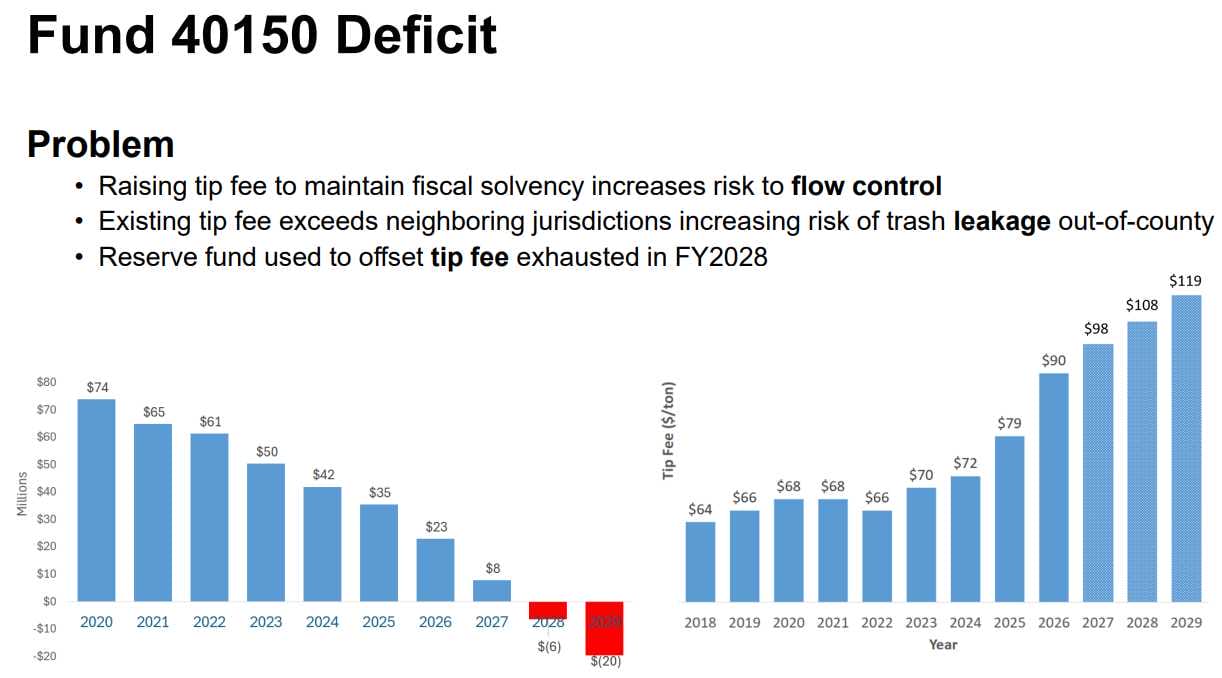
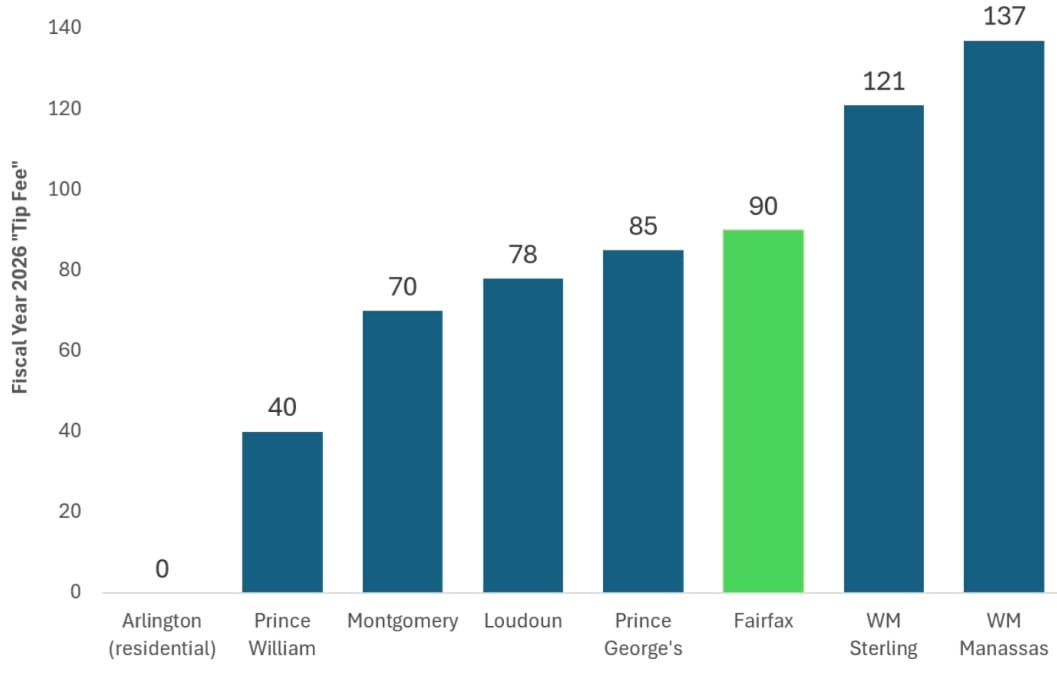
In fiscal year 2028, “tipping fees” paid to deposit trash in the county system will not fully cover operational costs, despite increases that now put Fairfax’s fees at the high end of the region.
“This is a pretty vexing problem,” Franconia District Supervisor Rodney Lusk said.
Christopher Herrington, director of the county’s Department of Public Works and Environmental Services, said staff have found ways to cover an anticipated $6 million shortfall for the next fiscal year. But over time, there is “no silver bullet” that will make the deficits disappear, he warned.
At the July 7 meeting, Herrington laid out proposals ranging from using general fund tax dollars to cover the costs to eliminating the I-66 Transfer Station altogether. County officials also could start charging for currently free services, increase the plastic bag tax or sell advertising space on the side of the county’s trash trucks to recoup some costs.
Stopgap measures will work for now, Herrington said.
“We can get through fiscal 2028,” he told supervisors.
After that, choices quickly may become more complicated.
“There are no easy answers or solutions,” said Providence District Supervisor Dalia Palchik, who chairs the environmental committee.
In May, staff proposed implementing a “sustainability fee” that would average about $60 per household on all property owners, whether they use the county’s trash collection or private haulers. Supervisors shot that idea down, but may now be having second thoughts.
“Every option should be on the table,” Dranesville District Supervisor Jimmy Bierman said. “Put it all together, package it up.”
County Executive Bryan Hill, who in coming months will begin developing an FY 2028 budget proposal, said using General Fund tax revenue to subsidize flow-control costs would remain on the table, though he would prefer to avoid dipping into those already-tight funds.
“That absolutely is the hope, but I’m not going to say that’s not going to happen,” he said.
The challenge for Hill and those working under him is trying to balance a number of challenges and competing priorities on the fly.
“We need short-term and long-term” strategies, Springfield District Supervisor Pat Herrity said.
Herrity said creativity was needed, telling staff that “you’ve got to get out of whatever box you’re in.”
“Supervisor Herrity’s right,” Mason District Supervisor Andres Jimenez said. “We’ve got to really think out of the box.”
Alcorn repeatedly pressed to find a way to have haulers bypass the I-66 Transfer Station and take trash directly to the I-95 facility. Staff replied they would work on options to achieve that, but warned it could bring consequences both foreseeable and unforeseen.
Fairfax County requires all trash haulers providing service in its borders to use the government facilities, even though tipping fees are lower in other jurisdictions. The more Fairfax has to increase its fees, the more likely haulers will surreptitiously take their deposits elsewhere, Herrington said in May.
Forcing haulers to use Fairfax facilities even as fees increase potentially could lead to litigation, he said then.
In late 2024, county staff proposed establishing a unified sanitation district that would require residential customers to use private haulers contracted directly by the county. Currently, about 90% of residents in the county use private companies hired either individually or through their homeowners’ association.
Under state law, the county government would have to give displaced haulers five years’ notice before assuming oversight of trash collection. In May, supervisors opted to shelve the proposal following criticism from the public and industry.
The concept may not be entirely dead — “We can absolutely look at it again,” Palchik said on Tuesday — but it wouldn’t help solve the current fiscal conundrum facing county leaders.
County staff have held discussions with nearby localities about potential partnerships, but “not many of our neighboring jurisdictions are particularly interested,” Herrington said.
Lusk offered to partner with Bierman and Board of Supervisors Chair Jeff McKay to discuss the matter with other elected officials on a regional level. The three men represent Fairfax on the board of directors of the Metropolitan Washington Council of Governments.
Each Fairfax County resident produces about a ton of trash per year, according to county officials. They are hoping that figure begins to drop as additional recycling opportunities are rolled out.
