

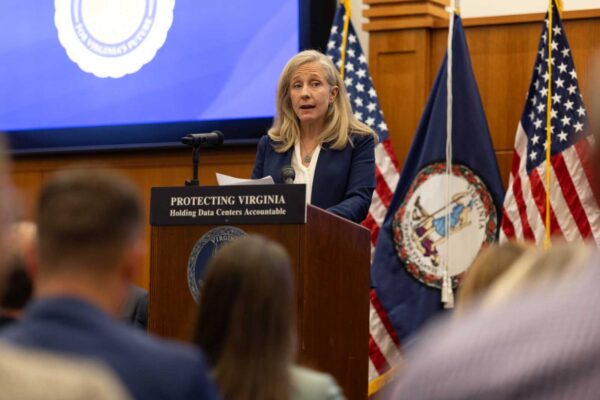
Virginia Gov. Abigail Spanberger has issued an executive order creating a new “accountability framework” that aims to increase transparency around proposed data center projects, establishes checkpoints around energy and environmental impacts, and convenes a new “rapid response” AI task force.
Touted as the “most comprehensive and aggressive data center accountability framework in the country,” Executive Order 22 bans nondisclosure agreements by state agencies or employees, eliminates “by-right” approvals in favor of requiring public hearing and approval processes for projects that generate over 25 megawatts of power, and requires centers to contribute a “more equitable share” of electric costs.
“I am making this announcement because we are at an inflection point with this technology,” Spanberger said at a press conference before signing the order today (Sept. 18). “The industry has been rapidly expanding in the last few years without a coordinated or clear plan to address the impacts on Virginians, on their electric bills, their water, their land, their air, or our quality of life.”
“These impacts are not hypothetical or far off into the future,” she added. “Virginians are feeling them right now, day in and day out, which is why the need for action is urgent, and why the state must lead with a clear, detailed, and comprehensive plan.”
The order addresses several points of frustration among Northern Virginia residents. First, it directs the Virginia Department of Environmental Quality (DEQ) to expedite noise regulations “consistent with DEQ’s existing statutory authority and applicable legislative direction.”
The department will also conduct a cumulative-impact review of backup power generators, including the effects of any generated emissions and ways to reduce impacts on public health.
DEQ will submit its findings and recommendations regarding potential improvements to the governor’s office on issues such as permitting, emissions controls, public disclosure, and designation of cooling water scarcity areas, where evaporation could have an impact on water quality.
Virginia Energy will also evaluate establishment of “operational state best practices to improve grid reliability, including ride-through and voltage protections.” The order further directs Virginia Chief Energy Officer Josephus Allmond to advocate for “solutions that shield Virginia households from energy infrastructure costs driven by data center large loads.”
“Data centers cannot drive up energy costs or energy infrastructure costs for others in Virginia. Period,” Spanberger said. “This accountability framework has several new requirements that will make sure that is the case.”
The order additionally encourages local hiring, labor agreements “where possible,” and prioritization of Virginia businesses.
The AI task force — consisting of Virginia Chief Transformation Officer David Wilkinson, Counsel to the Governor Matt McGuire, and Secretary of Administration Traci J. Deshazor — will focus on addressing risks posed by the rapid development of AI, including workforce displacement, data privacy, and cybersecurity.
The three task force members will evaluate Virginia law and precedent to identify “existing enforcement and regulatory options,” assess cybersecurity risks, and support the Commonwealth in becoming “a leader in secure and responsible use of AI.” They will also coordinate with both private AI developers and other government leaders to address risks and mitigations.
The governor said she would work with Virginia’s General Assembly to write the standards into state law during the 2027 legislative session. The House Democratic Caucus issued a statement calling Spanberger’s data center framework “a step in the right direction” that reflects “shared priorities of increasing transparency, supporting Virginia workers, strengthening environmental standards.”
Some individual members of the General Assembly issued their own individual statements of support.
“This plan holds data centers accountable for paying their fair share of the transmission and generation costs they’re driving up, rather than passing those costs off to residential ratepayers,” said Del. Irene Shin (D-8), who represents the Herndon area.
Del. Rip Sullivan (D-6), who represents Great Falls and McLean and was honored earlier this month for his legislative work around data centers, called Spanberger’s announcement a “refreshing” change of pace from her predecessor, Republican Glenn Youngkin, who had opposed the Clean Economy Act aimed at promoting renewable energy.
“I and many others in the General Assembly have been advocating for major reforms for years, and meaningful progress can now be made with an administration willing to make this issue a priority,” Sullivan said in a statement.
Spanberger’s announcement followed a prolonged budget battle between Virginia’s legislative chambers and the governor over a longstanding tax exemption for data centers. Created as an incentive in 2010, the sales tax exemption on eligible computer and software equipment was implemented as an incentive for the industry to come to the state. Critics said it led to $1.6 billion in lost revenue.
While the state Senate sought to end that exemption starting next year, the House didn’t agree. A final compromise budget didn’t end the exemption, but did impose an electricity tax expected to bring in $600 million annually. Spanberger has said that ending the exemption would be reneging on an agreement the state had agreed to keep in place until 2035.
Conservation groups said the order was a welcome response to the Virginians who’ve been “clamoring for action.”
“Virginia LCV represents voters from across the Commonwealth,” said Michael Town, executive director of the Virginia League of Conservation Voters. “We fight for a cleaner environment and for a healthier democracy. When the people are crying for help because their community is being polluted and no one is listening, both our environment and our democracy suffer. Until today, that has been our path with data centers.”
However, the Virginia Chamber of Commerce had a more cautious view of the order, saying in a press release that “the economic impact of Virginia’s data centers must be at the forefront of policy discussions: 74,000 jobs, $9.1 billion in economic output, and $5.34 billion of state and local tax revenue.”
“Maintaining the sales and use tax exemption for data center equipment remains an essential pillar of Virginia’s economic competitiveness,” the release states. “Any effort to weaken it, particularly in addition to the new restrictions under consideration, would further compound the risk to Virginia’s reputation as a top state for business.”
It remains to be seen how the new statewide framework will affect existing centers and pending proposals in Fairfax County, such as the controversial Plaza 500 site in the Bren Mar Park area of Lincolnia. A rally was held near the site yesterday (Sept. 17).
The Save Bren Mar Coalition, a group that has been fighting construction of the center, issued a statement saying it welcomed the order, but “without the Governor’s swift intervention the Executive Order and Accountability Framework will be meaningless to our community.
“Our community is desperately asking the Governor to call on the Fairfax County Planning Commission to deny the pending unapproved Edsall Data Center Substation 2232 application at the December 2 public hearing so this Executive Order and the Data Center Accountability Framework can impact the Plaza 500 site. Our community should not be denied the strong protections that Governor Spanberger is proposing. We are not the canary in the coal mine.”
