


Fairfax County needs to move further away from a one-size-fits-all approach to addressing homelessness, local supervisors were told last Tuesday (Oct. 6).
At a meeting of its housing committee, the Fairfax County Board of Supervisors reviewed a draft revision to the Homelessness Strategic Plan, which is undergoing its first major update in nearly two decades.
The revision adds “more specific guidance” for addressing different causes of homelessness, said Shenandoah Gale, a consultant who detailed the proposal to supervisors.
The revamped five-year plan breaks those facing homelessness into six categories, from households with working parents that are without a home for the first time to people persistently living on the street with minimal support. The more specific categories could help the county match “services more closely to each group,” Gale said.
“No single approach works for everyone,” she said.
Depending on which category an individual fits in, efforts by the county government and other advocates to place and keep them in permanent housing have ranged from success rates of 2% to 60%.
As part of the report, the county is setting new goals intended to increase success rates in each category. Among other strategies, the plan recommends increasing outreach to people without shelter and households at risk of eviction, and testing new programs, such as home sharing or pairing individuals with peers who’ve experienced homelessness and can help them navigate social services.
The revamped strategic plan, dubbed “The Way Home Fairfax,” comes as Fairfax homelessness continues to rise.
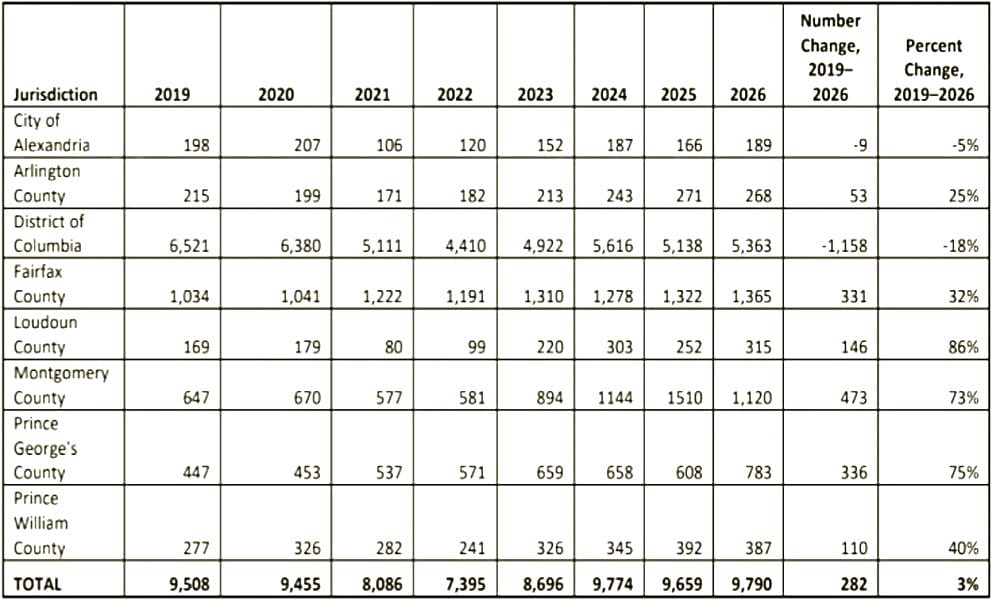
In the 2026 Point-in-Time survey conducted in February by the Metropolitan Washington Council of Governments, a total of 1,365 people in Fairfax were counted as being homeless, either in shelters or on the street. That’s up 42% since 2017 and the highest rate in the post-Covid era.
“This is something we’re seeing not just in Fairfax County, but nationally,” said Tom Barnett, deputy director of the county’s Office to Prevent and End Homelessness.
The county last adopted a plan to address homelessness at the end of March 2008, setting a goal of ending homelessness the Fairfax and Falls Church community in 10 years by adopting a “Housing First” strategy.
The plan emphasized a need for more housing as well as social services to both prevent people from becoming homeless in the first place and quickly move them into permanent housing if they do enter the system. It initially saw success, with the number of individuals counted as homeless dropping to 964 in 2017, per county data, but COG’s annual point-in-time count has found a consistent upward trajectory since then.
With the trend continuing in the wake of the pandemic, the Board of Supervisors directed county staff in April 2022 to review their current efforts and work with the Continuum of Care Board to update the county’s strategies and programs.
Given that increase of individuals without stable housing, Fairfax officials need to redirect their efforts, Springfield District Supervisor Pat Herrity said.
“We’re investing a lot of money. We’ve got to do more of what works and less of what doesn’t,” he said.
Board Chair Jeff McKay also reacted positively to changes in direction.
“It’s frustrating to everyone in this room that we’re not seeing improvements,” he said.
McKay said the multi-layered approach being proposed represents “a more realistic goal that can be tracked … based on reality.”
David Meyer, who chairs the county’s Continuum of Care Board, said having more precision in outreach and end goals offered “an opportunity to change lives.”
The draft plan now goes out for public review, including an online survey. Designed to guide efforts through 2031, it incorporates Fairfax County, the cities of Fairfax and Falls Church, and the towns of Herndon and Vienna.
