

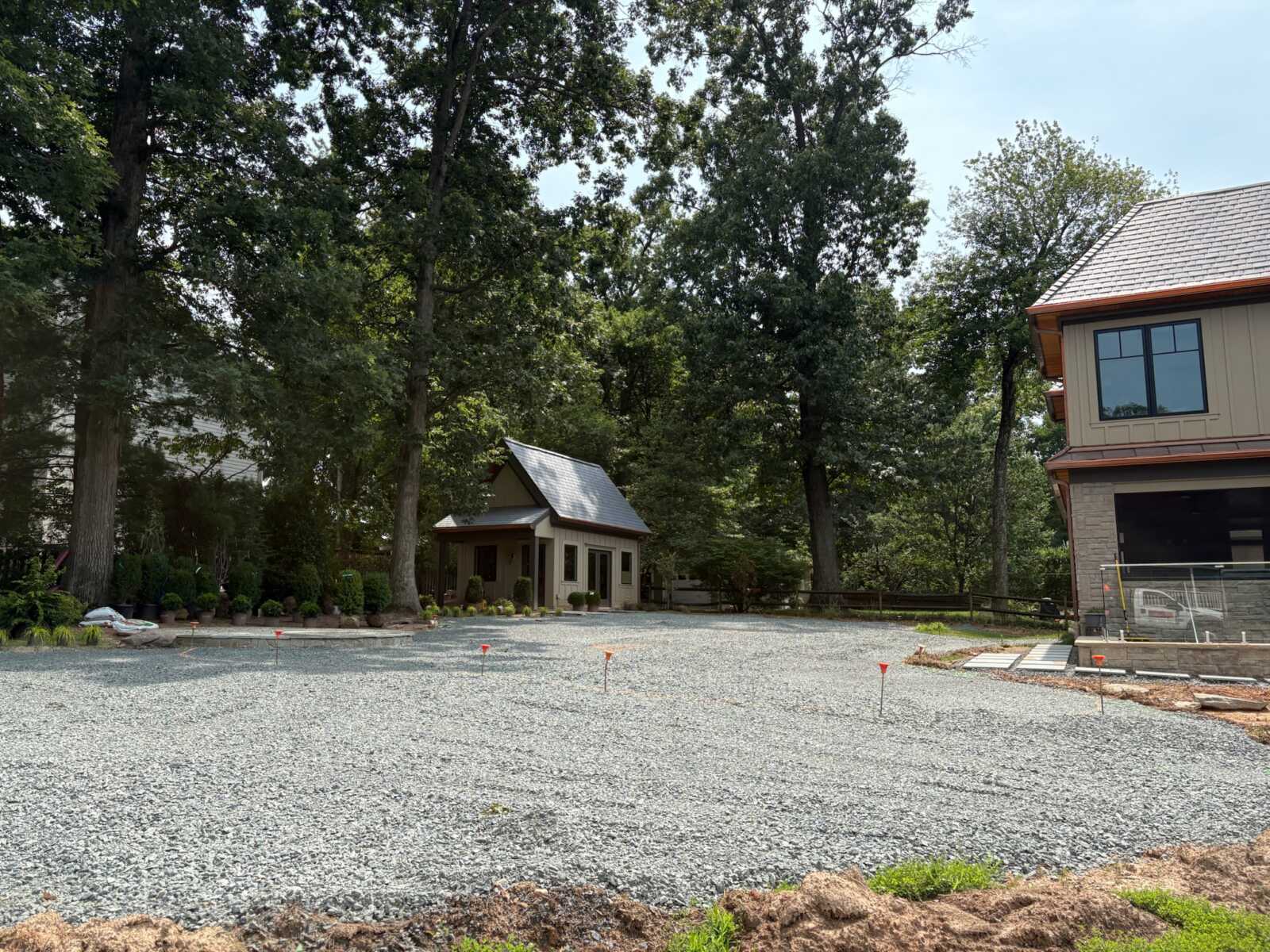
Homeowners in Fairfax County no longer need to provide an additional parking space or continue living on-site if they want to establish a second, smaller dwelling on their property.
The Fairfax County Board of Supervisors adopted a zoning ordinance amendment on Nov. 17 that eased some restrictions on accessory living units (ALUs) in an effort to address a housing shortage multiple members described as a “crisis.”
“We all know that affordable housing issues are real, and the only way to address them is to have every possible tool in our toolbox,” Board of Supervisors Chairman Jeff McKay said before the 9-1 vote. “This issue alone may not move the needle significantly, but combined with the other efforts that we’re working on as a board, I believe we can make a difference.”
The county previously revised its regulations for ALUs — defined as secondary dwelling units on the same site as a single-family detached house — as part of a broader zoning code update in 2021.
However, those changes, including the removal of limitations on who could live in an ALU, didn’t lead to the increase in units envisioned by county leaders and housing advocates, and feared by many neighborhood associations. From July 1, 2021 through Oct. 31, 2025, the county issued 203 administrative permits and 24 special permits for ALUs, staff told the board at last week’s meeting.
With housing costs driving many residents, including young adults and families, out of Northern Virginia, county staff recommended further tweaking the zoning ordinance to grant homeowners more flexibility for ALUs and streamline the process of getting one approved.
Incorporating some suggestions from the Fairfax County Planning Commission, the updated rules approved by the Board of Supervisors:
- Removed an administrative permit requirement for interior ALUs and detached units on lots at least 15,000 square feet in size, which now only need the same building permits as other types of residential construction
- Allowed detached ALUs on lots smaller than 15,000 square feet, or approximately one-third of an acre, with a special permit, a process that involves a Board of Zoning Appeals public hearing
- No longer require the property owner to reside on the site after the ALU is established
- Increased the maximum size for ALUs of 1,200 square feet or 40% of the primary house, whichever is smaller. Units can also occupy an entire basement.
- Raised the occupancy limit from two to three people
- Eliminated an additional parking space requirement, though the overall property must still meet off-street parking standards for a single-family detached house
Even if they’re allowed by right without a special permit, ALUs must still conform to height, setback and lot coverage requirements, among other regulations, county staff noted.
Approximately 42% of single-family lots in the county are eligible for a by-right detached ALU under the 15,000-square-foot minimum, which was recommended by the planning commission, according to Providence District Supervisor Dalia Palchik. Staff confirmed that was accurate.
Acknowledging concerns about additional construction and reduced open space on single-family lots, Palchik noted that homeowners and developers can already expand or replace existing homes without obtaining an administrative permit, resulting in the regular sight of small single-family homes getting torn down and replaced with “mansions.”
“It’s an economic development issue, as we heard: 30-to-50-year-olds are leaving the county,” she said. “Unless we make room for families, for children and grandchildren to be able to live in this county without having to pay upwards of a million dollars for a home, we will continue to face this crisis to more than a tipping point, which is where we are now.”
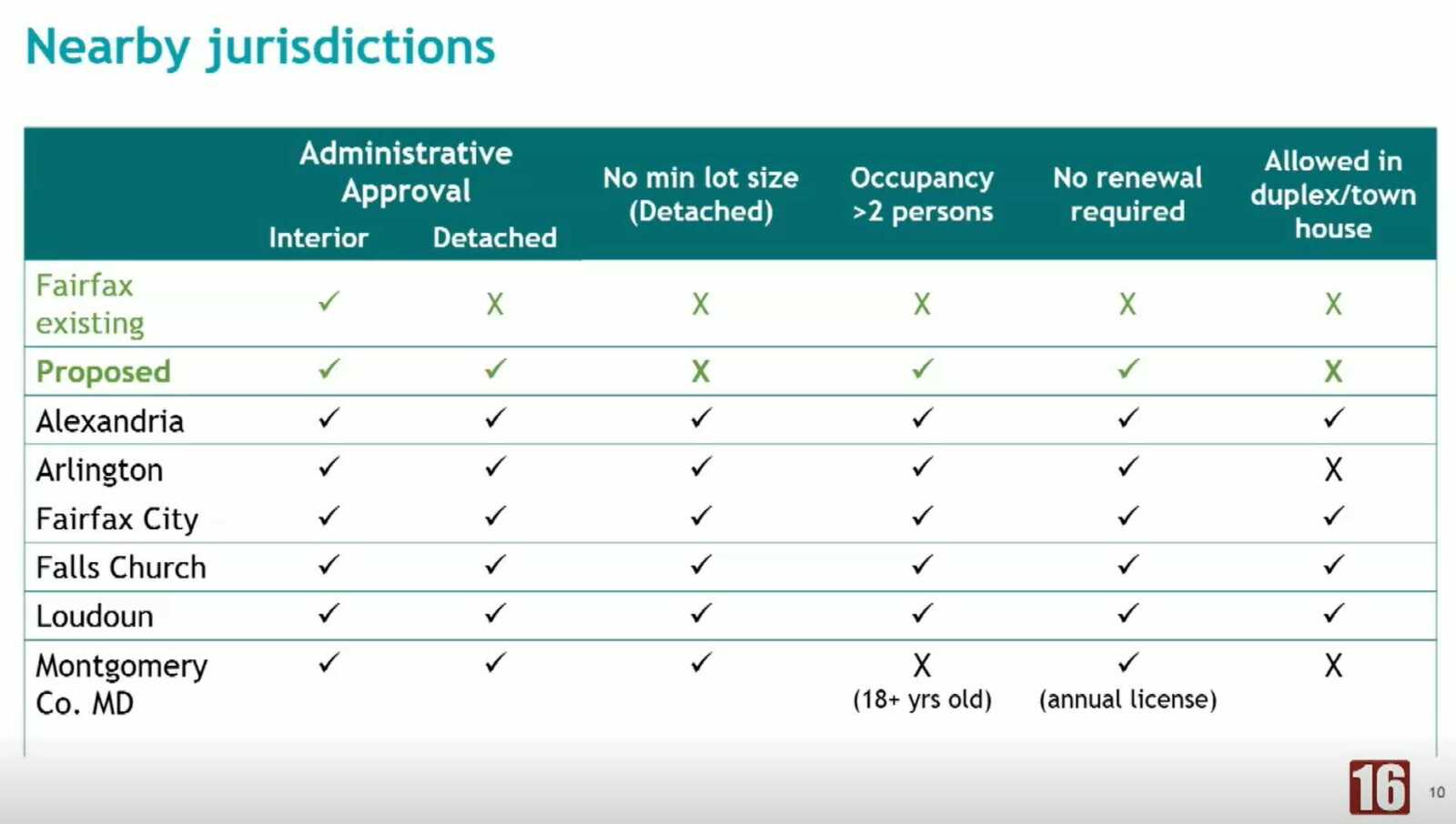
The county’s rules are still more restrictive than those of other suburban localities in the region, which have otherwise ditched minimum lot size requirements.
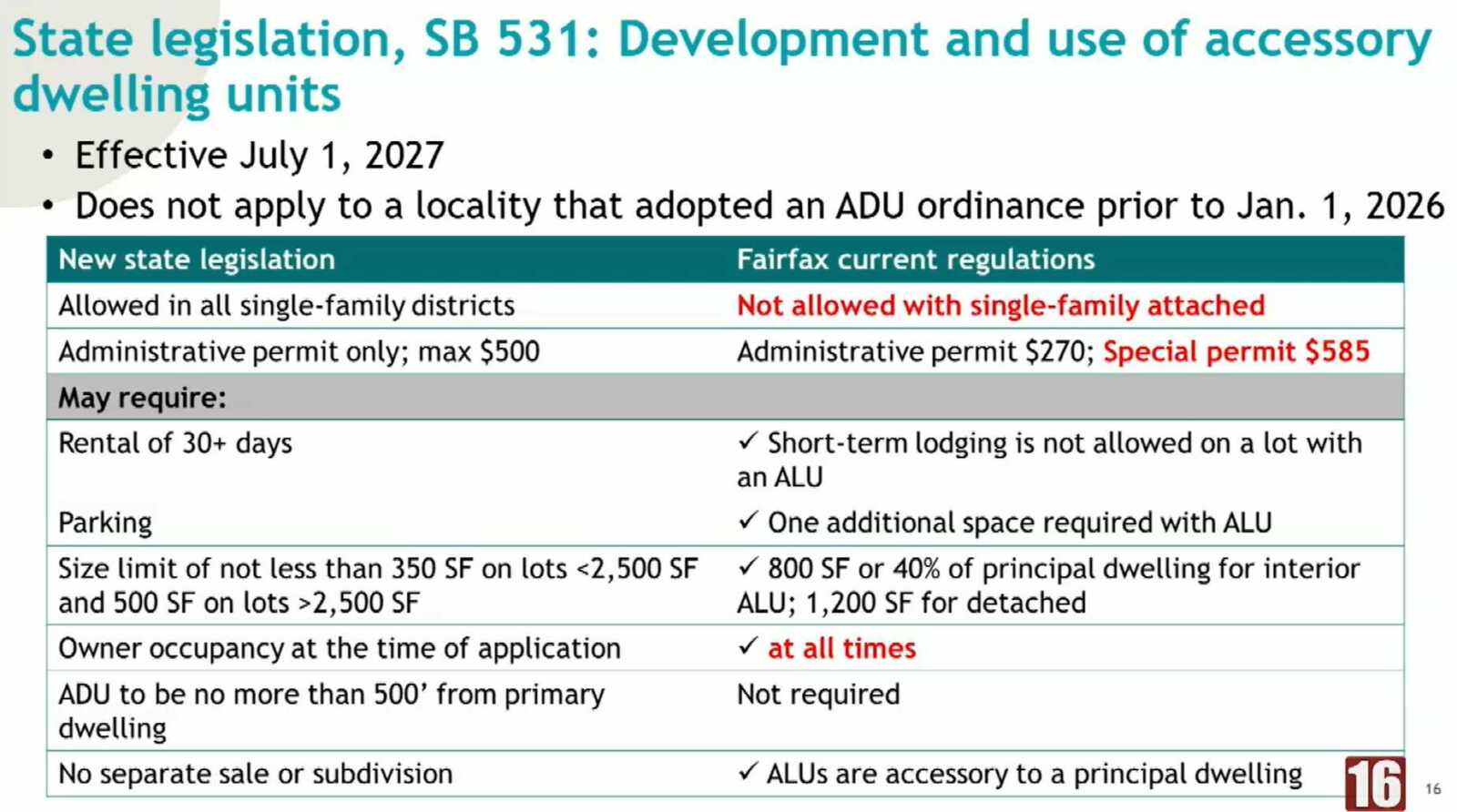
They’re also more limited than what would be allowed under a new law that the Virginia General Assembly adopted this year. Set to take effect next July 1, the law requires localities to permit accessory dwelling units in single-family residential zoning districts, which could include both detached houses and townhomes. Because Fairfax County already had ALU regulations in place, it was exempted.
Speakers split on rules going too far or not far enough
Several speakers at the board’s public hearing on the amendment called for the county to go further in easing its regulations.
Michelle Petrini said she and her husband want to add an ALU on their property for their adult son, who has autism. Hoping to ensure her son can live as independently as possible even after his parents are gone, she spoke in favor of a planning commission recommendation that would’ve allowed detached units on lots smaller than 15,000 square feet with an administrative permit, rather than a special permit.
“Please do not make it harder for my family and families similar to ours to obtain these accessory living units for family members who need them as such an accommodation,” Petrini said.
At the same time, other speakers argued that existing requirements, such as those related to owner occupancy and parking, should be retained to reduce potential neighborhood impacts.
Great Falls Citizens Association Land Use and Zoning Committee Chair Keyvan Moussavi suggested that the county conduct a study of the “combined effect of more construction on our watershed, tree canopy, groundwater, septic systems and roads.”
“For ALUs to address the housing shortage, many ALUs must be built, which will severely impact the semi-rural character of our wonderful Great Falls,” Moussavi said. “One size does not fit all. Reviewing each property separately does not tell us what happens when those changes accumulate across communities.”
While Palchik “semi-reluctantly” supported the amendment even though she “personally would’ve gone further,” Springfield District Supervisor Pat Herrity expressed apprehension that it didn’t quite find the right balance between the need for more housing and reduced bureaucracy, and “the need to protect our suburban neighborhoods.”
“My biggest concern is we can’t restrict the overall impact on a given neighborhood or block, because once you allow them, you allow them for everyone,” Herrity said at the board meeting. “If even half the lots opt for an ALU, you’ve got significant impacts to neighborhoods.”
Herrity still ultimately voted for the amendment, noting that the 2021 revisions didn’t result in a surge in accessory unit construction and that the ordinance could be revisited later “if things start to get out of control.”
Mount Vernon District Supervisor Dan Storck emerged as the lone “nay” vote, citing the reduced minimum lot size for detached ALUs as his main sticking point. Under the 2021 zoning code update, the minimum property size was 2 acres.
“[There are] huge efforts we’re making to try to concentrate density and growth where the traffic and transit can support it,” Storck said, pointing to the county’s investment in revitalizing the Richmond Highway corridor. “I know there’s not too many of these at this time, but when you lower the lot size requirements as we’ve done here … that’s in my mind too far.”
McKay and Franconia District Supervisor Rodney Lusk both noted that the county is making “significant” investments in public education, only to see many graduates leave because they can’t afford to live where they grew up.
Lusk suggested that the board might want to evaluate whether to allow ALUs in townhomes, given that some units can rival or even surpass single-family homes in size.
“We have four-story townhomes that are approaching 3,000 square feet, and we’re saying in these townhomes, we can’t put an ALU?” he said. “So, I would make the argument that we need to look at this issue at some future point as well, because there’s space. There’s definitely space that could accommodate that in the future.”
